Soil Erosion Control Mats and Soil Tackifier Erosion Control
Erosion control mats cover bare soil the moment they are stapled and suit slopes steeper than 3:1. A soil tackifier glues seed and mulch in place instead and protects for weeks to months.
Soil erosion control mats are rolled blankets of straw, coconut, wood, or synthetic fiber that cover bare soil until plants take root. Temporary mats last 3 to 36 months, and permanent turf reinforcement mats last longer. A soil tackifier is a liquid glue sprayed over soil, seed, and mulch instead. Mats suit steep ground, and tackifiers suit open areas.
Key Takeaways
- Soil erosion control mats are rolled blankets that cover bare soil and shield it from rain and wind.
- Single net mats suit slopes to 3:1, double net mats suit slopes to 2:1, and turf reinforcement mats suit permanent work.
- A soil tackifier is a plant-based or polymer binder that glues soil, seed, and mulch together.
- Guar runs 5 to 10 percent of mulch weight, and psyllium or starch runs 80 to 200 pounds per acre.
- Mats protect at once and last months to years, while tackifiers set in hours and last weeks to months.
What Are Soil Erosion Control Mats?
Soil erosion control mats are rolled blankets that cover bare soil and shield it from rain and wind. The Alabama Blue Book calls them rolled erosion control products, or RECPs, made of natural or polymer fibers bound into one matrix. Seed sprouts through the openings while the mat holds the soil. The next headings cover what mats contain and how they work.
We install mats on slopes, ditches, and seeded ground through our erosion control specialists. Each job starts with the slope ratio, the soil, and the time the cover must last. The sections below explain those choices one at a time.
What Are Erosion Control Mats Made Of?
Erosion control mats are made of straw, coconut coir, excelsior, jute, or synthetic fiber. Excelsior is curled wood fiber, and coir is coconut shell fiber. NC State Extension notes that netting on one or both sides holds the fill together. Some mats skip the net and rely on interlocked fibers or adhesive. Layers like these shape how the mat works on the ground.
How Do Erosion Control Mats Work?
Erosion control mats work by blocking raindrops and slowing runoff across the soil surface. The fibers hold moisture near the seed, and staples pin the mat so water cannot slide underneath. NC State Extension says a mulch cover of at least 85 percent of the soil surface helps keep seed from washing away. Roots then grow through the mat and take over the work. Mats have several names, which the next heading sorts out.
What Is the Difference Between Erosion Control Mats and Blankets?
The difference is mostly the name, because mats and blankets belong to the same family of rolled products. Erosion control matting is the trade term for the whole group. Blankets are temporary and break down in 3 to 36 months. Turf reinforcement mats, or TRMs, are Type 5 products built for long-term protection.
Our post on slope blanket choices compares blanket types for steep ground in more detail. Single net and double net straw products get their own breakdown in the straw post. The next heading covers a name that shoppers use for seeded mats.
What Are Grass Mats for Erosion Control?
Grass mats for erosion control are blankets laid over seeded soil so grass sprouts through the open weave. Some retailers call them germination blankets or seed mats. The mat keeps the seed, moisture, and soil in place before roots form. Our straw blanket types post covers the most common version. Next comes the question of when a mat is the right pick.
When Should You Use Soil Erosion Control Mats?
Use soil erosion control mats on slopes steeper than 3:1, in channels, and on seeded ground facing heavy rain. A 3:1 slope drops 1 foot for every 3 feet of run. The Alabama Blue Book says slopes steeper than 3:1 usually need rolled or hydraulic products. The table below matches each mat type to its limits.
| Mat type | Max slope | Minimum shear stress | Functional life |
|---|---|---|---|
| Net or open weave (1.A, 2.A) | 5:1 | 1.0 lbs/ft2 | 3 or 12 months |
| Single net blanket (1.C, 2.C) | 3:1 | 1.5 lbs/ft2 | 3 or 12 months |
| Double net blanket (1.D, 2.D) | 2:1 | 1.75 lbs/ft2 | 3 or 12 months |
| Open weave textile (3.A) or blanket (3.B) | 2:1 or 1.5:1 | 2.0 lbs/ft2 | 24 months |
| Open weave textile or blanket (4.A, 4.B) | 1:1 | 2.25 lbs/ft2 | 36 months |
| Turf reinforcement mat (5.A to 5.F) | 1:1 to 0.5:1 | 6.0 to 14.0 lbs/ft2 vegetated | Long term |
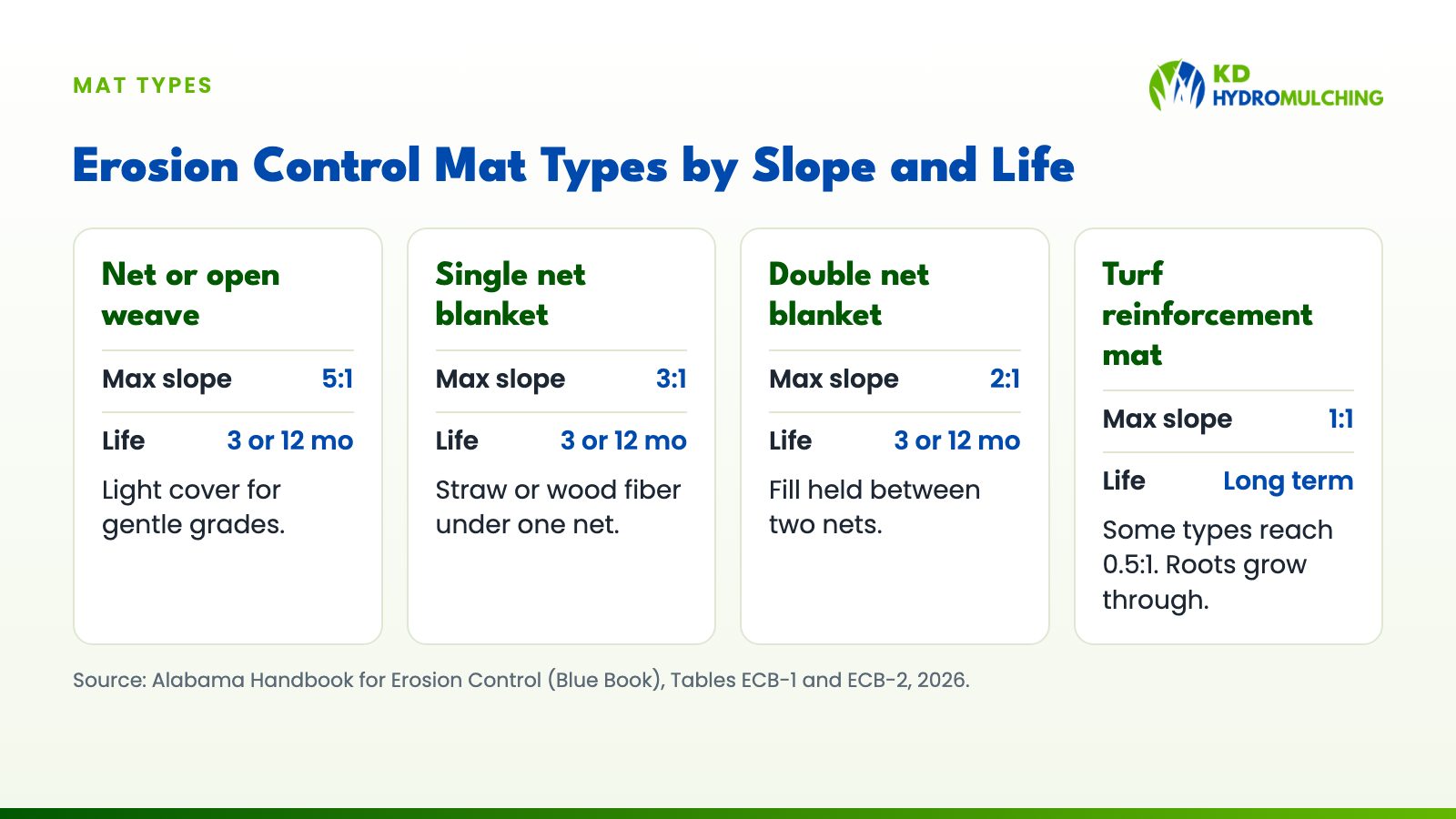
Shear stress is the pulling force of flowing water on the soil, measured in pounds per square foot. Valor Environmental adds that straw mats last up to 12 months, blends up to 24 months, and coir 2 to 3 years. The graphic below shows the same ladder from light nets to permanent mats.
How Do You Install an Erosion Control Mat?
Install an erosion control mat by grading the slope, seeding it, and rolling the mat downhill with firm soil contact. Six steps cover the job.
- Grade the slope smooth and remove rocks, large clods, and woody debris.
- Seed the soil before laying the mat.
- Dig a top trench 6 to 8 inches deep, anchor the mat edge, and backfill it.
- Unroll the mat downslope in the direction of water flow without stretching it.
- Overlap neighboring rolls by 3 to 6 inches.
- Staple the mat at no less than 1.3 staples per square yard, using 11-gauge staples with 6 inch legs.
Rolls cover 80 to 100 square yards in widths of 3 to 8 feet, according to Muller Inc. Hydroseeding.info reports that crews spray hydromulch in about 2 hours where a blanket takes a crew day. Water the seed under the mat by following our seeding care schedule. Spray products have their own binders, which the next section explains.
What Is Soil Tackifier Erosion Control?
Soil tackifier erosion control is the use of a glue-like binder that holds soil particles, seed, and mulch together. The binder forms a thin, permeable crust on the surface. Water and air still pass through, and grass can still sprout. The crust protects the soil for weeks to months until roots take over.
What Is a Soil Tackifier?
A soil tackifier is a binding agent mixed with water and sprayed over soil, seed, or mulch. Caltrans calls it a glue for hydroseed treatments, and the binder is either plant-based or a polymer emulsion. A polymer emulsion is a liquid plastic suspended in water. Hydroseeders mix the binder into the tank or spray it over the mulch afterward. Our hydroseeding contractors use this step on slopes and open ground. Binder types come next.
What Types of Soil Tackifier Are There?
Soil tackifiers come in two types, plant-based and polymer. Plant-based binders include guar, psyllium, and starch. Polymer binders include polyacrylamide, or PAM, and acrylic emulsions. The table below lists rates and dry times from the Caltrans toolbox.
| Tackifier | Type | Rate per acre | Dry time |
|---|---|---|---|
| Guar | Plant-based | 5% to 10% of mulch weight | Not listed |
| Psyllium | Plant-based | 80 to 200 lb | 12 to 18 hours |
| Starch | Plant-based | 150 lb | 9 to 12 hours |
| Polyacrylamide (PAM) | Polymer | 5 lb in 10 lb per 1,000 gal of water | Not listed |
| Acrylic copolymer | Polymer | 1,175 gal of 10:1 water to polymer mix | 36 to 48 hours |
| Liquid methacrylate | Polymer | 20 gal, diluted | 12 to 18 hours |
Guar is the default pick, because Caltrans advises specifying guar when the choice is unclear. NC State Extension adds that starch tackifiers carry 7 to 8 percent natural nitrogen. Emulsified asphalt was once a common tackifier, but it is toxic to plants and animals and banned in some states. The graphic below sums up the plant-based and PAM rates.

How Much Tackifier for Hydroseeding?
The tackifier rate for hydroseeding is 5 to 10 percent of mulch weight for guar. Psyllium and starch run 80 to 200 pounds per acre. Polymer rates rise with slope steepness. A sodium acrylate copolymer runs 3 to 5 pounds per acre from flat ground to 5:1. The same product runs 5 to 10 pounds on 5:1 to 3:1 slopes. On 2:1 to 1:1 slopes it runs 10 to 20 pounds.
The mulch under the binder runs 2,000 pounds per acre in 4,000 gallons of water, per Alabama state figures. A bonded fiber matrix runs 6,000 gallons at 3,000 pounds per acre. Straw with seed runs 1.5 to 2 tons per acre in the Blue Book. The Blue Book calls straw and binder applied together the most effective method.
Retail packs suit small repairs. One 10 pound Earthwise Seed-Tac bag covers 5,000 square feet and lists at $59.95 at Lowe's. Larger jobs use the rates above, applied by our tackifier application crews. The next heading covers how long the binder holds.
How Long Does a Soil Tackifier Last?
A soil tackifier lasts weeks to months until plant roots take over the soil. The binder protects the surface only, so seed and mulch must carry the long-term protection. The Blue Book says a disturbed treated area needs a repeat application. The Blue Book also calls for buffer zones when spraying near natural water bodies. Comparing the two products side by side comes next.
Which Is Better, Soil Tackifier or Erosion Control Mats?
A soil tackifier differs from erosion control mats because a tackifier glues cover in place while a mat is the cover. A mat shields the soil the moment crews staple it down. A tackifier shields the soil after it sets, which takes 0 to 48 hours in the Caltrans table. The table below compares the two.
| Factor | Erosion control mat | Soil tackifier |
|---|---|---|
| Protection starts | At once, after stapling | After the binder sets in hours |
| Slope fit | Steeper than 3:1 and channels | Rate rises with slope, applied through a hydroseeder |
| Protection life | 3 to 36 months, or permanent for TRMs | Weeks to months |
| Install method | Rolled out and stapled by hand | Sprayed with mulch and seed |
| Wildlife risk | Netting can entangle animals | No netting |
Hydroseeding.info notes that a bonded fiber matrix needs 24 to 48 hours without significant rain to bond. A staked mat has no such wait, which matters before a storm. A binder wins on speed across large open areas. NC State Extension notes hydromulch needs no netting that could trap wildlife or mowers. The graphic below turns this into a quick chooser.
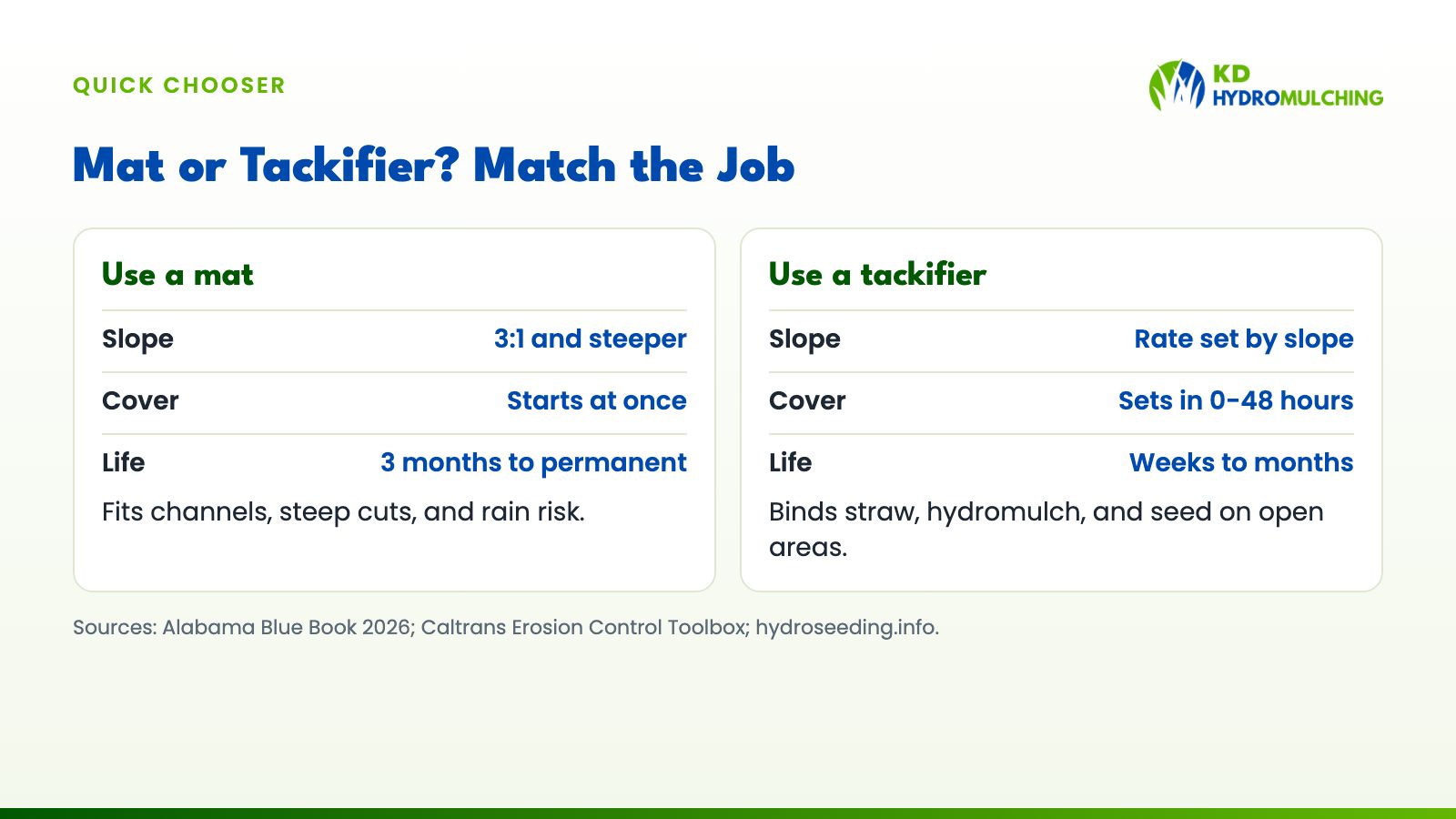
Pick a mat for channels, cut slopes, and ground with rain on the way. Pick a tackifier to bind straw, hydromulch, and seed on open ground. Our erosion control comparison shows where each method fits among the others. Side questions on cost, wildlife, permits, and seed follow next.
What Else Should You Know About Erosion Control Mats and Tackifiers?
How Much Do Erosion Control Mats Cost?
Erosion control mats start around $26 per roll for basic straw. Coconut or permanent rolls run $150 to $400 or more. Farm Plastic Supply lists a single net straw blanket from $25.99. Spray jobs price by area instead, and our hydroseeding pricing post covers those ranges.
Do Erosion Control Mats Harm Wildlife?
Mats with plastic netting can trap snakes and other animals. Wildlife friendly netting is the Alabama Blue Book advice. A USDA Forest Service paper by Barton and Kinkead (2005) found snakes entangled in rolled products. Natural fiber netting and netless mats lower that risk.
Do You Need a Permit for Erosion Control?
Sites that disturb 1 acre or more need construction stormwater permit coverage. The US EPA program also requires stabilizing bare areas idle for more than 14 days. A sediment fencing barrier catches sediment at the bottom of the slope while mats and binders protect the soil above it.
What Grass Seed Goes Under an Erosion Control Mat?
Tall fescue goes under a mat in fall. Seed it at 40 to 50 pounds per acre between September 1 and November 1, per Blue Book Table PS-1. Our seed selection post covers warm-season choices. Seed goes down before the mat in every case.
Frequently Asked Questions About Erosion Control Mats and Tackifiers
Does Grass Grow Through Erosion Control Mats?
Yes, grass grows through erosion control mats because the open weave lets blades push up through the gaps. Straw, coir, wood fiber, and jute mats all use this open structure. Seed goes under the mat, and the fiber breaks down over months.
What Is a Natural Tackifier?
A natural tackifier is a plant-based binder such as guar, psyllium, or starch. NC State Extension says guar, plantago, and starch tackifiers usually run 100 to 200 pounds per acre. These binders are non-toxic and biodegradable.
Does a Tackifier Replace Mulch?
No, a tackifier does not replace mulch, because it only binds loose material at the surface. The Blue Book says seed and mulch should carry protection beyond the life of the binder. Pair the binder with straw or hydromulch.
How Does KD Hydromulching Help With Erosion Control?
KD Hydromulching helps with erosion control by installing mats, straw matting, tackifiers, and soil binders on slopes and bare ground. We match the product to the slope ratio, the soil, and the weather window. Our crews handle grading, seeding, and cover under one plan.
Steep banks need a closer look at the soil, the slope length, and the runoff path before any product goes down. That work falls under bank stabilization. The service pairs mats with grading and seed on cut slopes and fill slopes alike. Each step is timed to the weather.
Sites in North Alabama can send photos and measurements to start a plan. The quote request page takes the slope ratio, the area in square feet, and the planned seeding date. A crew then recommends a mat, a tackifier, or both.
Mats, spray binders, and seed work together as one plan, and a short call sorts out the order of work. Reach out to KD Hydromulching operators to plan the right cover for your ground.