Erosion Control Blanket for Steep Slopes
The top erosion control blanket for steep slopes is a double-net coir blanket or a turf reinforcement mat. Coir and double-net blankets suit 2:1 and steeper slopes, while straw fits 3:1 or flatter slopes.
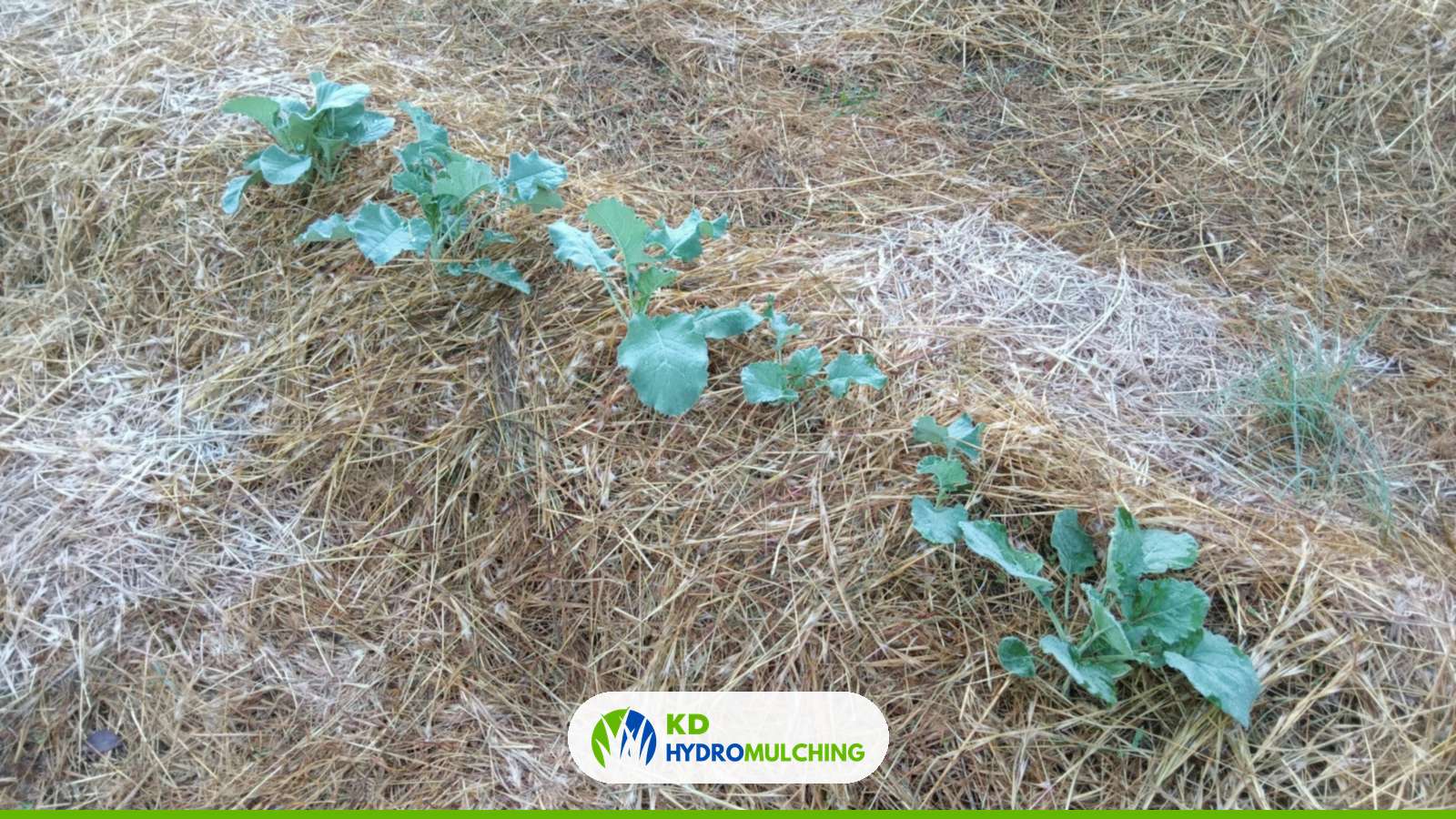
The top erosion control blanket for steep slopes is a double-net coconut coir blanket or a permanent synthetic turf reinforcement mat. Coir and double-net blankets suit slopes of 2:1 and steeper, while straw and single-net blankets fit 3:1 or flatter slopes. Staples go in at about 1.3 per square yard, and firm soil contact decides whether the blanket holds on the slope.
Key Takeaways
- Coir and double-net blankets are rated for slopes of 2:1 and steeper, and 36-month Type 4 blankets reach 1:1.
- Single-net blankets stop at 3:1, so steeper ground needs a stronger product.
- Staples go in at a minimum of 1.3 per square yard on slopes, says the Alabama Blue Book.
- Straw blankets last up to 12 months, and coir blankets last 2 to 5 years.
- A blanket protects soil the moment it is stapled, while hydromulch needs 24 to 48 hours to bond.
- Sites disturbing 1 acre or more need stormwater permit coverage under federal rules.
What Is the Best Erosion Control Blanket for Steep Slopes?
The top erosion control blanket for steep slopes is a double-net coir blanket or turf reinforcement mat rated for your slope ratio. The Alabama Blue Book lists Type 1.D and 2.D double-net blankets for slopes up to 2:1. Type 3.B reaches 1.5:1, and Type 4.B reaches 1:1. Ground steeper than 1:1 needs a mat or an engineered fix.
Our crews install these products through our slope stabilization work, which starts with grading the face and testing the soil. Seed and fertilizer go on first, and the blanket goes over them. The graphic below shows how slope ratio maps to blanket type.
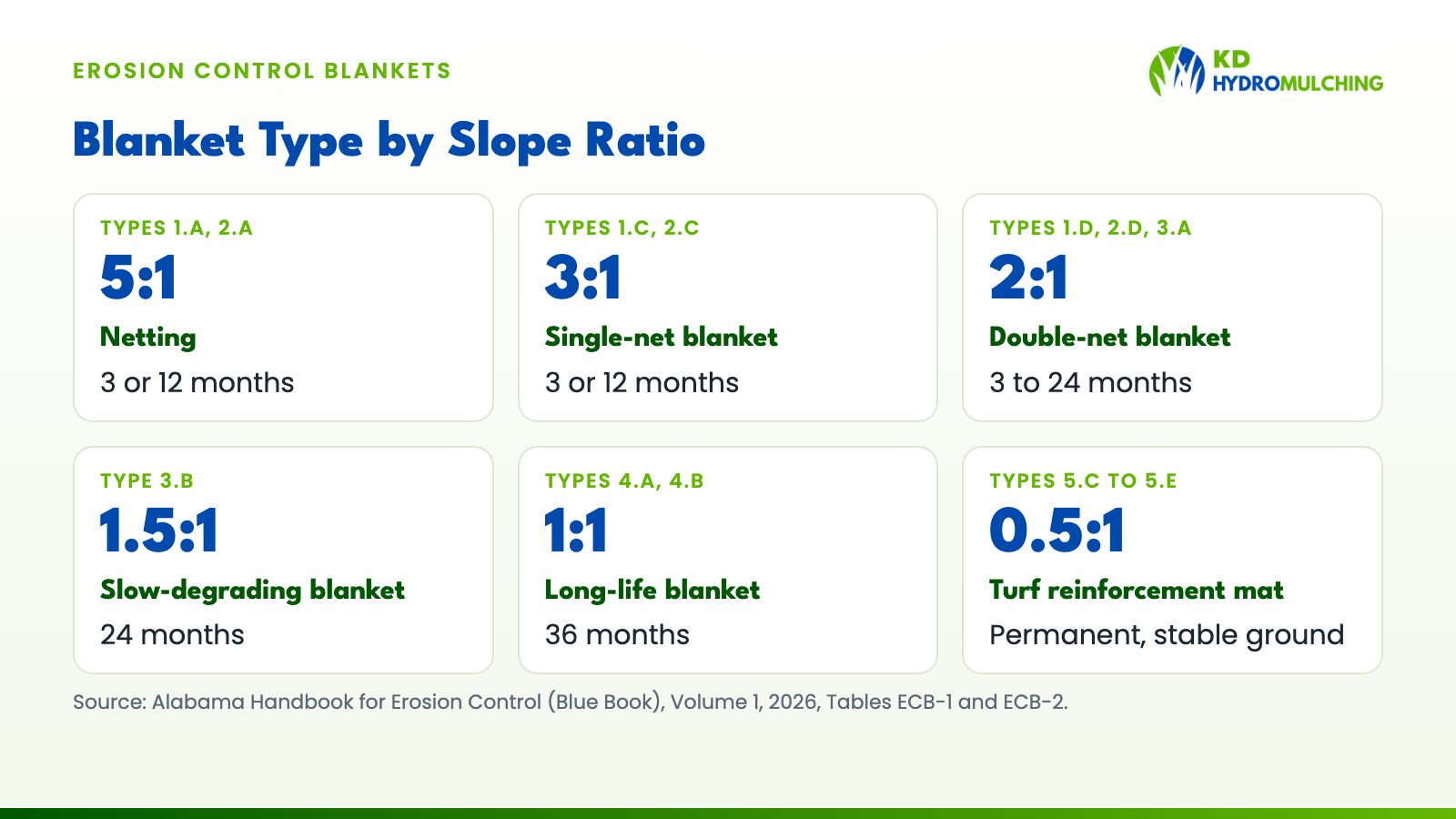
The graphic draws on the Blue Book blanket tables. The next heading turns those ratings into a selection rule.
Which Erosion Control Blanket Matches Your Slope Ratio?
Match the erosion control blanket to the slope ratio and the time vegetation needs to establish. A 3:1 ratio means the ground drops 1 foot over 3 feet of horizontal distance. Steeper ratios push water faster and need stronger netting. Four steps narrow the choice.
- Measure the slope ratio with a level and a tape.
- Pick a blanket type rated at or above that ratio in the table below.
- Pick a longevity that outlasts the time your seed needs to cover the soil.
- Choose double netting once the grade passes 3:1.
The table lists each Blue Book type with its construction, maximum slope, and longevity. Type numbers rise with durability, so a higher number fits a steeper face.
| Blanket type | Construction | Maximum slope | Longevity |
|---|---|---|---|
| 1.A and 2.A | Netting or open weave textile | 5:1 | 3 or 12 months |
| 1.C and 2.C | Fiber fill under a single net | 3:1 | 3 or 12 months |
| 1.D and 2.D | Fiber fill between two nets | 2:1 | 3 or 12 months |
| 3.A | Open weave textile | 2:1 | 24 months |
| 3.B | Slow-degrading fill between two nets | 1.5:1 | 24 months |
| 4.A and 4.B | Open weave textile or slow-degrading fill between two nets | 1:1 | 36 months |
| 5.A, 5.B, and 5.F | Turf reinforcement mat | 1:1 | Permanent |
| 5.C to 5.E | Turf reinforcement mat | 0.5:1 | Permanent |
The table shows why single-net blankets fail on hillsides steeper than 3:1. The next heading covers the upper limit of every product.
What Slope Is Too Steep for an Erosion Control Blanket?
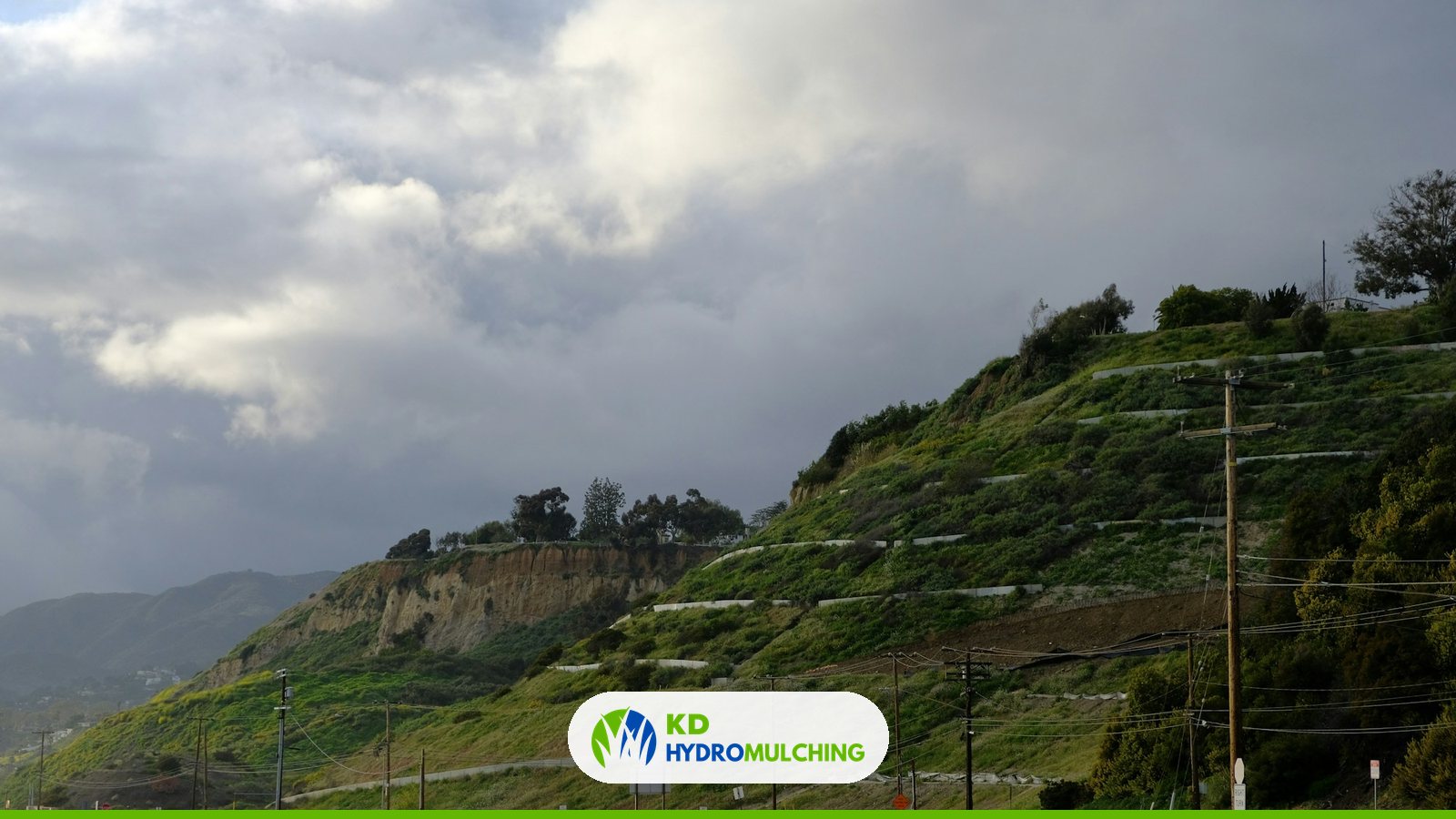
A slope steeper than 1:1 is too steep for most blankets, and only mats rated 5.C to 5.E reach 0.5:1. The Blue Book limits those mats to geotechnically stable slopes, meaning the soil mass itself is not sliding. A moving slope needs an engineer before any blanket goes down.
Shorter runs also help steep faces. Blue Book spacing for slope breaks is 20 feet at 1:1, 40 feet at 2:1, and 60 feet at 3:1. Slope breaks shed water before it gathers speed. Our team plans these breaks as part of stabilizing hillsides before blankets arrive.
Do Erosion Control Blankets Work on Steep Slopes?
Yes, erosion control blankets work on steep slopes when the blanket is rated for the ratio and pinned to firm soil. The Blue Book requires intimate soil contact across the whole installation. Crews must not stretch the blanket over bumps or dips. Gaps under a blanket let water run beneath it.
Protection starts at once, according to hydroseeding.info, because staples and weight hold the blanket in place. Rills and gullies signal drainage faults, and our slope problems checklist flags them for grading first. Poor prep lets water run under the blanket. The next heading compares how long each blanket lasts.
Which Erosion Control Blankets Last the Longest?
Turf reinforcement mats last the longest, because their synthetic fibers are permanent and do not degrade. The Blue Book lists Type 4 blankets at 36 months and Type 3 at 24 months. Temporary biodegradable blankets typically last 12 to 36 months, says Pathlight Pro. Fill material sets the rest of the range.
What Materials Are Used in Erosion Control Blankets for Slopes?
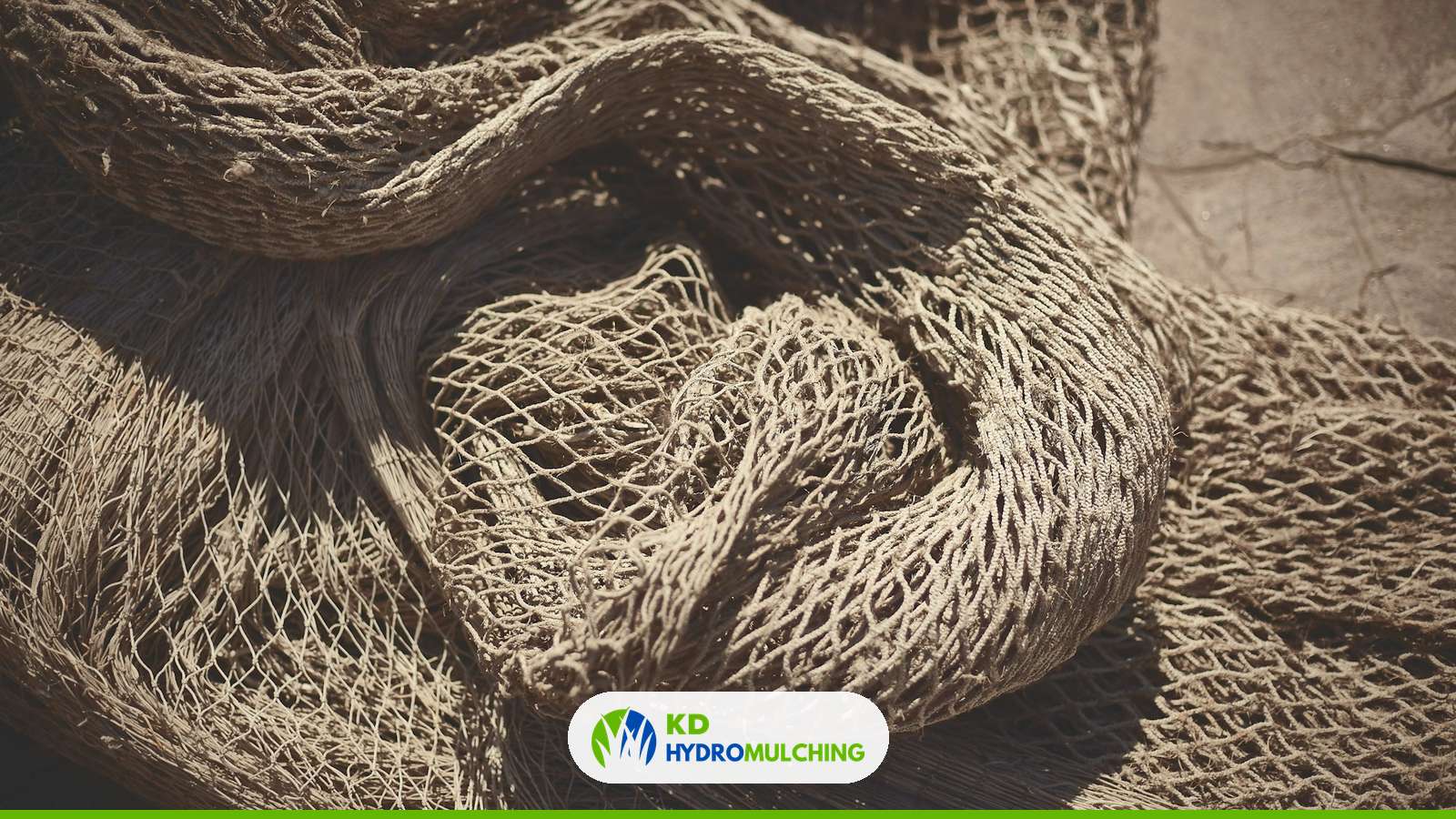
Erosion control blankets for slopes use straw, coconut coir, excelsior, or synthetic fibers held together by netting. Valor Environmental describes excelsior as shredded aspen wood fibers. Netting can be photodegradable plastic mesh or woven natural fiber, per the Blue Book. Each fill breaks down at a different pace.
- Straw: suits slopes from flat to 3:1 and lasts up to 12 months.
- Straw and coconut blend: suits 3:1 to 2:1 slopes and lasts up to 24 months. BMP Supplies lists a 70% straw and 30% coconut mix.
- Coir: suits 2:1 or steeper slopes and lasts 2 to 5 years.
- Synthetic: suits permanent stabilization and may last indefinitely, says Valor Environmental.
A slope erosion control blanket also needs the right netting. The Blue Book approves single-net products to 3:1 and double-net products to 2:1. The graphic below compares lifespan by material.
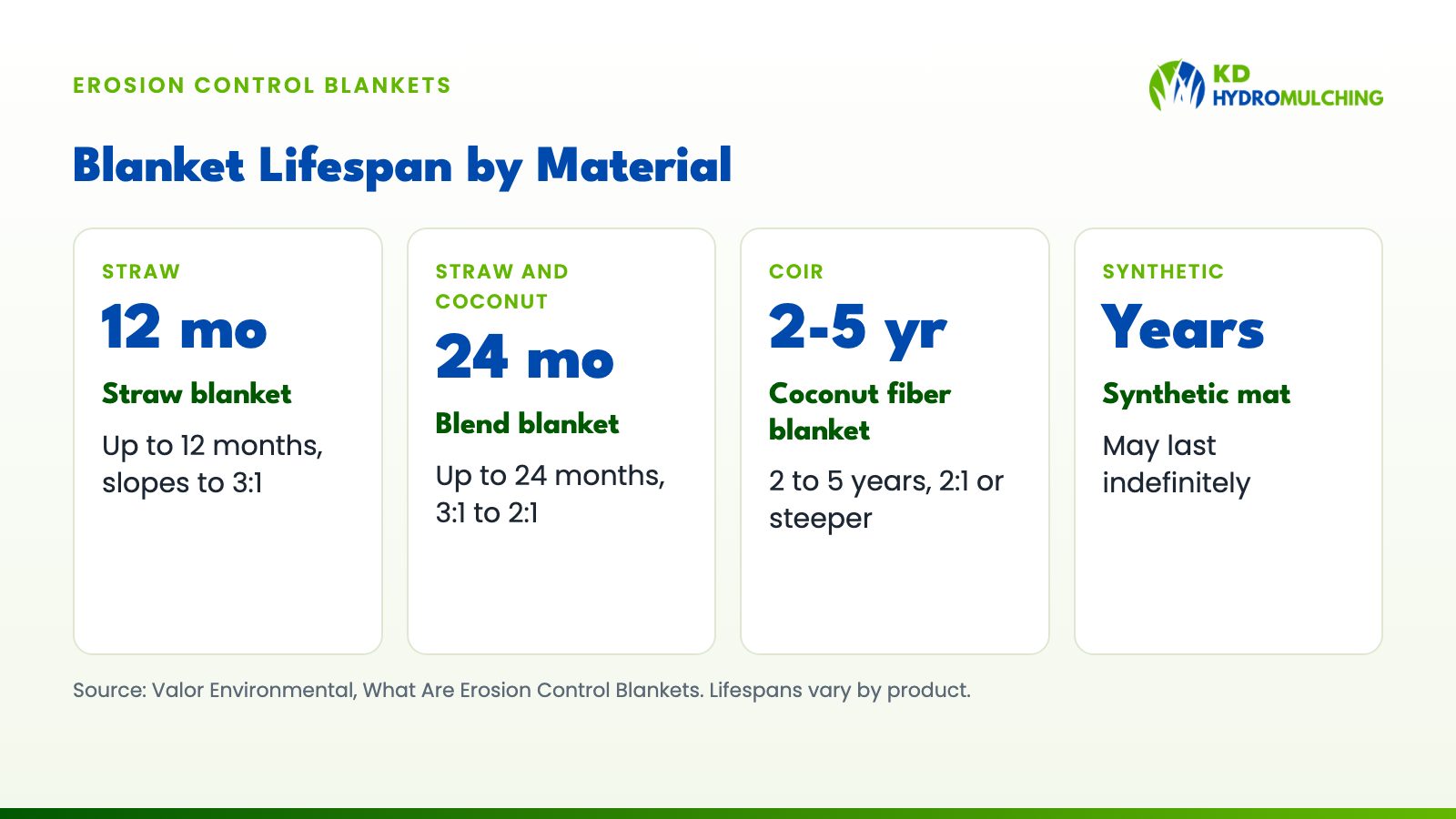
Natural fiber blankets also suit sensitive sites. Valor Environmental notes that some regulations restrict non-degradable netting near wetlands and waterways. Material choice therefore follows both slope and site rules. The next section explains how to place the roll.
How Do You Install an Erosion Control Blanket on a Slope?
Install an erosion control blanket on a slope by preparing firm soil, anchoring the top edge, rolling downslope, and stapling every seam. Erosion control blanket slope installation follows six steps. Each step comes from the Blue Book or Valor Environmental.
- Smooth the face until the soil is firm and free of dips that would leave air gaps.
- Correct soil pH and compaction, then add lime and fertilizer per a soil test and spread seed.
- Anchor the top edge of the blanket in a shallow trench so water cannot slip underneath.
- Roll the blanket out in the direction of water flow without stretching it.
- Overlap neighboring edges by 3 to 6 inches.
- Staple at a minimum of 1.3 per square yard, with spacing no wider than 3 feet.
Temporary blankets take U-shaped wire staples of 11-gauge or heavier with legs at least 6 inches long. Permanent blankets take wood stakes on 4-foot centers along each edge. The graphic below summarizes the key numbers.
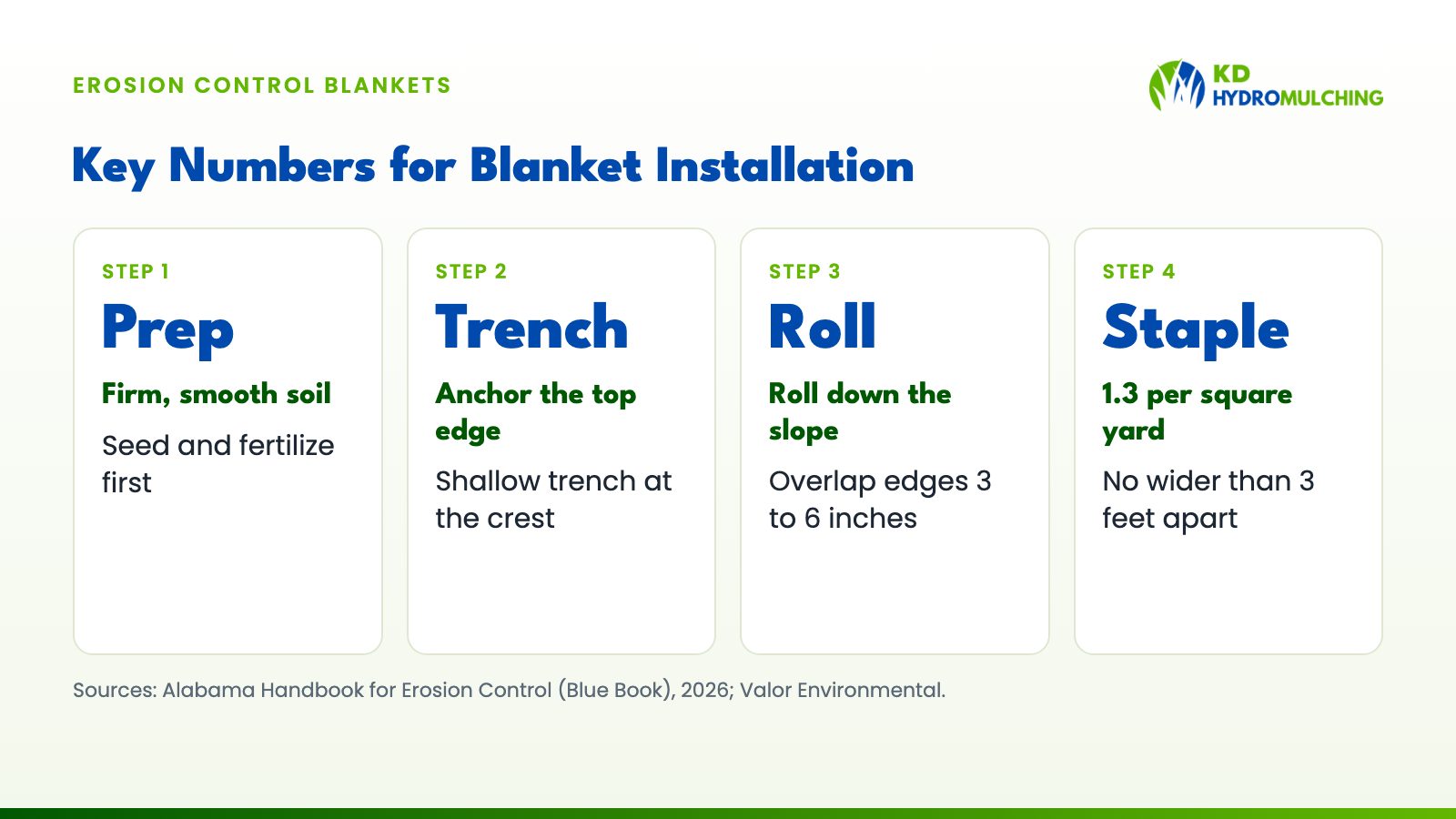
Rolls cover 80 to 100 square yards and cut to widths of 3 to 8 feet, according to Muller, Inc. Crews plan seams around those widths. Our slope grading prepares the face before any roll goes down, and crews clear rocks, roots, and clods first. Each roll then lies flat against the soil.
Seeded slopes also need water until roots take hold, because the seed under the blanket must sprout. Our care instructions cover the watering schedule.
Should You Install an Erosion Control Blanket Yourself?
Install small, flat patches yourself, but hire a crew for steep slopes. Valor Environmental recommends professional installation for steep slopes, large sites, and high erosion risk. Trenching, overlaps, and anchoring all affect performance. Our blanket installation covers those details on slopes of any size.
How Does an Erosion Control Blanket Compare With Hydromulch on a Steep Slope?
An erosion control blanket gives instant protection, while hydromulch covers a slope faster. The hydroseeding.info comparison says a slope that takes about 2 hours to hydromulch can take a crew a full day to blanket. Bonded fiber matrix needs 24 to 48 hours without significant rain to bond.
| Factor | Erosion control blanket | Bonded fiber matrix |
|---|---|---|
| Protection starts | The moment staples go in | After 24 to 48 hours without significant rain |
| Crew time | About a full crew day for a slope | About 2 hours for the same slope |
| Application rate | At least 1.3 staples per square yard | 3,000 pounds per acre in 6,000 gallons of water |
| Typical fit | High-stress spots and steep pockets | Broad open slope faces |
The table shows a trade between speed and immediate cover. The Blue Book calls hydraulic mulch or blankets more appropriate than straw on slopes steeper than 2:1. The Alabama Soil and Water Conservation Committee lists bonded fiber matrix at 6,000 gallons of water and 3,000 pounds per acre.
Cost also differs by method. HomeGuide lists a slope surcharge of $0.05 to $0.10 per square foot for hydroseeding. Our hydromulch application covers broad faces, while blankets protect channels and the steepest pockets. Crews can combine both methods, which leads to the extra questions below.
What Else Should You Know About Steep Slope Erosion Control?
Steep slope erosion control works as a stack of measures, and these short answers cover the common gaps. Our hillside stabilization plans combine seed, blankets, and runoff control. Each answer below comes from state guidance or a named source.
What Is the Best Erosion Control for a Steep Hill?
Steep hill erosion control works as a layered system of plant cover, a blanket or hydraulic mulch, and runoff control. The Blue Book says vegetation absorbs raindrop energy, binds soil, and slows runoff. Slope breaks and a silt fence handle water that cover cannot. Our guide to preventing slope erosion expands on each measure.
What Is the Best Ground Cover for a Steep Hillside?
Ground cover for a steep hillside works when it is dense, deep rooted, and matched to sun and soil. Erosion control plants for steep slopes bind soil with roots and shield it with leaves. A blanket protects those plants until roots take hold. Our list of plants for slopes names choices by site.
Do You Still Need a Silt Fence With a Blanket?
Yes, add a silt fence at the base when soil can still leave the site. The Blue Book limits a standard silt fence to a drainage area of 1/4 acre per 100 linear feet. Reinforced fence serves 1/2 acre per 100 feet. Post spacing stays at 10 feet or less.
Do You Need a Permit for Slope Work?
Yes, a construction site that disturbs 1 acre or more needs stormwater permit coverage under federal rules. The US Environmental Protection Agency runs that program. The permit program is the National Pollutant Discharge Elimination System (NPDES). Smaller sites should check state and local rules. A written plan should list each blanket and slope break. Erosion control on steep slopes then stays inspectable.
How Does KD Hydromulching Help With Steep Slope Erosion Control?
We help with steep slope erosion control by matching each product to the slope ratio and soil on your site. Our erosion control services include blankets, straw matting, tackifiers, soil binders, and silt fence. Hydroseeding and hydromulch cover the broad faces. Every plan starts with measuring the grade.
Our experienced crew serves slopes across North Alabama from our Huntsville base. We select the erosion control blanket for steep slopes after grading and a soil check. Seed mix, mulch, and blanket type all follow from that check.
Property owners and contractors can contact our team to schedule a site visit. Each visit ends with a written list of products, slope breaks, and seed.
The plan uses the ratings and staple rates covered above. Slope erosion control methods then match the ground instead of a default. Choose KD Hydromulching professionals for a steep slope plan built from those numbers.