Erosion Control Blanket with Seed
Spread the grass seed first, then roll the blanket over it so the seed touches soil. Tall fescue suits fall, bermudagrass suits spring, and straw covers slopes to 3:1 for up to 12 months.
An erosion control blanket with seed is a rolled mat that covers seeded soil, and a few mats arrive pre-seeded. Crews spread seed first, then roll the blanket out within 24 to 48 hours. Straw blankets suit slopes up to 3:1 and last up to 12 months while the grass takes over. Retail seed mats for small lawn patches cost about $10 to $15 per 20 square feet.
Key Takeaways
- Seed goes on before the blanket, because seed needs direct contact with soil to sprout.
- Pre-seeded mats embed the seed in the fibers, but a fixed mix cannot follow planting windows.
- Tall fescue suits fall seeding at 40 to 50 pounds per acre, and common bermudagrass suits spring at 10 pounds.
- Straw blankets cover slopes to 3:1 for up to 12 months, and coconut blends cover steeper ground.
- Leave a straw blanket in place until the grass is 2 to 3 inches tall.
- Hydroseeding covers large areas faster, while blankets protect seed the day they go down.
What Is an Erosion Control Blanket with Seed?
An erosion control blanket with seed is a rolled mat that holds grass seed against the soil while roots form. A seed germination blanket goes over seed you spread yourself. A seeded erosion control blanket arrives with the seed already built into the fibers.
The Alabama Blue Book says blankets shield seed from raindrop impact and hold moisture and soil temperature steady. Those effects give stronger and faster germination of grasses and legumes. Our crews handle this work through our seeded blanket installation service. Both versions start with prepared soil, so the pre-seeded type is the first one to define.
What Is a Pre-Seeded Erosion Control Blanket?
A pre-seeded erosion control blanket is a biodegradable mat with seed embedded in the fibers. Sellers list it as erosion control matting with seed. Viresco Sator, a European product, weighs about 20 kilograms per 100 square meters and breaks down in about 4 to 5 months. HBB Geosales builds its pre-seeded mats to order with a chosen seed mix.
HBB notes that these mats may not be cost effective for very large areas. Retail listings show GrowTrax seed mats at about $10 to $15 for 20 square feet. A fixed factory mix cannot follow the planting windows, so the seed order matters next.
Do Seed Germination Blankets Work?
Yes, seed germination blankets work because they hold seed, moisture, and warmth against the soil. The cover also keeps rain and wind from moving the seed down a slope. Straw, wood fiber, and coconut fiber are the common materials. A seed erosion control blanket of straw suits lawns and gentle slopes.
Results depend on the seed touching soil and on steady watering. The next section explains why the seed goes down before the roll.
Do You Seed Before or After an Erosion Control Blanket?
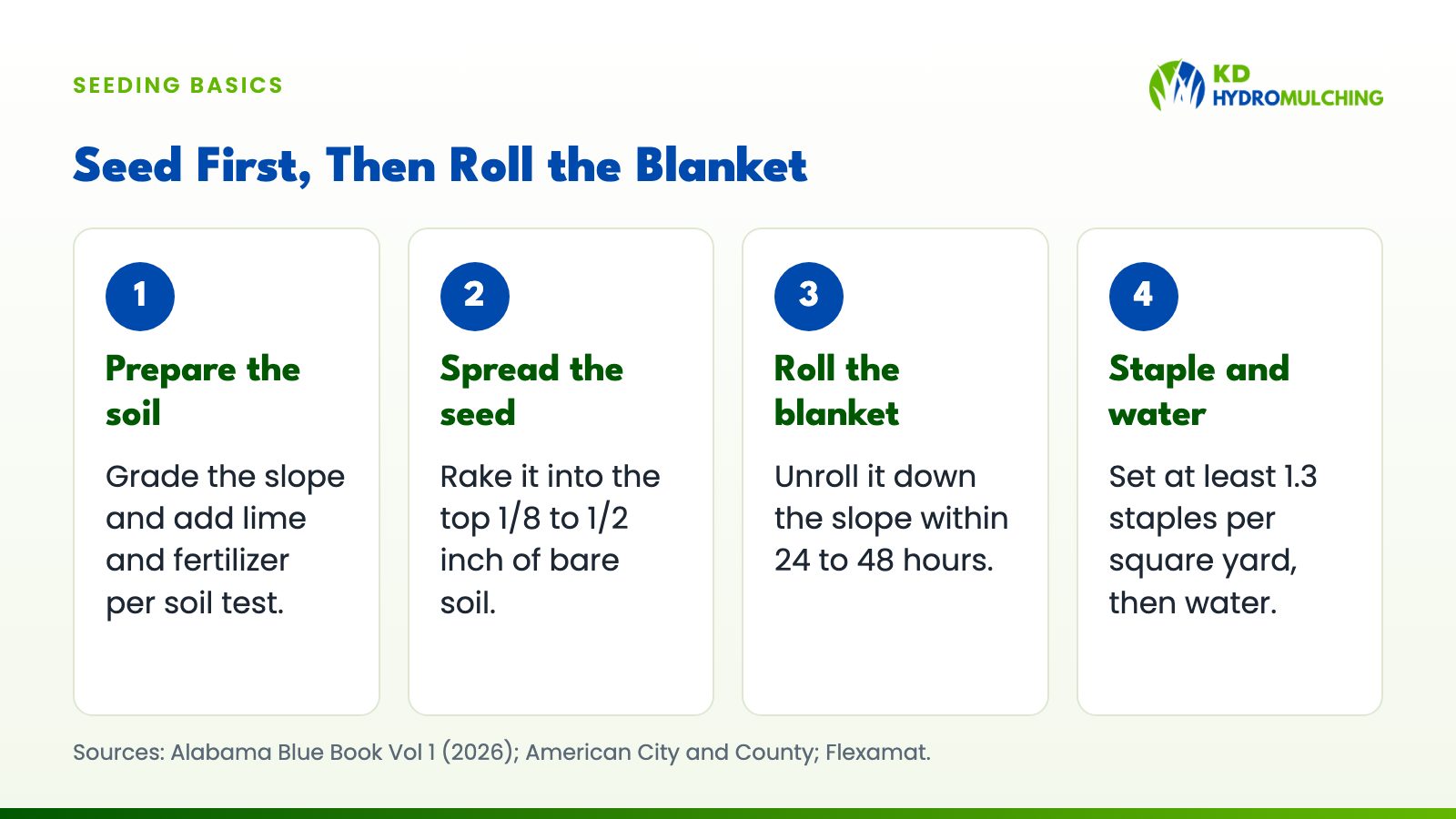
You seed before an erosion control blanket, because seed needs direct contact with soil to sprout. American City and County magazine calls seeding before matting placement the preferred method for the highest germination rate. Seed belongs in the top one-eighth to one-half inch of soil, where moisture collects.
Seeding over a blanket that is already down cuts seed-to-soil contact. The same magazine advises 10 percent more seed for dense, fibrous mats. Large, low-density seeds such as wildflowers need 10 percent more in open mats and 25 percent more in closed mats. Small, dense Bermuda grass seed may need no increase in open-weave mats.
The graphic below shows the four-step order that keeps seed in contact with the ground.
Hydraulic seeding over a blanket works well with water alone as the carrier. Tackifiers and fiber mulch make seed stick to the matting instead of reaching the soil. Turf reinforcement mats (TRMs) are the exception, since these permanent mats go down first and get filled with soil. The Blue Book says seed is raked into that soil infill. Seed order is settled, so the seed species come next.
Which Seed Goes Under an Erosion Control Blanket?
Tall fescue goes under an erosion control blanket in fall, and common bermudagrass goes under it in spring. The Blue Book sets tall fescue at 40 to 50 pounds per acre from September 1 to November 1. Common bermudagrass runs 10 pounds per acre from April 1 to July 1.
The table below pairs each seed with its rate and planting window from the Blue Book seed tables.
| Seed | Rate Per Acre | Planting Window | Role |
|---|---|---|---|
| Tall fescue | 40 to 50 lb | Sep 1 to Nov 1 | Permanent grass |
| Common bermudagrass | 10 lb | Apr 1 to Jul 1 | Permanent grass |
| Alamo switchgrass | 4 lb | Apr 1 to Jun 15 | Permanent grass |
| Rye | 3 bushels | Sep 1 to Nov 15 | Nurse crop |
| Browntop millet | 40 lb | Apr 15 to Aug 1 | Nurse crop |
A nurse crop is a fast-growing grass that shields slower seedlings while they root. The Blue Book cuts the nurse crop rate by 50 percent when it shares a mix with permanent grass. Rye as a companion tops out at 30 pounds per acre.
Our post on slope seed choices covers rates for other grasses. The seed is only half of the system, so the blanket fill comes next.
Which Soil Erosion Control Blanket Should Cover the Seed?
A straw blanket is the usual cover for seed on gentle slopes, and coconut blends cover steeper ground. Valor Environmental rates straw for slopes from 0:1 to 3:1 and up to 12 months. Straw-coconut blends reach 2:1 and last up to 24 months. The table compares the three common fills.
| Fill | Slope Range | Lifespan |
|---|---|---|
| Straw | 0:1 to 3:1 | Up to 12 months |
| Straw-coconut blend | 3:1 to 2:1 | Up to 24 months |
| Coir (coconut) | 2:1 or steeper | 2 to 3 years |
Coir blankets cost more than straw. Farm Plastic Supply lists a single-net straw blanket from $25.99 and a 100 percent coconut blanket at $69.99. Retail listings put netless wood fiber blankets near $89 and up.
The graphic below turns the same slope limits into a quick comparison.

The Blue Book says slopes steeper than 3:1 usually need rolled or hydraulic products. Our straw blanket fills post covers netting and slope limits in detail.
Slope length and soil type matter as much as the ratio. The Blue Book sorts blankets into types with a functional life of 3, 12, 24, or 36 months. The steeper slope rolls post covers the harder grades. Hydroseeding is the main alternative to a roll, so the next section compares the two.
Is a Seeded Blanket Better Than Hydroseeding?
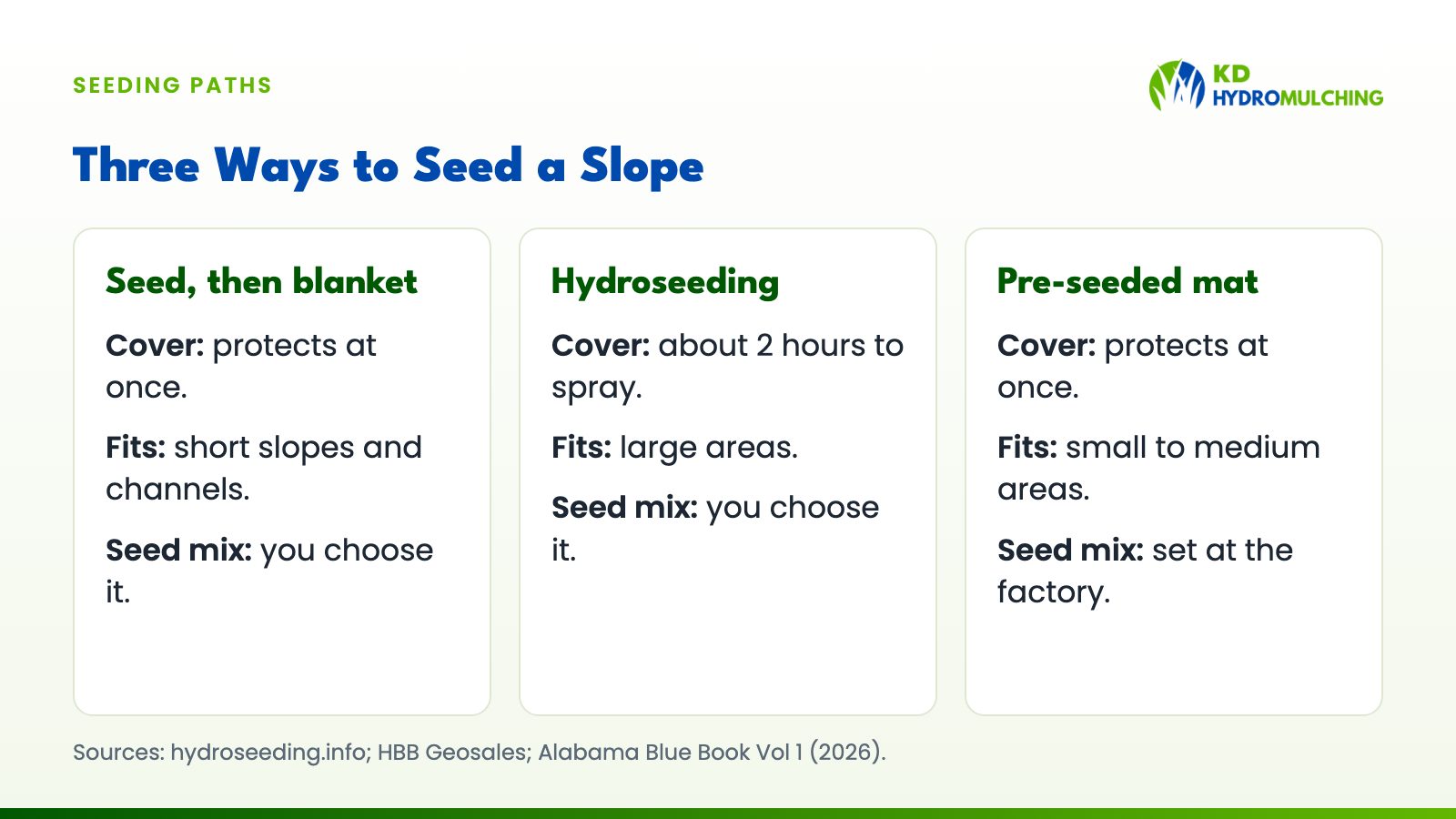
A seeded erosion control blanket suits short slopes and channels with a high erosion hazard, while hydroseeding covers large areas faster. The Blue Book points blankets to ground where plant growth is too slow to protect soil. Hydromulch takes about 2 hours to spray, where blankets take a crew day, according to hydroseeding.info.
A blanket protects the seed at once. Bonded fiber matrix, a stronger hydraulic mulch, needs 24 to 48 hours without significant rain to bond. The graphic compares the three seeding paths.
Our crews spray hydroseed and mulch across large slopes and roll blankets where water flows in a channel. Installation steps for the blanket route follow next.
How Do You Install an Erosion Control Blanket Over Seed?
Install an erosion control blanket over seed by seeding first and rolling the blanket out within 24 to 48 hours. Flexamat sets that window to help germination. The steps below cover the seed side of erosion control blanket installation.
- Grade the slope and work in lime and fertilizer per soil test.
- Spread seed on bare soil and rake it lightly into the surface.
- Dig a 6-inch trench at the top and unroll the blanket down the slope.
- Overlap the edges 3 to 6 inches and set at least 1.3 staples per square yard.
- Water the seedbed and inspect it within 48 hours after rain.
The Blue Book asks for 11-gauge staples with legs at least 6 inches long. It also puts manufacturer instructions first. Our erosion blanket work follows each roll label. Seed needs water once the blanket is down, so watering comes next.
How Should You Water Seed Under a Blanket?
Water seed under a blanket 2 to 4 times a day for 5 to 15 minutes early on. That schedule matches standard seeding aftercare for the first 3 to 4 weeks. Short, frequent passes keep the seedbed damp.
Our seed watering care page lays out the daily schedule. Watering continues while the blanket stays on, which leads to the next question.
How Long Do You Leave a Straw Blanket on Grass Seed?
Leave a straw blanket on grass seed until the grass is 2 to 3 inches tall, about 2 to 4 weeks. Biodegradable blankets break down over their 3 to 12 month life and need no removal. Plastic mesh that blocks light can be raked off gently once the grass is rooted.
Fast grasses such as perennial ryegrass reach that height in about 2 weeks. Slower species such as Kentucky bluegrass take 3 to 4 weeks or more. Several side questions come up on these jobs, and the next section answers them.
What Else Should You Know About Seeded Erosion Control Blankets?
Can You Just Throw Grass Seed on Top of Dirt?
Grass seed thrown on dirt can sprout, but rain moves the seed on a slope. The Blue Book calls mulch essential on slopes steeper than 3:1. A blanket or hydromulch holds the seed where it lands.
Can You Put Down Too Much Straw on Grass Seed?
Straw over seed should stay near 1.5 to 2 tons per acre. The Blue Book sets 2.5 to 3 tons per acre for straw without seed. A blanket removes the guesswork because the straw comes in a set layer.
Is a Burlap Erosion Control Blanket the Same as a Straw Blanket?
No, a burlap erosion control blanket is woven natural netting, while a straw blanket is straw held in netting. Untreated burlap lasts 6 to 12 months. The Blue Book rates woven natural fiber netting for slopes up to 5:1.
What Erosion Control Seed Works for Construction Sites?
Tall fescue in fall and bermudagrass in spring are the erosion control seed for construction sites in north Alabama. The EPA requires stormwater permit coverage for sites that disturb 1 acre or more. Bare areas idle more than 14 days need stabilizing.
Our grading before seeding work prepares the surface for either cover, and clean grade lets the seed touch soil.
Are Seed Blankets Worth It?
Seed blankets are worth it on small slopes and patch repairs. A straw germination blanket costs about $23 to $30 for a 4 by 50 foot roll, which covers 200 square feet. An erosion control seed blanket suits small areas, and HBB says traditional seeding is more economical on very large ones. The erosion method comparison weighs the other covers.
How Can KD Hydromulching Help With Erosion Control Blankets and Seed?
We seed and cover slopes across North Alabama, from small banks to utility corridors. Our crews prepare the soil, match the seed to the season, and choose between blankets and hydromulch. That mix is the core of our stabilizing seeded slopes work.
A site visit shows which cover fits your slope, how steep the grade runs, and where water flows during storms. Once the ground has been walked and measured, you can book a visit and we will set the seed plan together.
Our crews handle the full job from seedbed to staples. Every step stays on one schedule, with the same people on site from start to finish. That includes grading, seeding, and staking through our seed blanket service.
Questions about seed rates, planting dates, or blanket types are welcome before work starts. We answer them in plain terms and plan the seed and cover together. Ask the KD Hydromulching seeders anything.