Best Erosion Control Method and Best Plants for Erosion Control
Deep-rooted plants plus organic mulch protect most mild and moderate slopes, and blankets handle slopes steeper than 3:1. Slopes over 50 percent need terraces, retaining walls, or riprap.
The best erosion control method is deep-rooted plant cover held in place by organic mulch, blankets, or hydroseeded mat until roots grow. Mild slopes under 33 percent need mulch and grasses. Moderate slopes of 33 to 50 percent need blankets, and steeper slopes need terraces or retaining walls. Silt fence, tackifiers, and slope breaks stop runoff that cover cannot. Slope steepness and soil pick the final choice.
Key Takeaways
- Plant cover is the best erosion control method for lasting protection, because roots bind soil and leaves absorb raindrop energy.
- Slopes steeper than 3:1 usually need rolled blankets or hydraulic erosion control products, and slopes over 50 percent need terraces or walls.
- Straw mulch runs 1.5 to 2 tons per acre when seed goes down with it.
- Bonded fiber matrix needs 24 to 48 hours without heavy rain to bond to the soil.
- Silt fence serves a drainage area of 1/4 acre per 100 linear feet, or 1/2 acre when reinforced.
- Blankets last 3 to 36 months by type, so match the type to the slope.
What Is the Best Erosion Control Method?
The best erosion control method is a plant cover protected by mulch or a blanket until roots take hold. The Alabama Soil and Water Conservation Committee lists five jobs for vegetative cover. Plants absorb raindrop energy, bind soil, slow runoff, raise water absorption, and remove subsurface water. Slope steepness then decides which protection holds the cover in place.
Our crews apply these methods through our erosion control services, which include silt fence, blankets, straw matting, tackifiers, and soil binders. Each method protects soil in a different way and for a different length of time. The graphic below matches each slope range to a method.
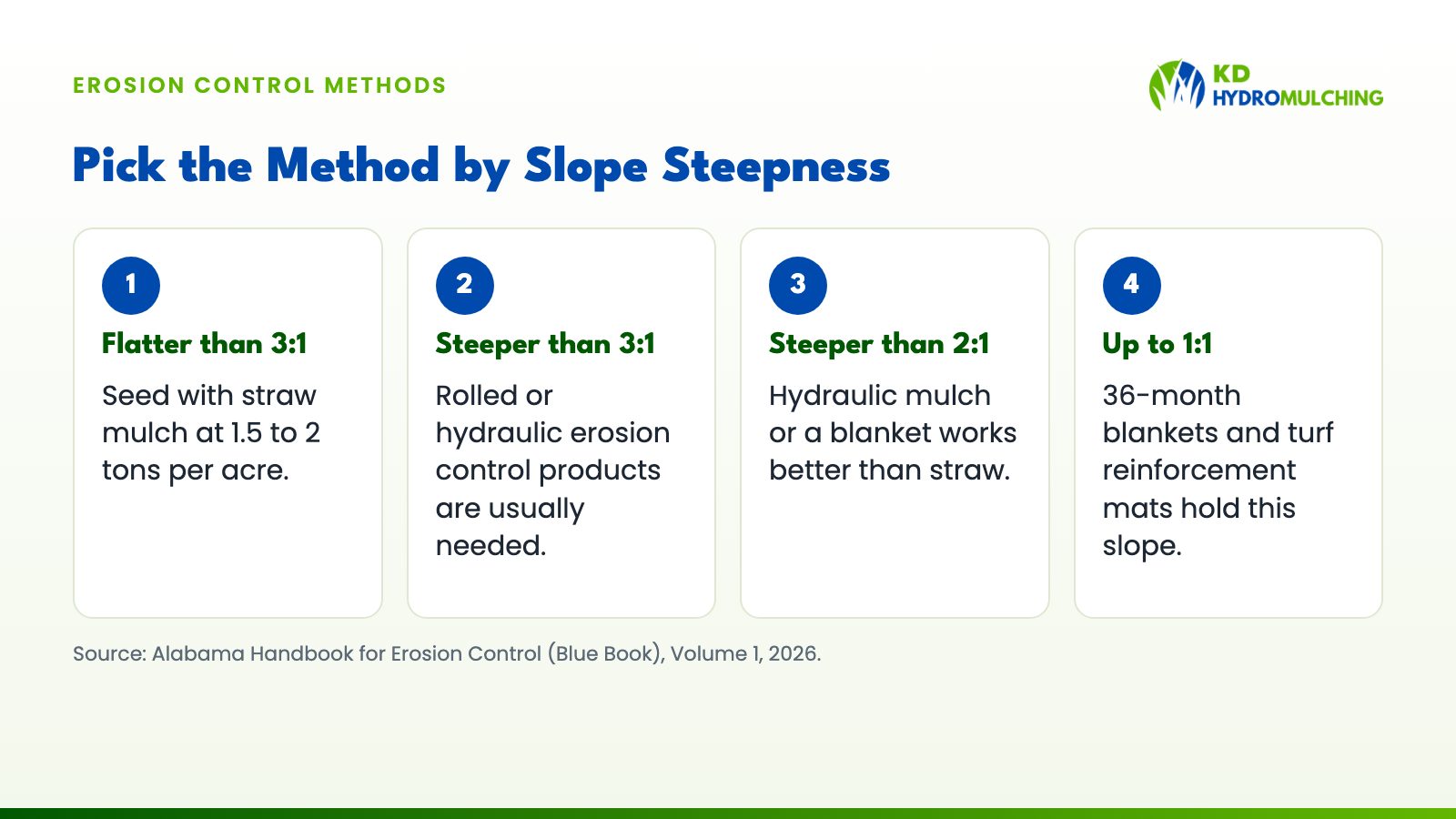
The graphic shows four slope ranges drawn from the Alabama Blue Book. The next section turns those ranges into a short selection process.
How Do You Pick the Best Erosion Control Method for Your Slope?
Pick the best erosion control method by measuring slope steepness as a ratio, such as 3:1. A 3:1 slope runs 3 feet across for every 1 foot of rise. Steeper ratios shed water faster and need stronger cover. Five steps narrow the choice.
- Measure the slope ratio with a level and tape.
- Find where runoff concentrates into rills, channels, or gullies.
- Check the soil for compaction and low fertility, since both slow plant growth.
- Match the cover to the ratio using the table below.
- Add a sediment barrier at the base where soil can still leave the site.
The table compares six methods by fit and main limit. Each limit comes from the Alabama Blue Book or Hydroseeding 101, a state training deck.
| Method | Where It Fits | Main Limit |
|---|---|---|
| Seed and straw mulch | Gentle slopes and flat areas | Not suited to slopes steeper than 2:1 |
| Hydromulch | Moderate slopes and open areas | Most open to raindrop impact of four mulch products |
| Bonded fiber matrix | Slopes too steep for rolled products | Needs 24 to 48 hours without heavy rain |
| Erosion control blanket | Slopes and water channels | Stapled by hand, so slower to install |
| Silt fence | Sediment at the base of a slope | Traps soil but does not hold the slope |
| Slope breaks | Long, steep slopes | Needs grading and careful spacing |
Plants anchor all six methods in the long run, so the next section starts with vegetation.
How Do Plants Control Erosion on a Slope?
Plants control erosion on a slope by shielding soil from raindrops and binding it with roots. Roots hold soil particles together, and stems slow the water that moves across the surface. Leaves also remove water between storms through evapotranspiration, which is water loss through leaf pores. Bare ground has none of these protections.
Trees add deeper roots over time. Muller Inc. reports that correctly planted and maintained trees cut erosion by as much as 75%. The best trees for erosion control depend on soil and sun, so a local extension office should confirm species. Ground cover still has to carry the slope while trees grow.
What Are the Best Plants for Erosion Control?
The best plants for erosion control are deep-rooted grasses and ground covers matched to sun, soil, and season. The Alabama Handbook table of permanent cover plants lists Pensacola bahiagrass, common bermudagrass, tall fescue, and Alamo switchgrass. The same table pairs each species with planting dates, so the calendar limits the best grass for erosion control.
The best seed for erosion control also changes with soil and slope. Shade changes the list again, and the best plants for erosion control in shade differ from sun mixes. Our guide to sloped yard plants covers the best erosion control plants by site, so this article stays with methods.
How Do Mulch and Erosion Control Blankets Protect Slopes?
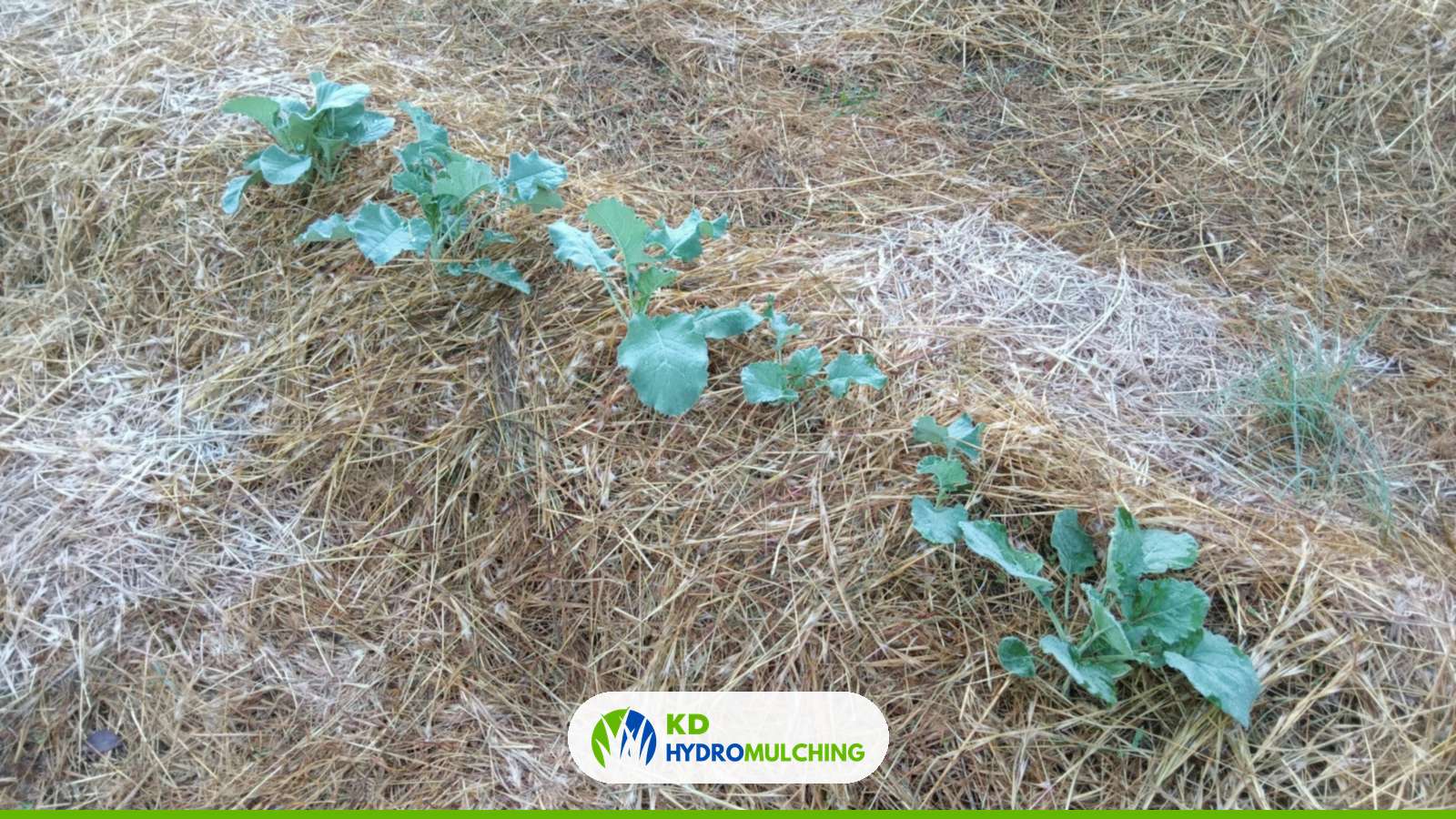
Mulch and erosion control blankets protect slopes by covering bare soil while seed germinates and roots form. The Alabama Blue Book lists straw with seed at 1.5 to 2 tons per acre, which reaches 75% ground cover. Straw alone runs 2.5 to 3 tons per acre. Wood chips need 5 to 6 tons, and pine straw needs 1 to 2 tons.
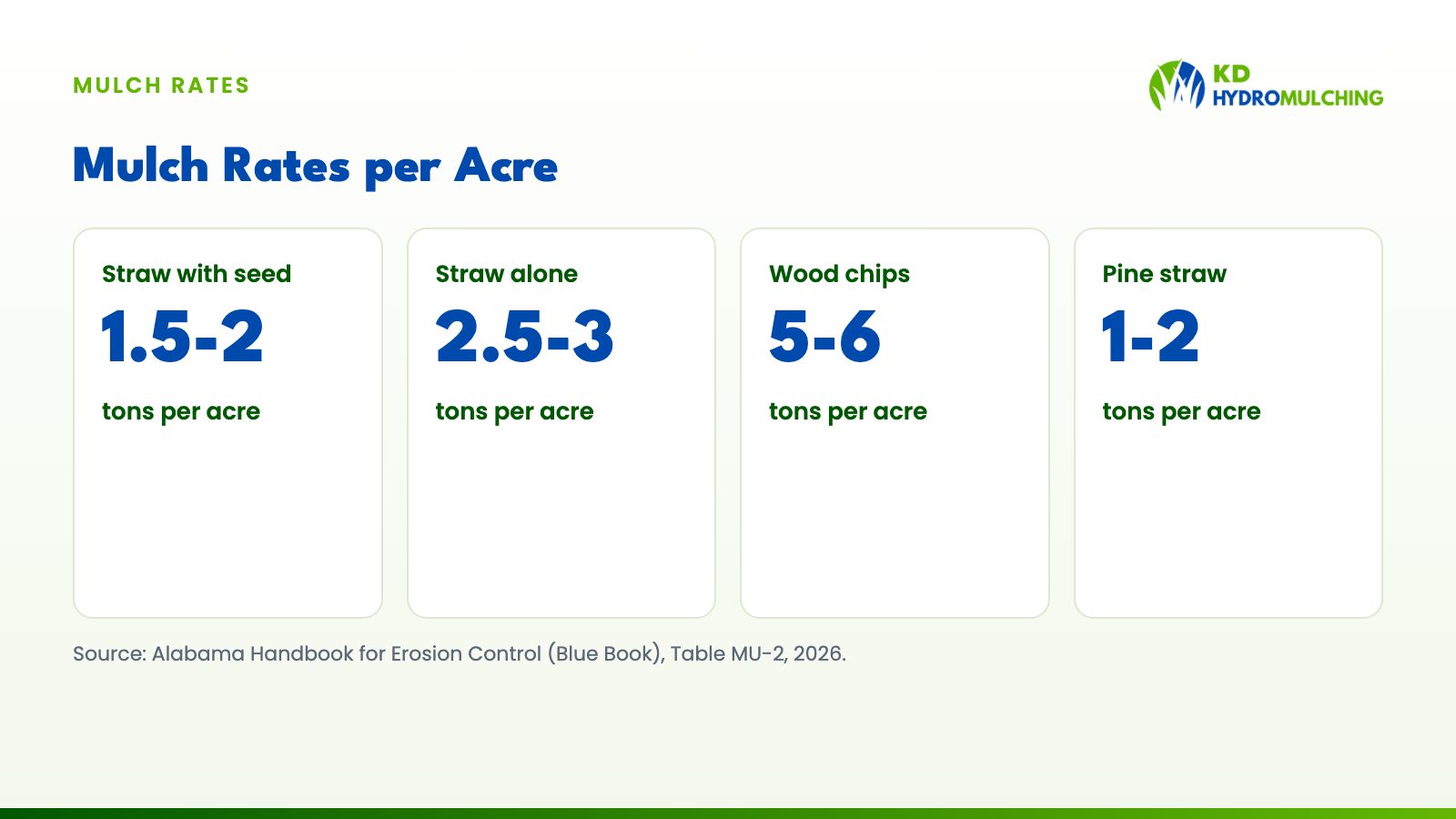
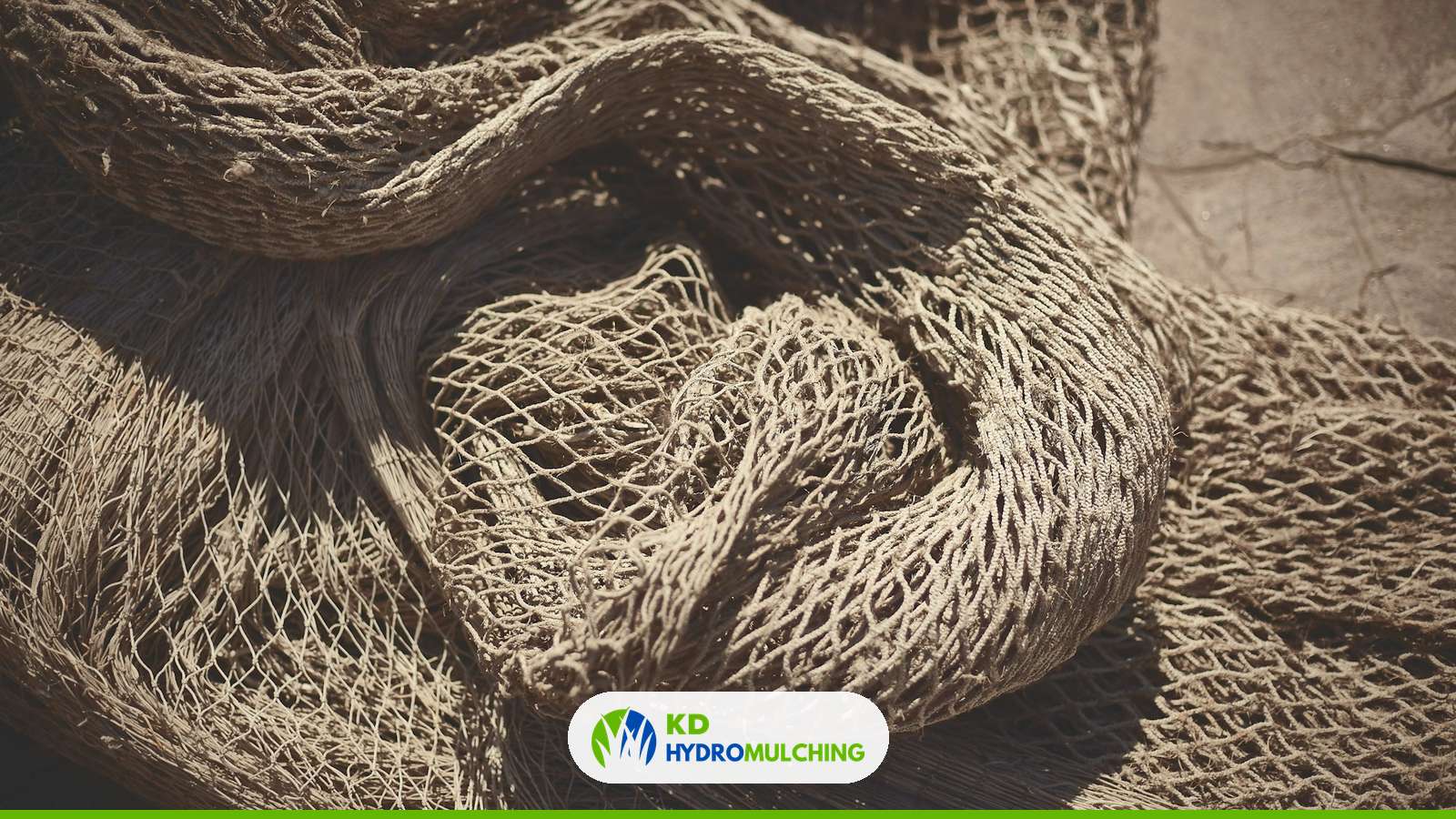
The graphic lists the four mulch rates per acre. Wind lifts loose straw, so crews anchor it with netting, a crimper, or a tackifier. Seedbed preparation comes first, because a loose, rough seedbed holds seed and fertilizer. Our site prep crews grade and loosen compacted soil before cover goes down.
What Is the Best Erosion Control Blanket?
The best erosion control blanket is the type rated for your slope steepness and the months of protection you need. The Alabama Blue Book sorts temporary blankets into Types 1 through 4 by functional longevity of 3, 12, 24, and 36 months. Type 5 products are turf reinforcement mats for long-term protection. Straw, coconut fiber, excelsior, and synthetic fibers are common fills.
The table shows the maximum slope for each blanket type. Higher types hold steeper ground for longer periods.
| Blanket Type | Functional Longevity | Maximum Slope |
|---|---|---|
| Netting or open weave (1.A, 2.A) | 3 or 12 months | 5:1 |
| Single-net blanket (1.C, 2.C) | 3 or 12 months | 3:1 |
| Double-net blanket (1.D, 2.D) | 3 or 12 months | 2:1 |
| Blanket (3.B) | 24 months | 1.5:1 |
| Blanket (4.B) | 36 months | 1:1 |
| Turf reinforcement mat (5.A) | Long-term | 1:1 |
Staples hold every type in place, at 1.3 or more per square yard on slopes. Blankets protect the moment they are stapled, while sprayed products need time to set.
How Does Hydroseeding Control Erosion?
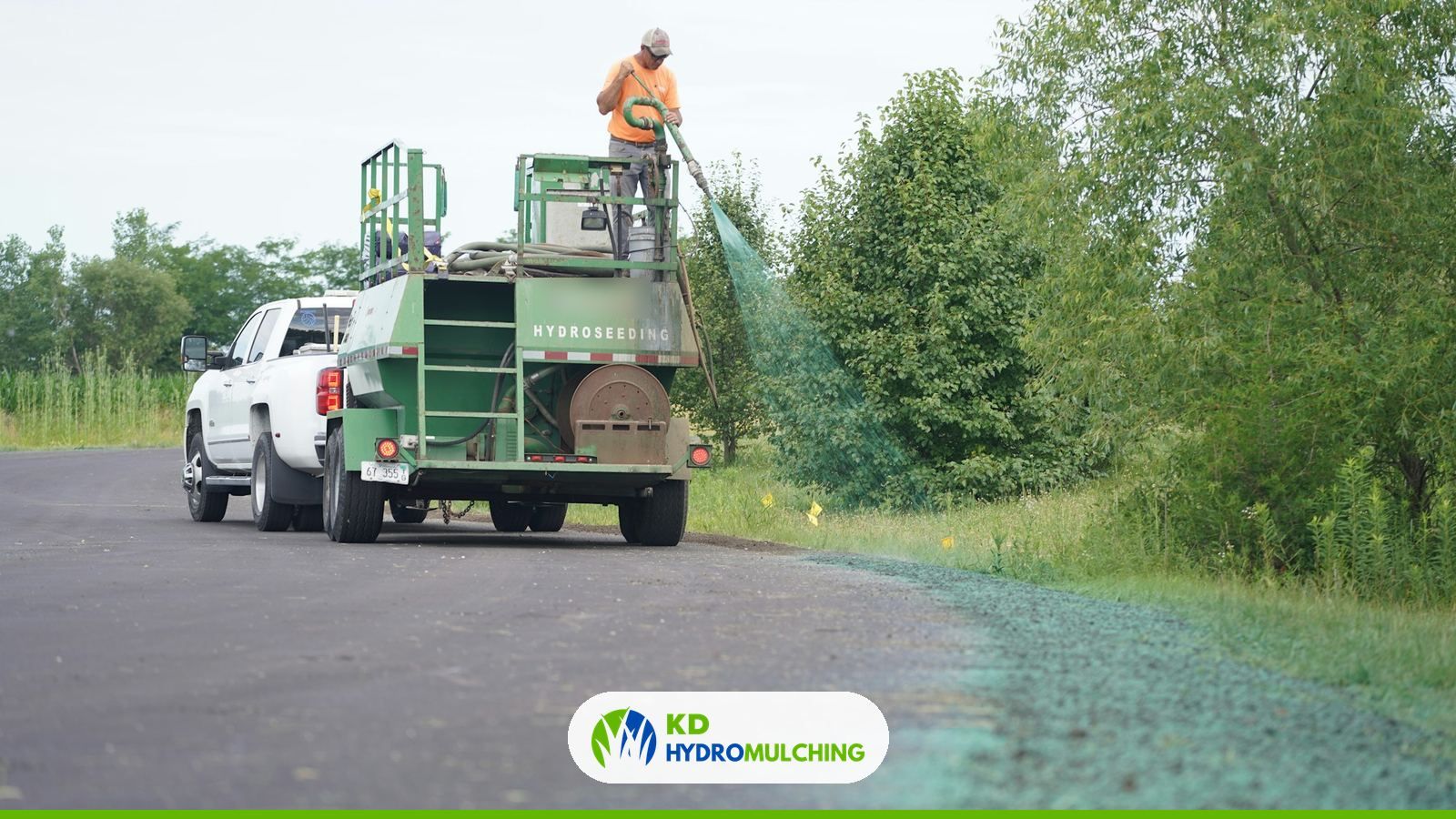
Hydroseeding controls erosion by spraying seed, mulch, and fertilizer in one slurry that covers the slope. The Alabama Soil and Water Conservation Committee lists 500 gallons of water per acre for seed and fertilizer. Hydromulch uses 4,000 gallons per acre at 2,000 pounds. Bonded fiber matrix uses 6,000 gallons per acre at 3,000 pounds.
Our hydroseeding crews spray slopes that rolled products cannot reach. The ALDOT specification sets a floor of 1 ton per acre for hydraulic mulch. Mulch alone does not finish the job, since seed must grow into a root mat.
How Does Hydroseeding Compare With Erosion Control Blankets?
Hydroseeding compares with erosion control blankets on speed and timing. The hydroseeding.info guide says a slope that takes about 2 hours to hydromulch can take a crew a full day to blanket. Bonded fiber matrix needs 24 to 48 hours without heavy rain to bond. Blankets protect right after stapling.
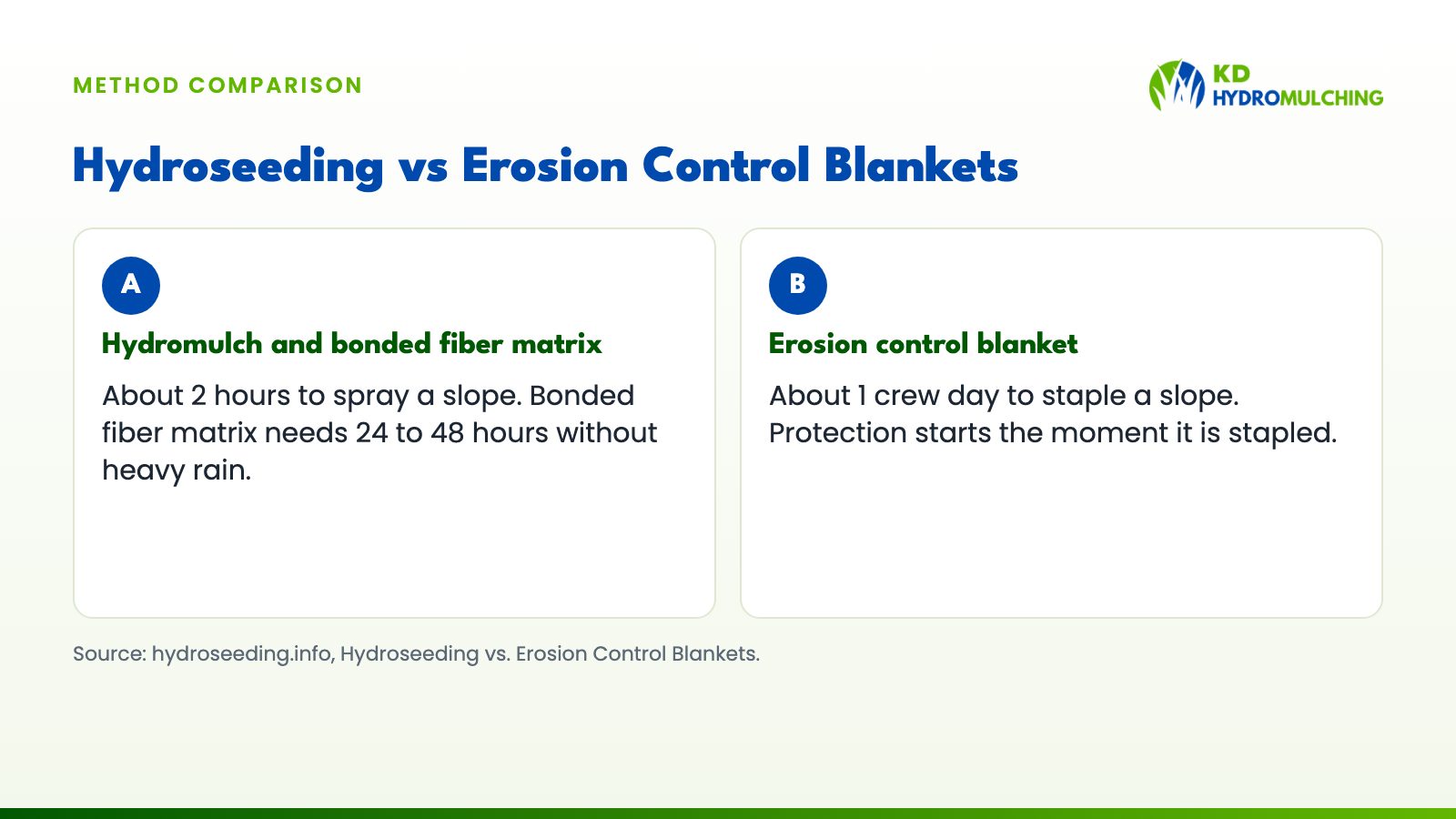
Crews often use both methods on one site. They spray broad slope faces and blanket channels where water concentrates. Aftercare then protects the new cover, and our post-seeding care notes explain watering and traffic limits.
What Do Tackifiers Do for Erosion Control?
Tackifiers do their erosion control work by gluing mulch fibers to the soil so wind and runoff cannot lift them. The Alabama Blue Book calls tackifier application through a hydroseeder practical for steep slopes. Applying straw and binder together is the most effective method, according to the same handbook. Liquid binders include synthetic products and organic tackifiers.
Can Drill Seeding Control Erosion on Gentle Slopes?
Drill seeding can control erosion on gentle slopes, because it places seed in the soil with ground-driven equipment. The Alabama Blue Book restricts equipment on slopes steeper than 3:1. Steeper ground goes to sprayed or rolled products. Flatter ground suits the drill seeding method well.
When Is a Silt Fence the Right Erosion Control Method?
A silt fence is the right erosion control method for trapping sediment below a disturbed slope. The fabric barrier slows runoff and drops soil behind it. The Alabama Blue Book limits the drainage area to 1/4 acre per 100 linear feet of non-reinforced fence. Reinforced fence handles 1/2 acre per 100 feet.
Crews set fence on the contour, with posts no more than 10 feet apart. Overflow points need a riprap splash pad over geotextile fabric. Our crews handle silt fence installation as part of job-site erosion plans. The EPA requires stormwater permit coverage for construction that disturbs 1 acre or more.
Which Structural Methods Help on Steep Slopes?
Structural methods help on steep slopes by breaking long runs of water into short ones. Slope breaks are benches or ridges that shorten the flow path. The Alabama Blue Book spaces them 20 feet apart on 1:1 slopes, 40 feet on 2:1, and 60 feet on 3:1. Spacing reaches 80 feet on 4:1 and 5:1 slopes.
Diversions and grading then guide runoff to stable outlets, so water leaves the slope without cutting gullies. Our guide to steep slope practices adds more detail for homeowners on grading, cover, and drainage. Each practice there pairs with the methods in this article.
Larger sites with failing banks need more than cover. Crews work to stabilize steep slopes with grading, matting, and seeding in a planned order.
What Else Should You Know About Erosion Control Methods?
Can Soil Erosion Be Reversed?
Soil erosion cannot be fully reversed, because topsoil forms at 300 to 400 years per centimeter. Muller Inc. gives that rate. Cover and regrading stop further loss. Gullies, bare slopes, and washouts appear on our erosion problems list.
What Is the Best Gravel for Erosion Control?
The best gravel for erosion control is angular stone sized to the water flow and set over geotextile fabric. The Alabama Blue Book uses that pairing at overflow points. A designer sizes the stone, and plant cover still protects the rest of the slope.
Do You Seed Before or After an Erosion Control Blanket?
Seed goes on the prepared soil before most blankets, following the maker's directions. The Alabama Blue Book notes that some turf reinforcement mats take seed in a soil infill after placement. Amendments go into the soil first.
What Is the Most Affordable Way to Prevent Erosion?
The most affordable way to prevent erosion on broad open slopes is hydromulch. The hydroseeding.info guide makes that case. Spraying needs less labor than stapling blankets by hand. Small problem spots may suit blankets instead.
Does Wind Cause Erosion Too?
Wind causes erosion on bare, dry ground by lifting loose soil and straw. The Alabama Blue Book anchors straw for that reason. Bare lots may also need dust suppression beside seed and mulch.
How Can KD Hydromulching Help With Erosion Control?
We help with erosion control by matching a method to your slope, soil, and water flow. Our work in North Alabama covers hydroseeding, blankets, silt fence, tackifiers, and soil binders. Each job starts with a site walk and a plan for the best erosion control method on your ground.
Send an estimate request with your slope photos and measurements. Tell us where water runs and where soil washes out. We reply with a method that fits the site.
Plan the work before the next heavy rain, since bare soil has no protection against storms. The KD Hydromulching experts handle seeding, mulch, and sediment control in one visit.