Straw Erosion Control Blanket
Straw blankets are rolled wheat straw stitched to netting that shields seeded soil. Pick single net for gentle slopes and double net for steeper ground, and plan on 3 to 12 months of cover.
A straw erosion control blanket is a rolled mat of wheat straw held by netting that protects bare soil while grass grows. Single-net blankets suit slopes up to 3:1. Double-net blankets suit slopes up to 2:1. Straw blankets break down in 3 to 12 months, so the grass must root before the mat is gone. Slope steepness, netting type, and wildlife safety decide which roll fits a site.
Key Takeaways
- A straw erosion control blanket is wheat straw stitched to netting and covers slopes to 3:1 (single net) or 2:1 (double net).
- Straw blankets last 3 to 12 months by type, while straw-coconut blends last up to 24 months.
- Loose straw runs 1.5 to 2 tons per acre with seed, but a blanket holds the straw in place with netting.
- Woven natural netting lowers the snake entanglement risk that plastic mesh creates.
- Staples go in at a minimum of 1.3 per square yard on slopes.
- Rolls cover 80 to 100 square yards in widths of 3 to 8 feet.
What Is a Straw Erosion Control Blanket?
A straw erosion control blanket is a temporary rolled mat of wheat straw stitched to netting. The straw shades the soil, slows runoff, and holds moisture next to the seed. The netting keeps the straw from sliding or blowing away.
The Alabama Blue Book calls these products rolled erosion control products. It names slopes and channels with a high erosion hazard as the right fit. Our crews install them as part of our straw blanket installation work. That work also covers silt fence, tackifiers, and soil binders. The structure of a blanket explains why it works, so the next section shows its layers.
How Does a Straw Erosion Control Blanket Work?
A straw erosion control blanket works by covering bare soil so rain cannot strike it directly. Straw fibers break the force of raindrops and slow water running down the slope. Seed under the mat stays put and sprouts through the straw.
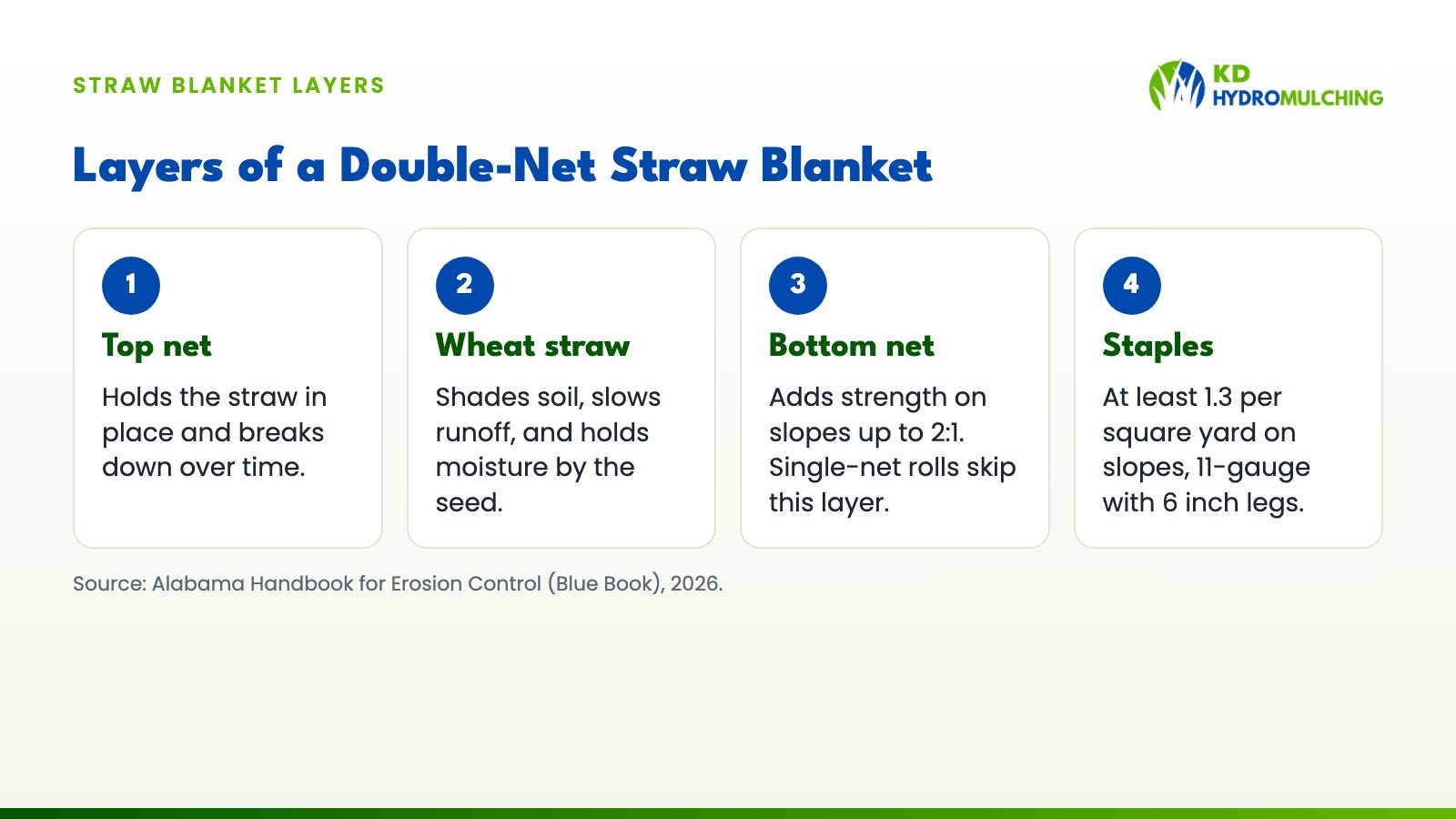
The graphic below shows the three layers of a typical double-net blanket and the staples that pin it down. Muller Inc lists common roll sizes of 80 to 100 square yards. Netting type matters as much as the straw fill.
What Is the Difference Between Single Net and Double Net Straw Blankets?
Double net straw blankets hold steeper slopes, up to 2:1 instead of 3:1. A single-net blanket has one net on top. A double-net blanket sandwiches the straw between two nets for more strength.
The table below lists the Alabama Blue Book temporary blanket types that use netting. The shear stress column shows how much flowing water each type resists.
| Blue Book Type | Netting | Max Slope | Functional Life |
|---|---|---|---|
| 1.C | Single net | 3:1 | 3 months |
| 1.D | Double net | 2:1 | 3 months |
| 2.C | Single net | 3:1 | 12 months |
| 2.D | Double net | 2:1 | 12 months |
Types 2.C and 2.D are the usual picks for straw because they last 12 months. The graphic compares the two layouts side by side.
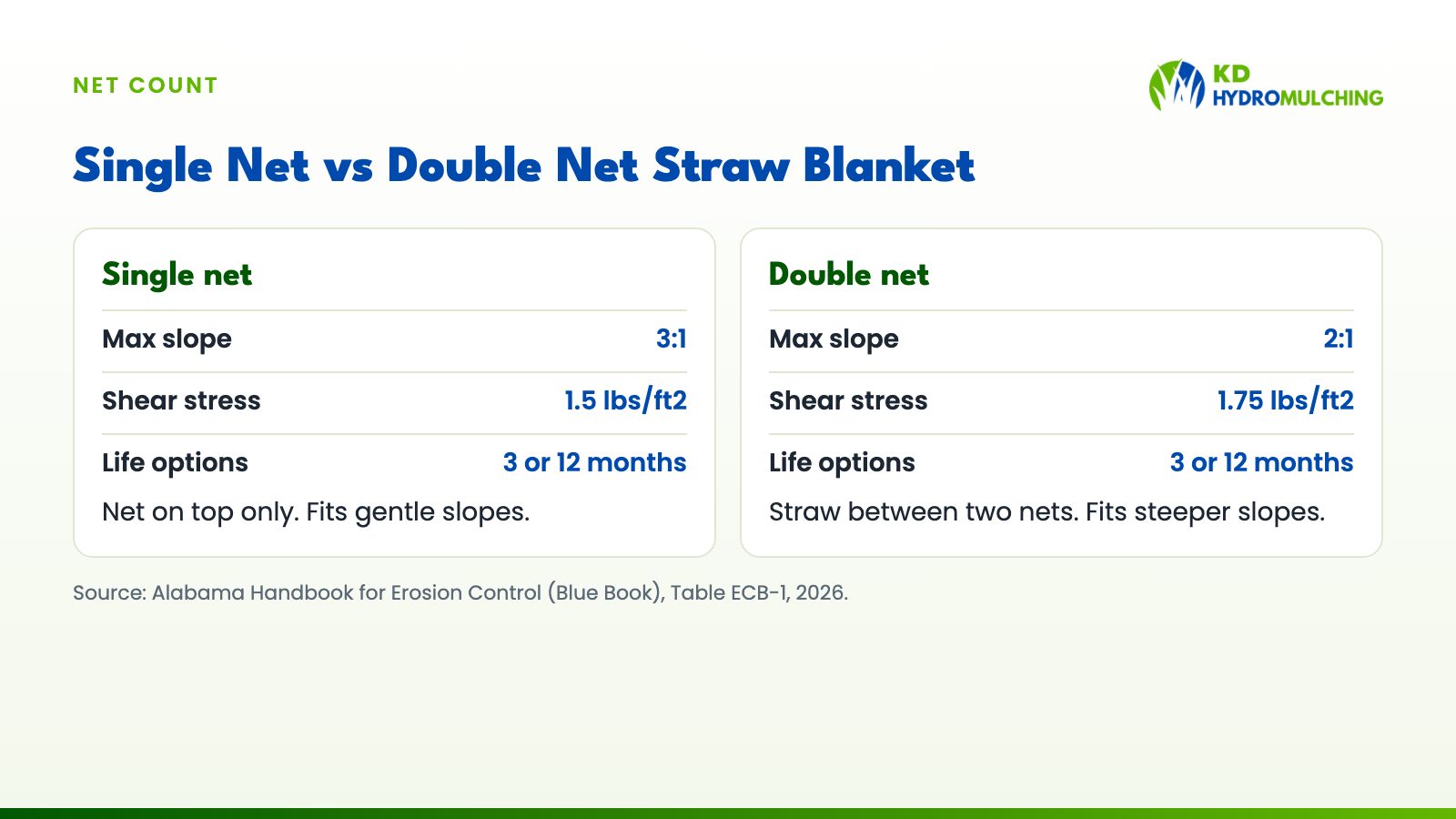
The Blue Book rates single-net blankets at 1.5 pounds per square foot of shear stress and double-net blankets at 1.75. Slope length and soil also matter, so the netting material comes next.
Is Photodegradable or Biodegradable Netting Better for Straw Blankets?
Biodegradable netting made from natural fiber is the safer choice because it rots in the soil and carries less wildlife risk. Photodegradable netting is plastic mesh that breaks down slowly under sunlight. BMP Supplies notes that plastic netting is usually black or green.
The Blue Book allows either material and asks designers to consider wildlife friendly netting when possible. Netting choice ties directly to lifespan, which the next section covers.
How Long Does a Straw Erosion Control Blanket Last?
A straw erosion control blanket lasts 3 to 12 months before the straw and netting break down. Valor Environmental lists straw-coconut blends at up to 24 months. Coir blankets run 2 to 5 years.
The Blue Book sorts blankets by functional life of 3, 12, 24, and 36 months. Grass usually needs a full growing season to cover the soil, so a 12-month straw type fits most seeded slopes. The next section compares straw with longer lasting fills.
How Does a Straw Blanket Compare With Coconut and Excelsior Blankets?
Straw blankets cost less and last a shorter time than coconut (coir) or excelsior blankets, so straw fits gentle slopes. Coir fits steeper ones. NC State Extension describes excelsior as curled wood fibers. Coir is made of coconut shell fibers.
The table below follows the Valor Environmental fill guide for slope ranges and life.
| Fill | Slope Range | Lifespan |
|---|---|---|
| Straw | 0:1 to 3:1 | Up to 12 months |
| Straw-coconut blend | 3:1 to 2:1 | Up to 24 months |
| Coir (coconut) | 2:1 or steeper | 2 to 5 years |
| Synthetic | Steep or permanent sites | Indefinite |
A 70 percent straw and 30 percent coconut mix is a common blend, says BMP Supplies. Straw alone is the right call only when the slope is gentle, and loose straw is the other option on gentle ground.
What Is the Difference Between Erosion Control Blanket vs Straw Mulch?
An erosion control blanket vs straw mulch differs in one way: the blanket has netting that anchors the straw. Loose mulch is only spread on top. Straw mulch erosion control needs tacking or crimping so wind and water cannot move it.
The Blue Book sets loose straw at 1.5 to 2 tons per acre with seed. Straw used as the only cover totals 2.5 to 3 tons per acre. Hand spreading uses 70 to 90 pounds of straw per 1,000 square feet. The Blue Book adds that slopes steeper than 3:1 usually need rolled or hydraulic products.
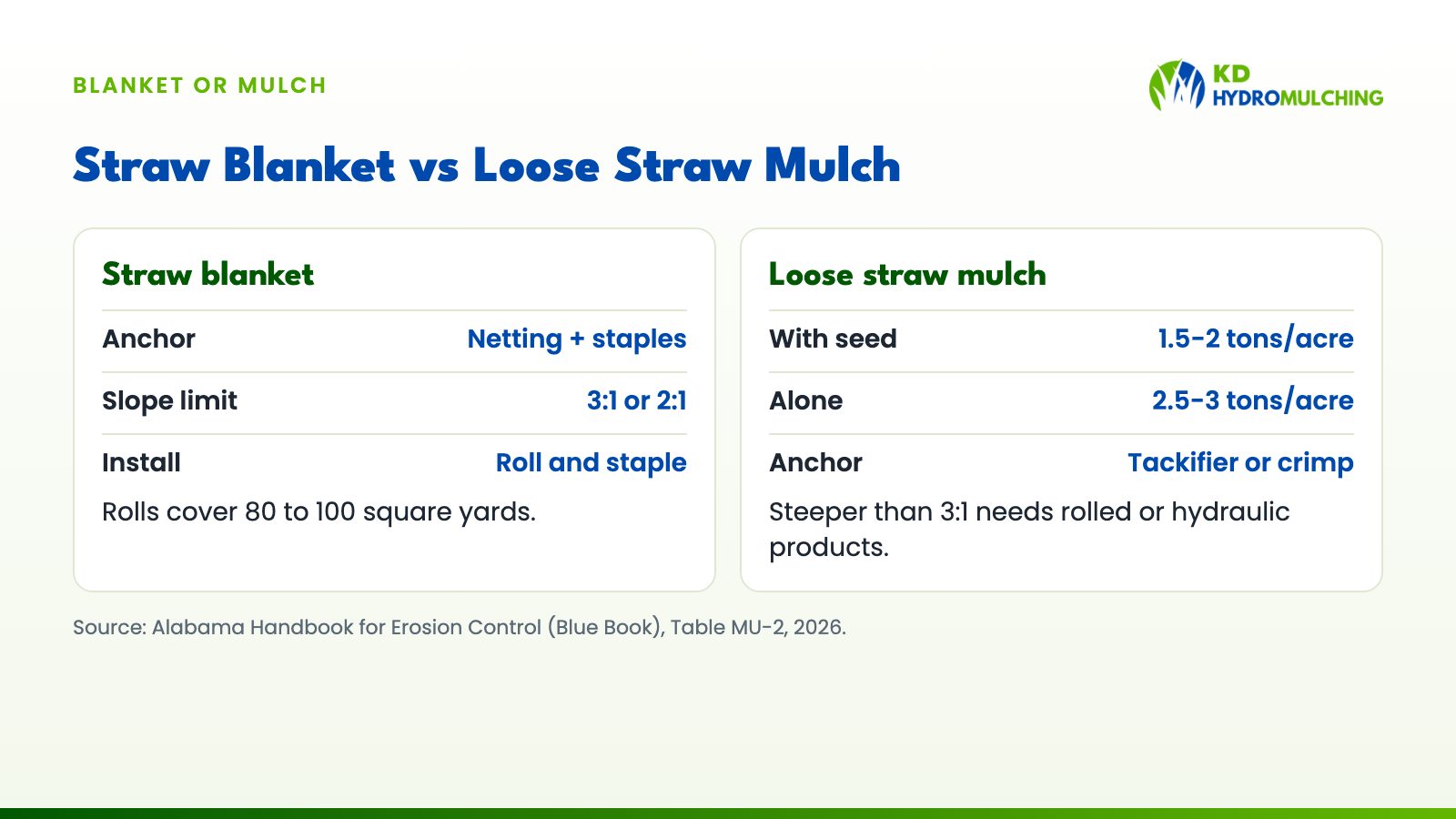
The graphic above contrasts rates, anchoring, and slope limits for each option. NC State Extension adds that straw is usually the least expensive mulch cover. Slope ratio then decides where each product belongs.
Where Do Straw Erosion Control Blankets Work Best?
Straw erosion control blankets fit gentle to moderate slopes and low-flow channels. Single-net rolls cover slopes up to 3:1. Double-net rolls cover slopes up to 2:1.
Ditches and swales can use straw blankets when flow stays light. The Blue Book rates these types at 1.5 to 1.75 pounds per square foot of shear stress. Straw for erosion control falls short on steeper banks. Slopes past 2:1 move to coir or a turf reinforcement mat. Our slope stabilization crew handles those steeper banks. Wildlife safety is the next point to check.
Are Straw Erosion Control Blankets Safe for Wildlife?
Straw erosion control blankets are safe for wildlife when the netting is woven natural fiber with a wide, loose weave. Plastic mesh with tight openings can trap snakes. Barton and Kinkead (2005) found rolled products to be a hazard to snakes in the Journal of Soil and Water Conservation.
The authors suggested a different mesh size for these products. Farm Plastic Supply lists a straw blanket with leno woven natural netting made to prevent wildlife entanglement. Hydromulch has no netting at all, notes NC State Extension.
How Are Straw Erosion Control Blankets Installed?
Straw erosion control blankets are installed by rolling them out downslope over smooth, seeded soil and pinning them with staples. A separate post covers the full install, so these five steps are the short version.
- Grade the slope smooth and remove rocks and clods.
- Spread seed and fertilizer.
- Bury the top edge in a trench.
- Roll the blanket in the direction of water flow with a 3 to 6 inch overlap.
- Staple at a minimum of 1.3 per square yard with 11-gauge staples that have 6 inch legs.
Hydromulch goes on in about 2 hours, while a blanket takes a crew day, says hydroseeding.info. Cost is the last piece of the picture.
How Much Does a Straw Erosion Control Blanket Cost?
A straw erosion control blanket costs from $25.99 a roll for single-net retail rolls. Farm Plastic Supply lists that starting price. Double-net rolls and larger sizes cost more, and staples add to the bill.
Installed prices depend on slope, access, and roll count, so we price each job after seeing the site. Cost also changes the choice between blanket and hydromulch, which our hydroseeding price guide covers.
What Else Should You Know About Straw Erosion Control Blankets?
Do Straw Blankets Decompose?
Straw blankets decompose within 3 to 12 months as the straw and netting break down into the soil. No removal is needed for natural nets, and seeded grass takes over the cover. Plastic mesh can linger longer, so net type matters.
How Do You Secure an Erosion Blanket?
Secure an erosion blanket with staples spaced no more than 3 feet apart, and closer on steeper slopes. Valor Environmental gives that limit. Edges and seams need the tightest spacing. Soil contact must stay flat, so the blanket should never stretch over bumps.
Is Loose Straw Cheaper Than a Straw Blanket?
Yes, loose straw with a tackifier costs less than a straw blanket on gentle slopes. NC State Extension calls straw the least expensive mulch cover. Blankets cost more but hold on slopes up to 3:1 without anchoring tools. Long utility strips often pair straw cover with utility corridor seeding.
What Are Straw Mats and Straw Rolls?
Straw mats are the same product as straw blankets sold under another name. Straw mats for erosion control, straw matting erosion control jobs, and straw erosion control rolls all describe the netted straw mat. Suppliers also write straw blanket erosion control on product pages. The names change, but the straw, the net, and the slope limits stay the same.
How Can KD Hydromulching Help With Straw Erosion Control Blankets?
We help with straw erosion control blankets by grading the slope, seeding, and rolling out the blanket. Our crews match the blanket to the slope, the soil, and the wildlife in the area. Slopes and ditches both appear on our problems we solve list. Each job starts with the slope ratio, the flow path, and the seed mix. Those three facts set the roll type and the staple pattern for the whole site.
The ground gets ready first, because a smooth, firm surface lets the blanket touch the soil. Our site prep service clears debris, grades the slope, and fixes compaction before any roll goes down. Clean grading also prevents gaps under the mat, where running water can cut a channel and lift the blanket off the soil.
A netless cover fits some slopes better than a blanket does, and we also spray hydromulch. Our hydroseeding company crews apply seed, mulch, and tackifier in one pass on slopes where netting is a problem.
Planning a job takes a short site review of slope ratio, flow, and soil. A local erosion control company can then quote straw rolls, staples, and labor together on one estimate for the whole slope. The estimate lists the roll type, the netting, the staple count, and the seed, so the scope is clear before work starts.
Reach out through the contact page to plan a straw blanket job at your property in Huntsville or North Alabama. Send the slope length, the rough steepness, and a few photos of the bare area. We will recommend a blanket type for the site.
Our team at KD Hydromulching company will review the slope with you before work starts. Straw blankets, hydromulch, and silt fence can then be matched to the soil and the rainfall on your site.