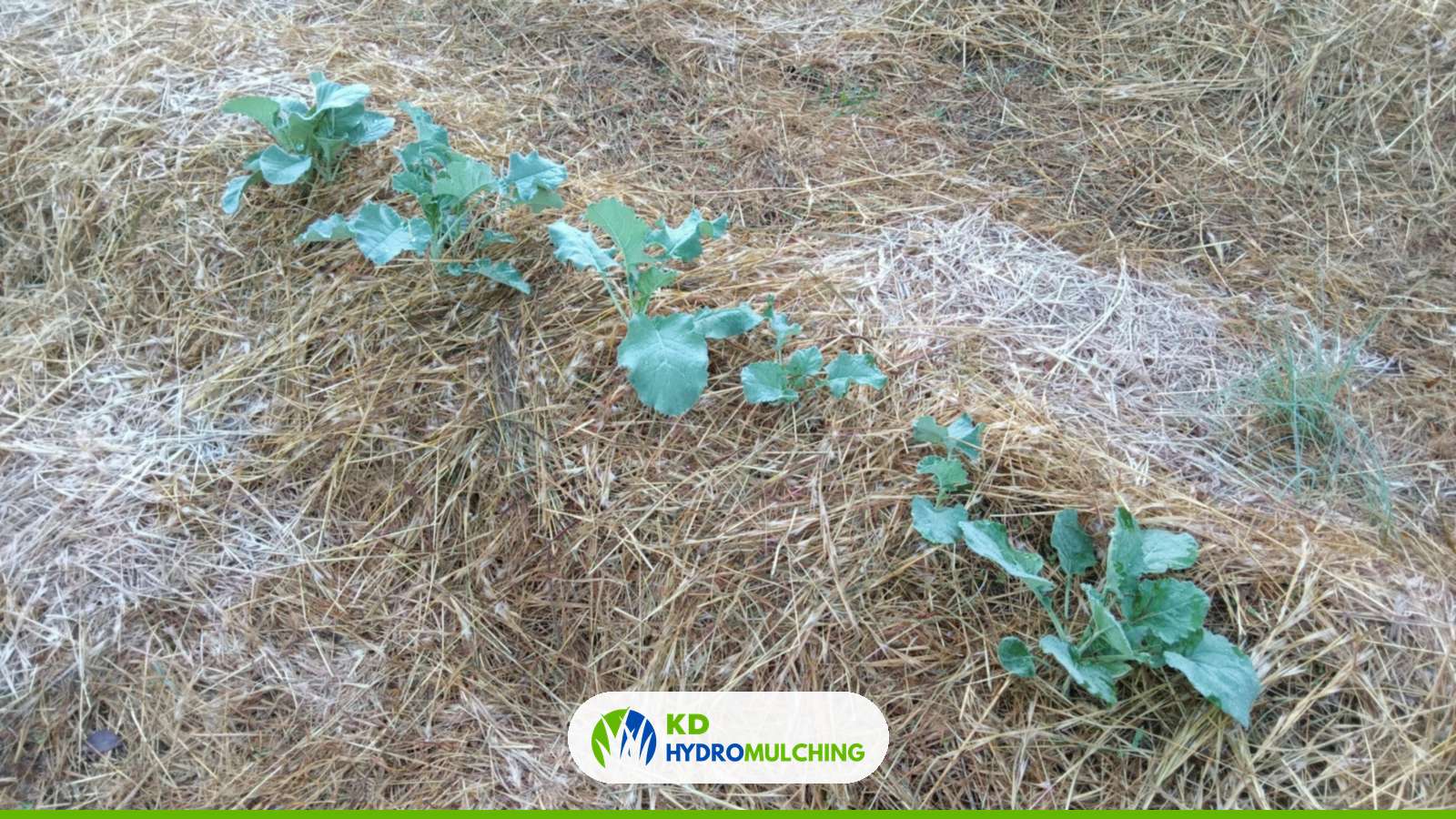
Erosion Control Grass Seed
Tall fescue is the main erosion control grass seed for slopes, sown at 40 to 50 pounds an acre in fall. Common bermudagrass, at 10 pounds an acre, covers spring planting.
Tall fescue is the top erosion control grass seed for slopes, sown at 40 to 50 pounds an acre. Fall planting runs September 1 to November 1. Common bermudagrass suits spring seeding at 10 pounds an acre from April 1 to July 1. A fast nurse crop and a layer of mulch hold the soil until roots grow. The Alabama Blue Book lists both rates and dates for each species.
Key Takeaways
- Tall fescue is the most widely used erosion control grass seed, planted at 40 to 50 pounds per acre.
- Common bermudagrass needs only 10 pounds per acre and takes spring seeding from April 1 to July 1.
- Nurse crops such as cereal rye must drop to half their full rate and stay under 30 pounds per acre.
- Annual ryegrass crowds out perennial grass, so the Blue Book advises against it as a companion crop.
- Mulch is essential to seeding success on slopes steeper than 3:1.
- Seed must stay in place for 1 full year before the stand counts as established.
What Is the Best Erosion Control Grass Seed?
The top erosion control grass seed is tall fescue for fall planting and common bermudagrass for spring planting. The Alabama Blue Book calls tall fescue the most widely used species in north Alabama for erosion control. Tall fescue thrives in full sun to partial shade and tolerates minimal care once established.
Our crews seed slopes through our erosion control crews using these same state-listed species. Common bermudagrass forms dense sod quickly from seed, but it does not tolerate shade or poorly drained soil. The table below lists the four seed options with rates and dates.
| Species | Season | Seed per acre | Dates in the north |
|---|---|---|---|
| Tall fescue | Cool | 40 to 50 lb | Sep 1 to Nov 1 |
| Common bermudagrass | Warm | 10 lb | Apr 1 to Jul 1 |
| Pensacola bahiagrass | Warm | 40 lb | Not listed (central: Mar 1 to Jul 1) |
| Alamo switchgrass | Warm, native | 4 lb | Apr 1 to Jun 15 |
The table shows that each species has its own planting window. The graphic below turns those windows into a yearly calendar.

Pensacola bahiagrass is the Blue Book choice for the southern half of the state, where it persists with little care. Bahiagrass grows slowly in the north and is not recommended there for erosion control. Alamo switchgrass is a native warm-season grass planted at only 4 pounds per acre. Native mixes like it bring deep roots but need weed control while they establish.
What Type of Grass Is Most Effective for Controlling Hillside Erosion?
The grass most effective for controlling hillside erosion is tall fescue seeded in early fall under mulch. Tall fescue grows in clumps, so it is slow to fill gaps in poor stands. Eroded spots may need replanting to finish the stand. Bermudagrass spreads by stolons and rhizomes and fills bare spots faster in full sun.
Sericea lespedeza is another listed legume, but it is slow to establish and gives little erosion control in its first year. The Blue Book also calls it invasive in forestry. Slope steepness then decides how much mulch or matting the seed needs.
What Type of Grass Seed Is Best for a Sloped Yard?
The best grass seed for erosion control on slopes is tall fescue under mulch in fall, with common bermudagrass in spring. The Blue Book calls mulch essential to seeding success on slopes steeper than 3:1. A 3:1 slope drops 1 foot for every 3 feet of run. Flatter yards can rely on seed and straw.
Warm and cool seasons also matter on a slope. Cool-season grass such as tall fescue grows mostly in fall and spring and rests in summer heat. Warm-season grass such as bermudagrass grows hardest in summer and goes dormant after the first frost. Each type needs a different planting window.
The Blue Book names March through May and late August through October as the effective windows for perennial grasses. Outside those dates, failure becomes more likely. A nurse crop then covers the gap.
Which Fast Growing Grass Seed for Erosion Control Works as a Nurse Crop?
Fast growing grass seed for erosion control works as a nurse crop that sprouts quickly and then yields to the perennial. The Blue Book defines a nurse crop as a quick-growing annual or weak perennial added to a permanent mix. It holds the soil while slower grass roots in.
Fast growing grass for erosion control in the cool season is cereal rye. Rye germinates at low temperatures and tolerates poor soils. Rye is especially helpful on erodible slopes and in late seeding. A thick rye stand can suppress perennial seedlings, so the Blue Book caps it at 30 pounds per acre.
Browntop millet covers the warm season. It grows 2 to 3 feet tall and starts quickly. Crimson clover is a cool-season legume the Blue Book names as a companion crop. The table lists all five annual choices.
| Crop | Season | Full rate per acre | Dates in the north |
|---|---|---|---|
| Cereal rye | Cool | 3 bushels | Sep 1 to Nov 15 |
| Wheat | Cool | 3 bushels | Sep 1 to Nov 1 |
| Crimson clover | Cool | 10 lb | Sep 1 to Nov 1 |
| Browntop millet | Warm | 40 lb | Apr 15 to Aug 1 |
| Annual ryegrass | Cool | 30 lb | Aug 15 to Oct 1 |
The Blue Book says to cut each full rate by 50 percent when the crop serves as a nurse crop. The graphic below shows the halved rates beside the full rates.

Annual ryegrass gives dense cover rapidly, yet it is highly competitive and crowds out most other species. The Blue Book does not recommend it as a companion crop in perennial mixtures. Ryegrass seed also volunteers and can interfere with later permanent cover. The right planting date is the next choice.
When Should You Plant Grass Seed for Erosion Control?
Plant grass seed for erosion control from September 1 to November 1 for tall fescue. The Alabama Cooperative Extension System names September to October as the ideal time, because roots form before summer heat. Spring planting is risky and needs large amounts of water.
Warm-season seed follows the opposite calendar. Common bermudagrass goes down from April 1 to July 1. Alamo switchgrass runs from April 1 to June 15. These dates come from Table PS-1 of the Blue Book.
Is October Too Late to Seed Grass for Erosion Control?
No, October is not too late for tall fescue, because the planting window runs to November 1. The Blue Book extends cereal rye to November 15 as a temporary cover. Seed sown after those dates risks poor germination before winter.
Late-season grading often misses the perennial window. A rye cover then protects bare soil until the next planting season. Crews return in the proper window to add the permanent seed.
How Much Grass Seed Do You Need for Erosion Control?
Erosion control grass seed runs 40 to 50 pounds an acre for tall fescue and 10 pounds an acre for common bermudagrass. The Blue Book states these rates as pure live seed, or PLS. PLS adjusts bag weight for seed purity and germination.
The Blue Book gives an example of the math. A species with 80 percent germination and 90 percent purity has 72 percent PLS. A 10 pound PLS rate then needs 13.9 pounds of bagged seed. Alabama law requires seed tags to show purity, germination, and weed seed content.
Mixes need extra care. The Blue Book warns against using any rate as part of a mixture unless the table shows that mixture. Blend rates should come from the table, such as 30 pounds of Pensacola bahiagrass with 5 pounds of common bermudagrass.
How Do You Seed a Slope for Erosion Control?
Seed a slope for erosion control by correcting the soil first and covering the seed right after sowing. The Alabama Blue Book requires fixing compaction and drainage problems before any seeding. Seedbed work follows the soil test.
- Loosen compacted soil to a depth of 6 to 8 inches.
- Apply lime and fertilizer by soil test, or 400 pounds of 8-24-24 an acre without one.
- Sow half the seed in one direction and half at right angles.
- Cover grass seed no deeper than 1/2 inch, and small grains no deeper than 1 inch.
- Firm the surface with a roller, then mulch right away.
Our seedbed preparation service handles grading, compaction fixes, and soil conditioning before the seed goes on. A target soil pH of 6.0 to 6.5 supports most grass roots. Mulch comes next in the process.
Does Grass Seed Need Mulch or an Erosion Control Blanket?
Grass seed needs mulch or an erosion control blanket on any slope where rain can wash seed away. The Blue Book says mulch gives instant cover and is essential on slopes steeper than 3:1. Straw mulch runs 1.5 to 2 tons per acre when applied with seed.
An erosion control blanket with grass seed combines cover and seed in one roll. Grass seed erosion control blanket products hold seed in place and grow through the open weave. Blanket types reach different slopes, from 5:1 for the lightest type to 1:1 for the heaviest.
Concentrated runoff needs more than loose seed. The Blue Book calls for sod, a hydromulch formulated for channels, or a blanket where water flows in a ditch. Slope breaks and runoff control are covered in the steep hillside tips post.
Will Grass Grow Through an Erosion Control Blanket?
Yes, grass will grow through an erosion control blanket, because blankets use an open weave of straw, coir, or synthetic fiber. Seed sits on the soil beneath the blanket. The roots anchor below while shoots push through the openings.
How Does Hydroseeding Compare to Dry Seeding for Grass Seed?
Hydroseeding applies grass seed, water, and mulch in one slurry sprayed over the slope. The Blue Book says a cellulose or wood fiber carrier holds the seed in the mix. Crews apply the slurry within 1 hour of mixing to protect the seed.
Fertilizer stays out of the seed slurry, because fertilizer salts can damage seed. It goes on as a separate pass after seedlings emerge. A rough, unsmoothed slope helps, since clods and stones hold seed in small cavities.
Bonded fiber matrix, or BFM, adds a stronger binder to the slurry. The Alabama Soil and Water Conservation Committee lists 6,000 gallons of water and 3,000 pounds of fiber an acre for BFM. BFM needs 24 to 48 hours without heavy rain to bond.
Steep banks may also need tackifiers and soil binder options that glue seed and mulch together. These products add hold where blankets cannot be rolled out. Slope steepness and soil type set the choice, and crews test small areas first on loose or sandy banks.
Hydroseeding suits slopes where crews cannot roll blankets by machine. Seed and mulch go down together in one pass across the surface. The slurry stays even from the top of the bank to the toe. Our hydroseeding method uses that approach on graded banks and lots.
Drill seeding sows seed in rows into prepared ground at a set depth. Rows of seed also resist washout on gentle grades better than loose broadcast seed. A drill seeder suits flatter, open acreage better than steep banks. Both methods then rely on mulch and moisture until the grass fills in.
What Else Should You Know About Erosion Control Grass Seed?
Can You Just Throw Grass Seed Down on Dirt?
No, loose seed thrown on dirt washes off slopes and dries out before roots form. The Blue Book calls for a firm seedbed, shallow cover, and mulch.
What Are the Best Grass Seeds for Sandy Areas?
Bahiagrass suits sandy soil in the southern half of Alabama. The Blue Book notes common bermudagrass does poorly on extremely droughty sand. Sericea is also not suited to sandy soil.
How Long Until a Grass Stand Counts as Established?
A stand counts as fully established only after soil cover holds for 1 full year from planting. Bahiagrass often needs 2 years to form good sod. Follow the new seed care steps while the stand fills in. Light watering, no foot traffic, and delayed mowing all protect young seedlings during that first year. Dry surface soil causes seedling failure, so moisture matters until roots reach deeper soil.
Does Seeded Ground Need Irrigation?
Irrigation greatly improves establishment and is rarely critical for low-maintenance cover planted in season. The Blue Book warns that too much water can cause runoff. Controlled watering avoids both dry spells and washout on slopes, and our irrigation setup work covers that need.
Where Do Plants and Shrubs Fit In?
Grass covers open slopes, while shrubs and ground covers handle shade and steep banks in many yards. The slope planting guide covers those plant options in detail and pairs well with seed.
How Can We Help With Seeding a Slope?
We help by matching seed, nurse crop, and cover to your slope ratio and planting date. Slopes with active erosion may need slope seeding with blankets or binders for added hold. Grading and soil fixes come first when compaction blocks root growth. The seed mix follows once the base is sound for roots and water.
Our crews at KD Hydromulching staff work across North Alabama on seeding, mulching, and erosion control projects. Each job starts with a look at the slope, the soil, the drainage, and the season. That visit sets the species and rates for the site.
Send us your slope details, and we can schedule a visit to plan the seed, mulch, and cover for your site.