In this article9 sections
- What Is the Best Mulch for Erosion Control?
- How Do Straw, Pine Straw, and Wood Chips Compare for Erosion Control?
- How Deep Should Mulch Be for Erosion Control?
- What Is Hydraulic Mulch for Erosion Control?
- Is Compost a Good Mulch for Erosion Control?
- Which Erosion Control Mulch Is Most Cost-Effective?
- How Do You Apply Mulch on a Slope?
- What Else Should You Know About Mulch for Erosion Control?
- How Can KD Hydromulching Help With Mulch for Erosion Control?
The best mulch for erosion control on most slopes is shredded hardwood bark or pine straw spread 2 to 3 inches deep. Their interlocking fibers grip each other and resist washing away. Straw anchored with a tackifier suits bare seeded ground. Hydraulic mulch covers large or steep areas. Rounded bark nuggets and plain wood chips slide downhill in heavy rain.
Key Takeaways
- Shredded hardwood, pine straw, and straw hold well because their fibers interlock instead of rolling.
- Organic bed mulch works at a depth of 2 to 3 inches, and thicker layers can slide.
- Straw goes on at 1.5 to 2 tons per acre with seed, and wood chips need 5 to 6 tons per acre.
- Hydraulic mulch uses 2,000 pounds per acre, and bonded fiber matrix uses 3,000 pounds per acre.
- Slopes steeper than 3:1 need rolled or hydraulic products, not loose mulch alone.
What Is the Best Mulch for Erosion Control?
The best mulch for erosion control is a fibrous mulch that interlocks into a mat. Examples include shredded hardwood bark, pine straw, and straw held by a binder. Interlocking pieces stay put when runoff speeds up. Mulch for erosion control also absorbs raindrop impact and slows water so it soaks in. Covering the ground comes first, and the next heading narrows the choice by slope.
Our crews apply mulch as part of our erosion control mulching work, next to blankets, tackifiers, and soil binders. A mulch layer should cover at least 85 percent of the soil surface, according to NC State Extension. Bare patches let rain cut small channels. The sections below match each mulch to a slope.
What Type of Mulch Is Best for Slopes?
The best mulch for slopes is shredded hardwood or double-shredded bark on gentle grades, plus pine straw. Their irregular strands weave together like a loose mat. Shredded cedar, sold as gorilla hair, behaves the same way on hillsides. Loose products still lose ground on steeper banks, so slope limits matter next.
Grades steeper than 3:1 usually need rolled or hydraulic products, per the Alabama Blue Book, the state's erosion control handbook. A 3:1 slope falls 1 foot for every 3 feet of horizontal distance. Steeper banks hold better under steep bank blankets or hydraulic application. Gentle yard grades suit loose mulch, as the next section compares.
How Do Straw, Pine Straw, and Wood Chips Compare for Erosion Control?
Straw, pine straw, and wood chips differ mainly in application rate and grip, and straw is the lowest-cost option. Straw mulch for erosion control lasts about 3 months, per NC State Extension. Wood chips need the heaviest rate. The table below lists the rates the Alabama Blue Book sets for each loose mulch.
Erosion control mulch types, rates, and limits
Mulch | Rate or depth | Where it works | Main limit |
|---|---|---|---|
Straw with seed | 1.5 to 2 tons per acre | Seeded slopes up to 3:1 | Blows away unless anchored |
Straw alone | 2.5 to 3 tons per acre | Bare areas awaiting seed | Lasts about 3 months |
Pine straw | 1 to 2 tons per acre | Gentle slopes and beds | Interlocks into a stable layer |
Wood chips | 5 to 6 tons per acre | Areas without planned grass | Grass struggles to grow through |
Shredded hardwood | 2 to 3 inches deep | Planted slopes and beds | Costs more per area than straw |
The table shows pine straw mulch takes the lightest rate and wood chips the heaviest. A thin straw layer fails, so rates matter as much as material. Depth is the next question.
How Deep Should Mulch Be for Erosion Control?
Mulch for erosion control should be 2 to 3 inches deep for organic bed mulch such as shredded bark. Too thin a layer lets raindrops hit the soil. A layer that is too thick can slide as one sheet on a slope. Even coverage with no bare soil matters more than extra depth.
One cubic yard of mulch covers 162 square feet at 2 inches deep and 108 square feet at 3 inches, per LawnStarter. Loosening the top of the soil first helps the mulch bond with the surface. Straw and hydraulic products use weight per acre instead of depth. Hydraulic products come next.
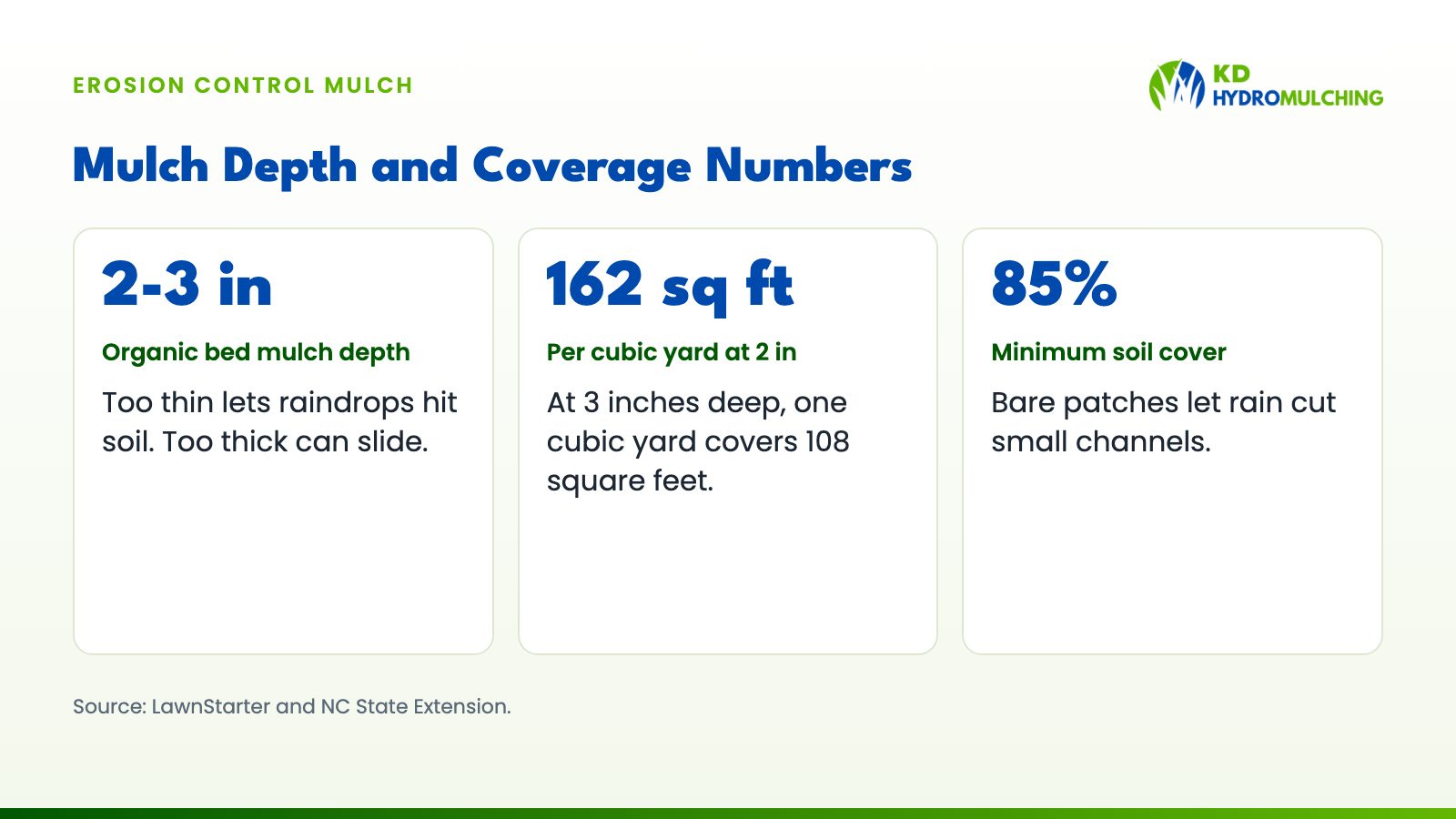
The graphic above shows the depth and coverage numbers side by side. Matching depth to the area saves material and money. Larger or steeper areas shift the choice toward spray-applied mulch.
What Is Hydraulic Mulch for Erosion Control?
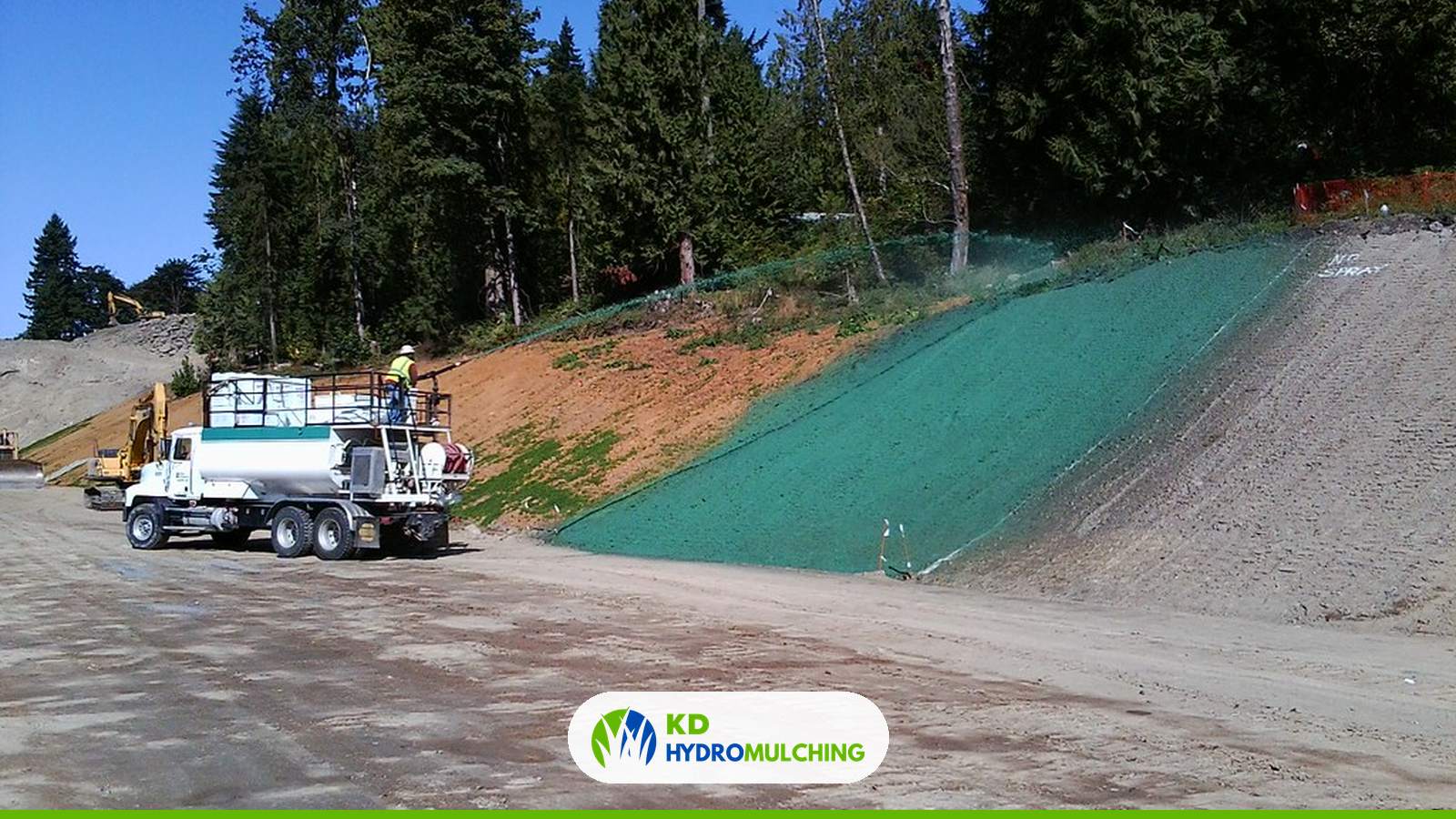
Hydraulic mulch is a slurry of wood or paper fiber and water sprayed over bare soil. Crews often add seed and a tackifier. It forms a protective crust that holds soil and moisture. Alabama specs use 2,000 pounds of hydraulic mulch in 4,000 gallons of water per acre. ALDOT never applies it below 1 ton per acre.
Our crews spray this slurry as hydraulic mulching on slopes, ditch banks, and cleared lots. Spray application reaches banks that machines cannot cross. The slope table below sets the rate by steepness, using Erosion Control Technology Council figures reported by NC State Extension.
Hydraulic mulch rate and longevity by slope
Slope | Max slope length | Rate per acre | Lasts |
|---|---|---|---|
5:1 or flatter | 20 ft | 1,500 to 2,500 lb | 1 month |
4:1 or flatter | 25 ft | 2,000 to 3,000 lb | 2 months |
3:1 or flatter | 50 ft | 2,000 to 3,500 lb | 3 months |
2:1 or flatter | 75 ft | 2,500 to 4,000 lb | 6 months |
2:1 or flatter | 100 ft | 3,000 to 4,500 lb | 12 months |
Steeper and longer slopes need heavier rates and longer-lasting products. The Alabama field rate of 2,000 pounds per acre sits inside the 3:1 range. Fiber type changes the price, as the next heading explains.
What Is the Difference Between Wood Fiber and Paper Fiber Hydromulch?
Wood fiber mulch is longer lasting and costlier than paper fiber, which is the least expensive hydromulch. NC State Extension ranks wood fiber with additives as the most expensive type and blends in between. Cost rises with longevity and slope.
Paper fiber suits flat or gentle ground that needs a short cover. Wood fiber suits slopes that must hold for months. A bonded version takes the product further, as the next heading covers.
What Is a Bonded Fiber Matrix?
A bonded fiber matrix is a hydraulic mulch with a bonding agent that forms a crust stronger than plain hydromulch. The Alabama Soil and Water Conservation Committee sets 3,000 pounds in 6,000 gallons of water per acre. Crews spray it on steeper banks where plain mulch would wash. The matrix needs 24 to 48 hours without significant rain to bond.
A bonded fiber matrix replaces rolled blankets on some banks. Our slope mulching crews choose between sprayed and rolled products by grade. Rolled products still protect at once, while spraying finishes in about 2 hours versus a crew day for blankets, per hydroseeding.info. A natural alternative is compost.
Is Compost a Good Mulch for Erosion Control?
Compost is a workable mulch for low to moderate slopes when spread 1 to 2 inches deep. A compost blanket can go up to 4 inches deep on slopes of 2:1 or steeper, according to NC State Extension. Seed belongs in the mix when the layer exceeds 2 inches. Compost properties vary by source material, which makes results less predictable.
Compost costs more than most other options, per the same source. It also feeds the seedlings as it breaks down. Straw and fiber still win on price for large areas. Cost is the next comparison.
Which Erosion Control Mulch Is Most Cost-Effective?
Straw is the most cost-effective erosion control mulch for flat to moderate slopes. Hydroseeding is the efficient choice for large seeded areas, at $0.07 to $0.25 per square foot. Straw is usually the least expensive mulch, per NC State Extension. Retail prices per cubic yard for bulk mulch follow, from LawnStarter.
- Pine straw costs $20 to $55 per cubic yard.
- Shredded hardwood mulch costs $40 to $70 per cubic yard.
- Bark mulch costs $30 to $100 per cubic yard.
- Wood chips cost $30 to $110 per cubic yard.
- Hay mulch costs about $60 per cubic yard.
Those prices include delivery and labor. A thin layer of fibrous mulch costs less per square foot than a thick layer of chips. Hand application adds labor, so machine spraying wins on large slopes, where hydromulching cost per square foot stays low. Applying the mulch correctly protects the investment.
How Do You Apply Mulch on a Slope?
Apply mulch on a slope by shaping the soil, spreading an even layer, and anchoring it. These five steps work for loose mulch.
- Fill rills and gullies and loosen the top inch of soil.
- Spread seed first, then mulch, so seed contacts the soil.
- Cover at least 85 percent of the surface with an even layer.
- Anchor straw by crimping or with a tackifier.
- Inspect after each heavy rain and patch bare spots.
Tackifiers glue the mulch together. Wood and paper fiber tackifier runs 500 to 1,000 pounds per acre, per NC State Extension. Guar, plantago, and starch types run 100 to 200 pounds per acre. Our mulch installation crews apply both loose and sprayed mulch. Questions about related methods come next.
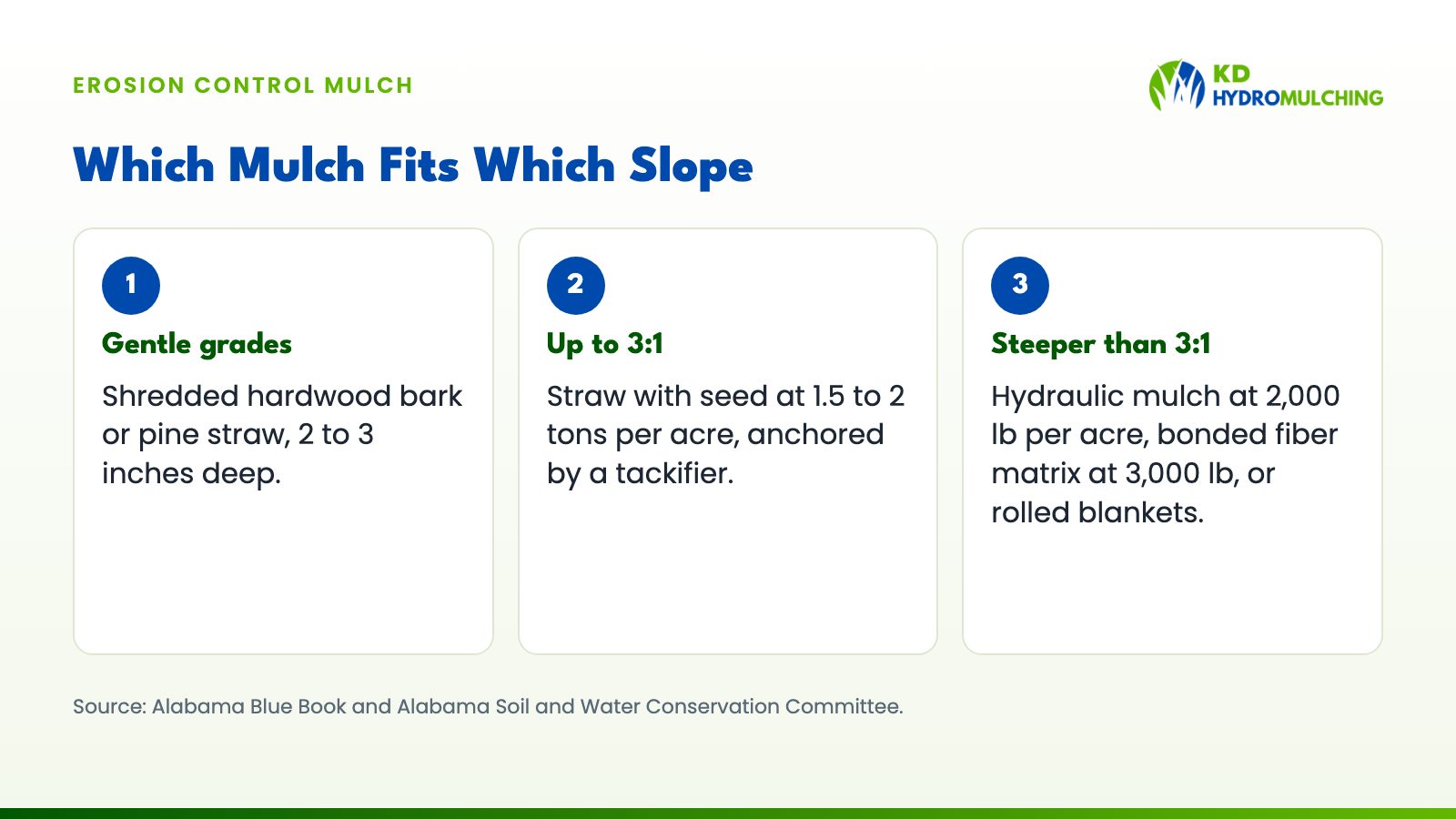
The graphic above matches each mulch to a slope range. Staying inside each limit keeps the mulch from sliding. Related questions about mulch choice follow.
What Else Should You Know About Mulch for Erosion Control?
Mulch for erosion control is one part of a system, not a stand-alone fix. These short answers cover the common follow-up questions.
What Mulch Should You Avoid on Slopes?
Avoid bark nuggets, smooth river rock, and plain wood chips on slopes. Rounded nuggets and chips lack interlocking edges, so heavy rain moves them downhill. Shredded fibers hold instead, and mulch works alongside the best erosion control method of plant cover.
Does Mulch Alone Stop Erosion?
Mulch alone does not stop erosion on steep or long slopes because it is a temporary shield. Deep-rooted grass is the long-term fix on every slope, and the right grass seed for slopes goes under the mulch.
Rolled products add holding power where loose mulch slides. A rolled straw blanket pairs straw with netting that keeps the straw in place during storms.
Mats hold harder grades, and they suit channels and banks where flowing water is a risk. Permanent reinforcement mats stay in place after the grass grows.
What Is the Cheapest Way to Stop Erosion?
Straw mulch with seed is the cheapest fix for erosion on gentle slopes. Hydroseeding handles larger areas at $0.07 to $0.25 per square foot. Steeper banks justify blankets or bonded matrix.
How Can KD Hydromulching Help With Mulch for Erosion Control?
KD Hydromulching sprays hydraulic mulch, applies tackifiers, and installs blankets on slopes and cleared land across Huntsville and North Alabama. Our crew matches the product to your grade and soil. Each mulch estimate starts with a site walk to measure the slope, soil, and size of the area, and we confirm the product and rate on site.
Seeded areas need watering after application so the seed sprouts under the mulch. Frequent watering matters most during the first weeks of growth, and it keeps the mulch damp and in place. Roots then reach into the soil beneath the mulch, and hydromulch aftercare in the first months of growth centers on that watering.
Seeded slopes also need patience while roots grow and the mulch breaks down. Straw and fiber mulch fade as grass fills in, and that handoff protects the soil. Repairs go faster when a crew catches bare spots early. Call (256) 973-8445 when a bank keeps washing out and you want the right mulch for the slope and size.