In this article7 sections
- What Is the Best Fertilizer for Hydroseeding?
- How Much Fertilizer Does Hydroseeding Need?
- Should You Test Your Soil Before Hydroseeding?
- When Should You Fertilize After Hydroseeding?
- What Else Should You Know About Hydroseeding Fertilizer?
- Fertilizer Questions Homeowners Ask
- How Does KD Hydromulching Help With Hydroseeding Fertilizer?
The best fertilizer for hydroseeding is a high-phosphorus starter, such as 16-45-8 or 12-18-8, that dissolves fully in water. Phosphorus builds roots while the seed sprouts in 5 to 14 days. A high-nitrogen feeding 4 to 6 weeks later thickens the new turf. A soil test sets the final rates, and lime goes down first so the roots can use the nutrients.
Key Takeaways
- Starter fertilizer for hydroseeding is high in phosphorus and fully water-soluble, such as 16-45-8 or 12-18-8.
- Starter rates run 0.5 to 1 pound of nitrogen per 1,000 square feet, and more than 1.5 pounds can burn seedlings.
- With no soil test, Alabama guidance is 400 pounds of 8-24-24 per acre, which equals 9.2 pounds per 1,000 square feet.
- Lime and a soil test come first, because lime fixes pH before roots start feeding.
- A follow-up feeding belongs 4 to 6 weeks after hydroseeding, with a high-nitrogen blend such as 25-0-10.
What Is the Best Fertilizer for Hydroseeding?
The best fertilizer for hydroseeding is a high-phosphorus, water-soluble starter such as 16-45-8 or 12-18-8. Phosphorus (the middle number on the bag) drives early root growth. Turbo Turf, a hydroseeding supplier, prefers a high-phosphorus starter, though some crews choose a balanced 19-19-19. The blend must pass through the tank without clogging the pump.
We spray starter fertilizer as part of our hydroseeding fertilizer service, and the choice always follows the soil and the grass. The next heading defines what makes a fertilizer a starter.
What Is Starter Fertilizer for Hydroseeding?
Starter fertilizer for hydroseeding is a phosphorus-rich blend that feeds seedlings from day one. Lawn Love notes that starter products carry about 20 percent or more phosphorus. Nitrogen stays moderate, so tender sprouts do not burn. Water-soluble versions also avoid abrasive granules that wear down pump parts. The ratio on the bag explains how each blend differs.
What N-P-K Ratio Is Best for Hydroseeding?
The right N-P-K ratio for hydroseeding is high in the middle number, such as 16-45-8 or 12-18-8. N-P-K stands for nitrogen, phosphorus, and potassium, listed in that order. Nitrogen greens the blades, phosphorus builds roots, and potassium helps the plant handle stress. The table lists common analyses and where crews use each one.
Common Fertilizer Analyses for Hydroseeding
Analysis | Type | Where It Fits |
|---|---|---|
16-45-8 | Water-soluble starter | Mixed into the slurry tank |
12-18-8 | Granular starter | Spread near seeding time |
18-24-12 | Granular starter | Spread before or after the slurry |
19-19-19 | Balanced | Tank mix some crews prefer |
8-24-24 | Alabama default | 400 pounds per acre without a soil test |
25-0-10 | High-nitrogen follow-up | Feeding 4 to 5 weeks after seeding |
The Google AI Overview and Turbo Turf agree on the high-phosphorus starters in the first rows. The Alabama Blue Book supplies the 8-24-24 default, and our care page supplies the 25-0-10 follow-up. Rates matter as much as the ratio, so the next section turns to amounts.
How Much Fertilizer Does Hydroseeding Need?
Hydroseeding needs 0.5 to 1 pound of nitrogen per 1,000 square feet from a starter fertilizer when no soil test is available. Peter Landschoot of Penn State Extension, quoted by LawnStarter, gives that range. He warns that more than 1.5 pounds of nitrogen per 1,000 square feet can burn young turf. The two sections below convert those numbers into bag amounts.
How Much Starter Fertilizer Per 1,000 Square Feet?
Starter fertilizer per 1,000 square feet should deliver no more than 1 pound of nitrogen. Lawn Love gives the same cap. A bag label lists its nitrogen percentage, so pounds of product equal target nitrogen divided by that percentage. A 10-10-10 bag holds 10 percent nitrogen, so 10 pounds of product supplies 1 pound of nitrogen. The per-acre numbers follow.
How Much Fertilizer Per Acre for Hydroseeding?
Fertilizer per acre for hydroseeding is 400 pounds of 8-24-24 when no soil test exists. The Alabama Blue Book lists that rate for grasses alone, which equals 9.2 pounds per 1,000 square feet. The Blue Book adds 30 to 40 pounds of nitrogen per acre once the grass emerges. That extra dose equals 0.8 pound per 1,000 square feet.
Grass and legume mixtures use 800 to 1,200 pounds of 5-10-10 per acre. One acre holds 43,560 square feet, so rates scale with lot size. The table gathers the key figures in one place.
Fertilizer and Lime Rates Without a Soil Test
Material | Rate | Source |
|---|---|---|
Starter nitrogen | 0.5 to 1 lb per 1,000 sq ft | Penn State Extension |
Burn risk | Over 1.5 lb nitrogen per 1,000 sq ft | Penn State Extension |
8-24-24 for grasses | 400 lb per acre (9.2 lb per 1,000 sq ft) | Alabama Blue Book |
Extra nitrogen at emergence | 30 to 40 lb per acre (0.8 lb per 1,000 sq ft) | Alabama Blue Book |
Lime on sandy soil | 1 ton per acre | Alabama Blue Book |
Lime on clay soil | 2 tons per acre (90 lb per 1,000 sq ft) | Alabama Blue Book |
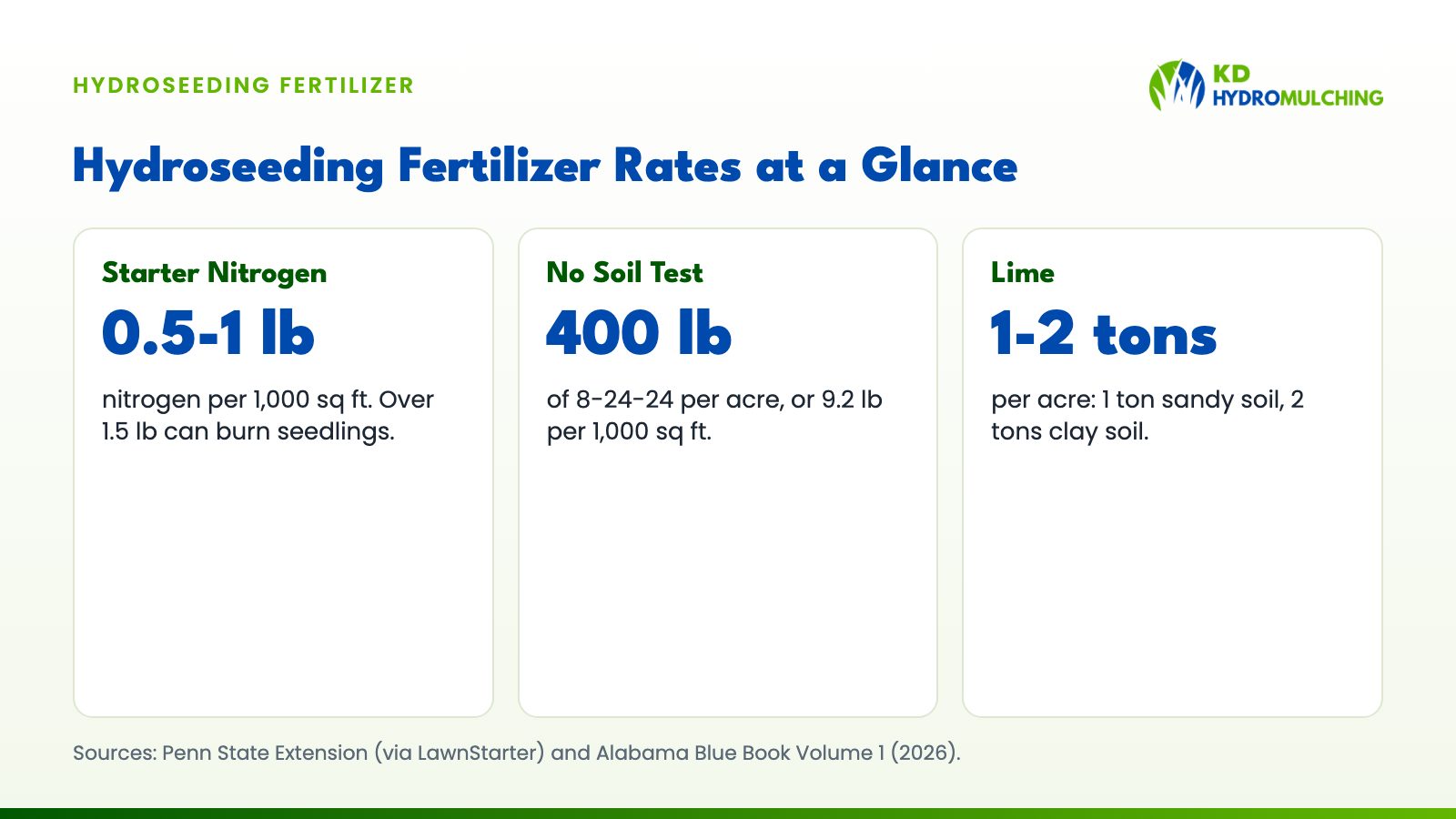
The graphic above summarizes the rates in the table. Lime rates sit in the table because lime and soil testing decide how well the fertilizer works. Testing comes next.
Should You Test Your Soil Before Hydroseeding?
You should test your soil before hydroseeding, because a soil test tells you which nutrients are missing. Auburn soil tests cost $10 per sample, and results arrive 1 to 2 days after the lab receives it. The Alabama Cooperative Extension System lists both numbers. Penn State adds that a starter product does not replace the phosphate and potash a test recommends. Sampling steps come next.
- Collect 15 to 20 soil cores in a zig-zag pattern across the lawn.
- Sample to the depth the soil was tilled for a new lawn.
- Mix the cores in a clean bucket and send one composite sample.
- Take separate samples from the front and back lawn.
- Follow the lime and fertilizer recommendations on the report.
Our soil amendment prep work follows those reports, because amendments go into the top 6 inches before any slurry is sprayed. Lime is the first amendment to settle, as the next heading explains.
How Much Lime Does Hydroseeding Need?
Hydroseeding needs 1 ton of lime per acre on sandy soil and 2 tons on clay without a soil test. The Alabama Blue Book sets those rates and says to skip lime on alkaline soil. Two tons per acre equals 90 pounds per 1,000 square feet. Tall fescue on sandy soil also takes 2 tons.
The Blue Book targets a pH of 6.0 to 6.5, and tall fescue tolerates 5.5 to 6.5. Lime is abrasive, so crews spread it before the slurry. The next question covers what else belongs in the tank.
Should Fertilizer Go in the Hydroseed Slurry?
Fertilizer can go in the hydroseed slurry when it is water-soluble and the tank handles it. The Alabama Blue Book warns that fertilizer salts can damage seed mixed with an inoculant. An inoculant is a bacteria coating on legume seed. It also advises applying lime and fertilizer before hydroseeding on rough seedbeds.
Alabama guidance sets 500 gallons of water per acre for a seed and fertilizer load. On slopes too steep for equipment, the Blue Book allows fertilizer and lime through the hydroseeder. Timing after the spray is the next concern.
When Should You Fertilize After Hydroseeding?
You should fertilize after hydroseeding about 4 to 6 weeks later, once the starter dose runs out. The Google AI Overview says the initial dose lasts 4 to 5 weeks. Our care page says to feed after 4 to 5 weeks with a high-nitrogen blend such as 25-0-10. Other lawn services report 30 to 45 days, which fits the same window.
Our feeding schedule repeats that feeding every 6 to 8 weeks. The numbered steps below show the full order from soil test to second feeding.
- Test the soil and apply lime before seeding.
- Spread any needed phosphorus and potash, then mix amendments into the top 6 inches.
- Spray the slurry with a starter fertilizer on hydroseeding day.
- Water on schedule while seed sprouts in 5 to 14 days.
- Apply a high-nitrogen feeding 4 to 6 weeks later, after the first mowing.
- Repeat the feeding every 6 to 8 weeks.
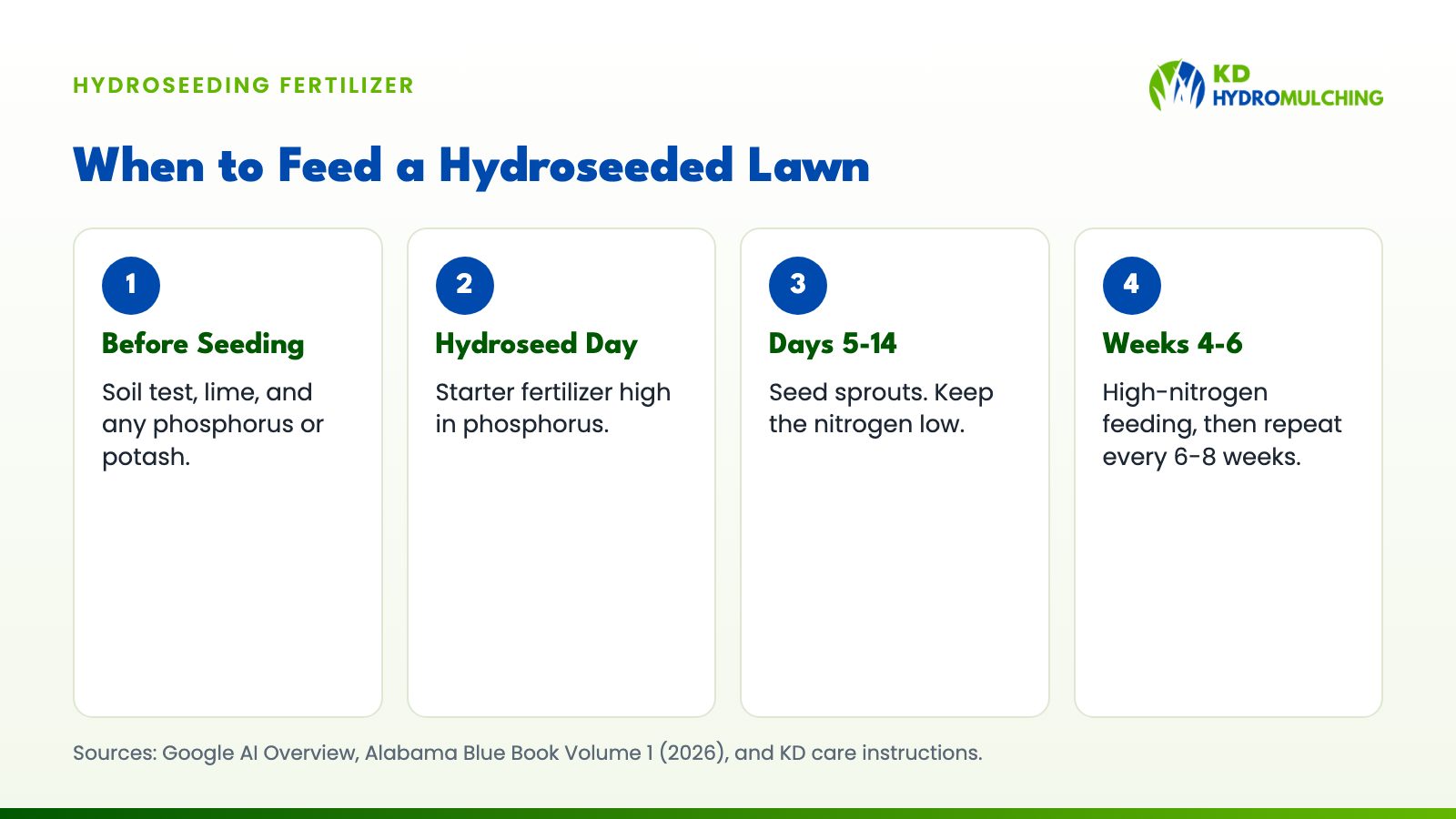
The timeline above shows when each product goes down. Seed sprouts in 5 to 14 days. The first mowing falls near week 4 to 6, at a height of 3 to 4 inches. Mowing timing links to the fertilizer window, so grass type matters next.
What Fertilizer Schedule Fits Tall Fescue After Hydroseeding?
Tall fescue after hydroseeding needs 1 pound of nitrogen per 1,000 square feet each month in late September, October, and November. The Alabama Cooperative Extension System puts the yearly total at 2 to 4 pounds, with most applied in fall. The extension also says to apply starter fertilizer as close to planting as possible. Warm-season grass follows a different plan.
Does Centipedegrass Need Less Fertilizer?
Centipedegrass needs less fertilizer than other turfgrasses. The Alabama Cooperative Extension System links excess nitrogen to centipedegrass decline and higher pest pressure. Tall fescue calls for the fall plan above, so the warm-season lawn gets lighter feeding. Planting windows differ for each species, and seed timing follows the season.
Can Too Much Fertilizer Hurt Hydroseed?
Too much fertilizer can hurt hydroseed by burning seedlings when nitrogen tops 1.5 pounds per 1,000 square feet. The Google AI Overview adds that heavy nitrogen at the start can promote weeds. Keep the first load high in phosphorus and low in nitrogen. The next heading gathers the shorter questions.
What Else Should You Know About Hydroseeding Fertilizer?
Hydroseeding fertilizer decisions also involve cost, preparation, and slopes. Each question below gets a short answer, and the full posts cover the details.
Does Fertilizer Change the Cost of Hydroseeding?
Fertilizer is one line inside the slurry price, not a separate bill on most estimates. Cost guides quote $0.07 to $0.25 per square foot for the whole job. Our slurry price breakdown shows how that range splits.
Does Fertilizer Matter on Steep Slopes?
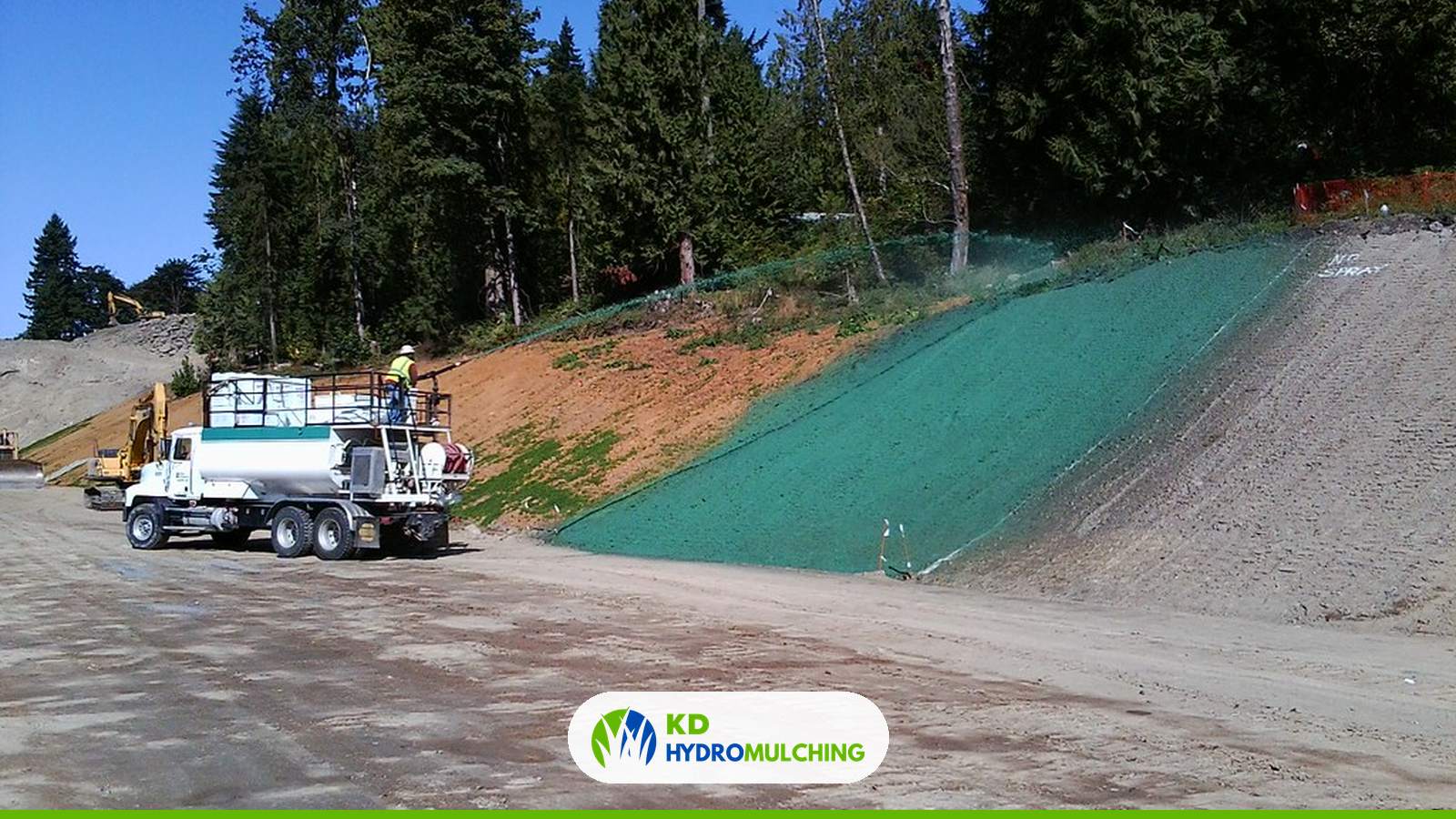
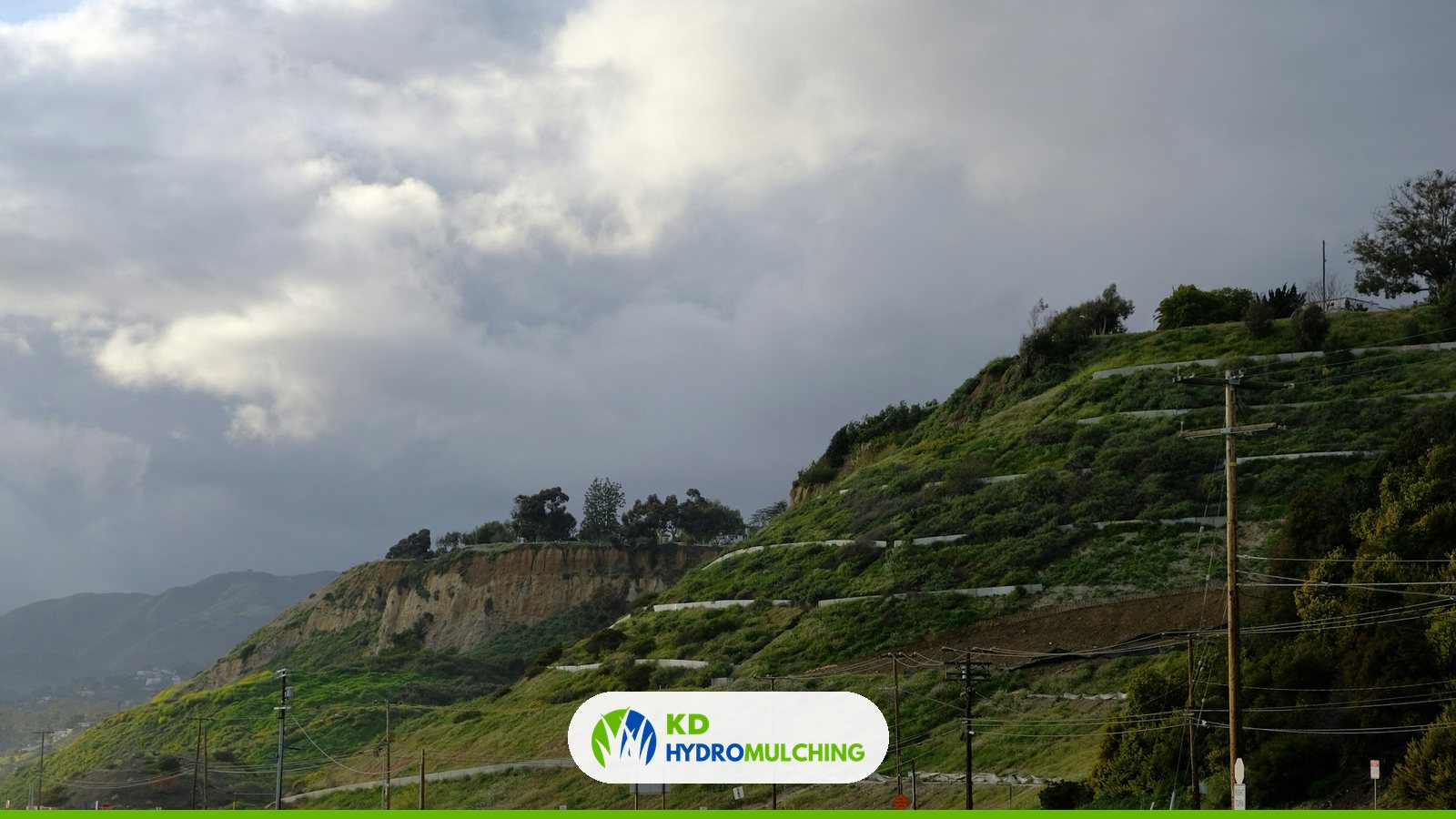
Fertilizer matters on steep slopes because bare soil needs nutrients and a tackifier to hold seed in place. A tackifier is a sticky binder that glues mulch to the soil. Slope work is part of our steep slope protection service.
Slope seeding fails when rain washes seed downhill before roots form. A binder holds the mulch in place until grass grows over the bank, and soil erosion control mats add a second layer of protection on slopes.
Is Hydroseeding Worth the Fertilizer Spend?
Hydroseeding is worth it on larger lawns, and starter fertilizer is a small share of the price. The value of hydroseeding shows up against dry seed and sod.
Fertilizer Questions Homeowners Ask
Is 10-10-10 Good Starter Fertilizer?
Yes, 10-10-10 works as a starter fertilizer. Lawn Love lists it as the common starter ratio. Higher-phosphorus blends such as 18-24-12 give seedlings more root fuel.
Is 18-24-12 a Good Starter Fertilizer?
Yes, 18-24-12 is a good starter fertilizer because it carries 24 percent phosphorus. The Google AI Overview lists it among granular starters. Keep the nitrogen under 1 pound per 1,000 square feet.
Should You Apply Starter Fertilizer Before or After Seeding?
Apply starter fertilizer before or right at seeding. Alabama guidance mixes lime and fertilizer into the top 6 inches before hydroseeding. Water-soluble starter can also ride in the slurry.
What Type of Fertilizer Is Best for Seeding Grass Seed?
The Google AI Overview names a high-phosphorus starter such as 12-18-8, 20-27-5, or 15-20-10 for seeding grass seed. Phosphorus fuels roots, and lower nitrogen prevents burning tender sprouts.
How Does KD Hydromulching Help With Hydroseeding Fertilizer?
KD Hydromulching installs hydroseeding with fertilizer matched to your soil and grass before the slurry goes on. We handle site preparation, soil conditioning, and hydroseeding, then share care instructions to follow. Our fertilized hydroseed jobs cover lawns, banks, and bare lots across North Alabama. Soil conditioning and seeding happen under one crew, so the fertilizer plan stays consistent.
A new lawn also needs reliable water, so our team installs and repairs sprinkler systems for new lawn irrigation. That watering plan protects the fertilizer you pay for during the first weeks of growth, when seedlings dry out fast.
Every fertilizer plan estimate starts with a walk of the site, the soil, and the grass type before any product goes into the tank. Call (256) 973-8445 to schedule a site walk in Huntsville or North Alabama.