In this article10 sections
- How to Prepare for Hydroseeding in 8 Steps
- How to Clear the Site Before Hydroseeding
- How to Grade the Yard for Hydroseeding
- How to Test Soil Before Hydroseeding
- How to Loosen Compacted Soil Before Hydroseeding
- How to Get Irrigation Ready for Hydroseeding
- When Should You Prepare for Hydroseeding?
- What to Do the Day Before Hydroseeding
- What Else Should You Know About Hydroseeding Preparation?
- How Does KD Hydromulching Help You Prepare for Hydroseeding?
How to prepare for hydroseeding comes down to eight jobs. Kill weeds 7 to 15 days ahead, clear debris and rocks, and grade away from the house. Loosen the top 3 to 6 inches of soil next. A soil test, 4 inches of topsoil where subsoil shows, and tested sprinklers finish the prep. Seed then sprouts in 5 to 14 days on firm, clean soil, and the lawn fills in from there.
Key Takeaways
- Preparation takes 8 steps: test soil, kill weeds, clear debris, grade, loosen, add topsoil, check sprinklers, and mark the spray area.
- Weed killer needs 7 to 15 days to work, so spraying comes first.
- A soil test costs $10 per sample at Auburn and sets the lime and pH plan.
- The finished seedbed is firm enough that footprints sink only 1 to 2 inches.
- The day before application, crews need clear access, flagged edges, and tested sprinkler zones.
How to Prepare for Hydroseeding in 8 Steps
Prepare for hydroseeding by working through eight steps in order. Test the soil, kill weeds, clear debris, grade, loosen the ground, add topsoil, check sprinklers, and mark the spray area. Slurry is the wet mix of seed, mulch, and fertilizer that the crew sprays onto that seedbed.
Crews spray slurry on hydroseeding day, and the homeowner checklist below readies the lawn for it. Order matters, because grading before weeds die repeats the work.
- Test the soil for pH and nutrients, and add lime months ahead.
- Kill weeds with a nonselective herbicide 7 to 15 days before tilling.
- Clear debris, roots, and rocks bigger than an egg.
- Grade the surface so water drains away from the house.
- Loosen the top 3 to 6 inches of compacted soil.
- Spread 4 inches of topsoil where subsoil, clay, or rock shows.
- Test every sprinkler zone and fix dry spots.
- Rake the surface smooth, firm it, and flag the spray area.
Weed control comes first on that checklist, so the next section covers clearing the site.
How to Clear the Site Before Hydroseeding
Clear the site before hydroseeding by killing live weeds first and then removing debris, roots, and rocks bigger than an egg. Green Gro Hydroseeding asks for at least 2 to 3 inches of loose soil on the surface. Bare soil lets the slurry touch the ground directly, which gives seed the contact it needs.
How to Kill Weeds Before Hydroseeding
Kill weeds with a nonselective herbicide 7 to 15 days before tilling, because glyphosate takes that long to work. Alabama Extension names glyphosate for this job and warns against combination products with residual control. Residual chemicals can stay in the soil and hold back new seed.
Tilling live weeds into the soil leaves roots in place, and those roots regrow faster than sprayed ones. Wait times differ by product, so the label sets the final date. Once the weeds are dead, the debris comes out next.
How to Remove Debris, Rocks, and Roots
Remove debris, roots, old sod chunks, and rocks bigger than an egg with a garden rake, a power rake, or by hand. Construction scraps, concrete bits, and buried lumber also come out. The Alabama Blue Book calls for soil free of large roots, branches, stones, and clods.
The same handbook lets clods and stones stay on slopes steeper than 3:1 when the slope will be hydroseeded. Flat lawns need a cleaner surface than slopes do. A cleared surface is ready for grading.
How to Grade the Yard for Hydroseeding
Slope the ground at least 0.5 inch per foot across the first 10 feet out from the foundation. The US Department of Energy sets that slope for homes. Low spots hold water, and standing water rots new seed.
Our yard grading work includes rough grading, finish grading, and compaction fixes before seeding. Ruts and ridges also cause trouble at spray time. Bella Terra calls the effect shadowing, because the far side of a rut misses slurry and comes in patchy.
Should the Seedbed Be Smooth or Rough?
Rake a flat lawn smooth, and leave a steep slope rough. The Alabama Blue Book says a rugged seedbed gives hydroseed a firm hold on slopes, because the bumps trap seed and mulch. Lawns need an even surface for mowing and even coverage.
The grading steps for cleared land show how rough and finish grades fit together. Smooth or rough, the soil still needs the right firmness.
How Firm Should the Soil Be Before Hydroseeding?
Firm the soil until footprints sink no more than 1 to 2 inches. Bella Terra rolls loose, fluffy soil with a lawn roller to reach that firmness. The Blue Book adds that light compaction helps seedlings, while excessive compaction blocks germination and roots.
How to Test Soil Before Hydroseeding
Test soil before hydroseeding by sending a mixed sample of 15 to 20 cores to a lab for pH and nutrient results. Auburn University's soil lab charges $10 per sample for routine analysis. Alabama Extension says the lab sends results 1 to 2 days after it receives the sample. That result shows how to prepare soil for hydroseeding, from lime to compost.
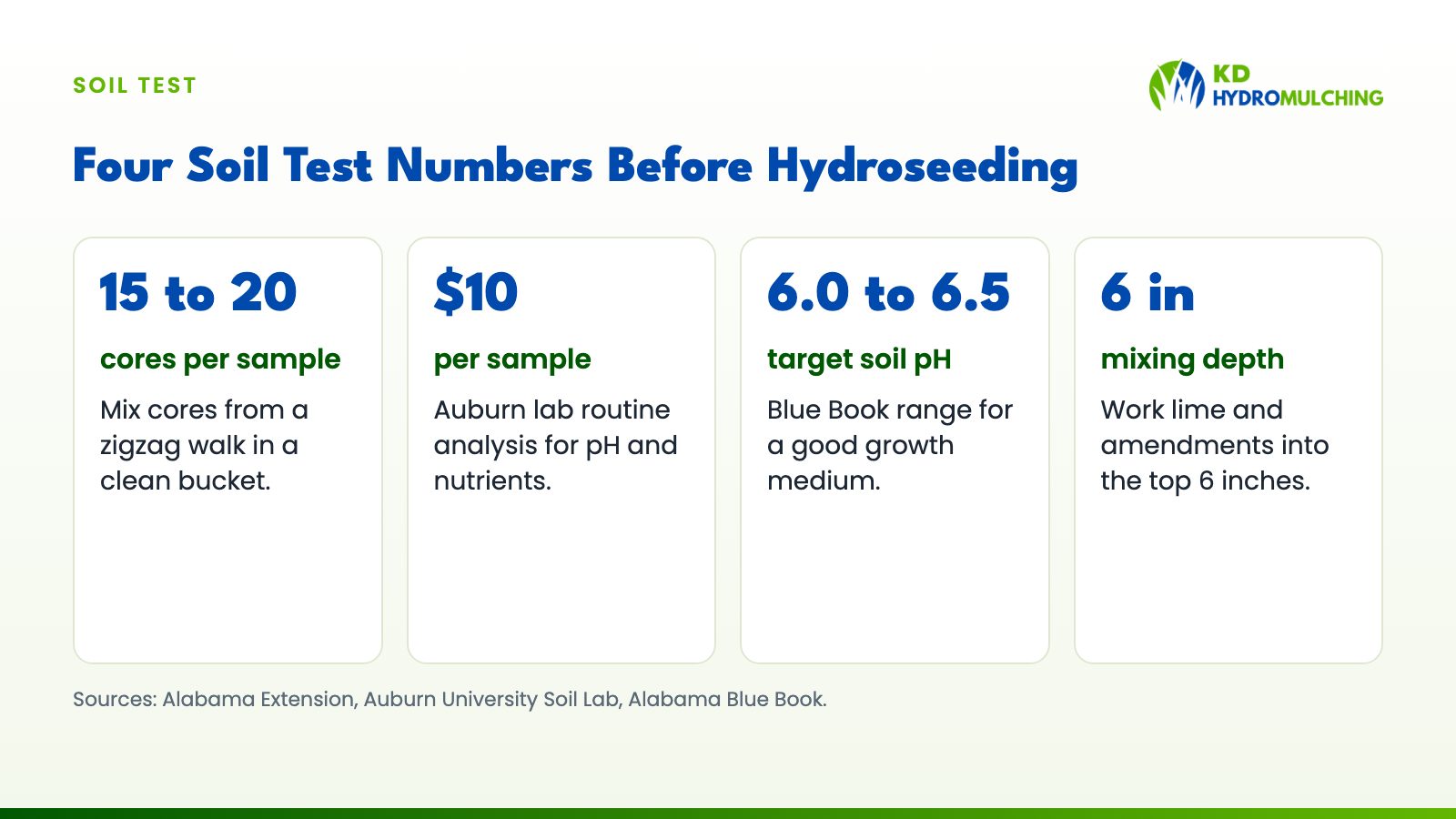
The graphic above shows the four soil test numbers used in this section. Sampling comes first.
How to Take a Soil Sample
Take a soil sample by pulling 15 to 20 cores in a zigzag pattern and mixing them in a clean bucket. Alabama Extension says new lawns should be sampled to the depth the soil was tilled. Front and back yards get separate samples when the soil differs.
Sample before any amendments go down, because the result sets what to add. Samples from disturbed sites represent a 6 inch profile in the Blue Book. The lab report then points to the right pH target.
What Is the Target Soil Acidity for Hydroseeding?
Soil pH for hydroseeding should fall between 6.0 and 6.5 on Alabama sites. The Alabama Blue Book gives that range for a good growth medium. Each grass type tolerates a slightly different range, as the table shows.
Soil pH Targets for Hydroseeded Grass in Alabama
Grass or Standard | pH Range | Source |
|---|---|---|
General growth medium | 6.0 to 6.5 | Alabama Blue Book |
Tall fescue | 5.5 to 6.5 | Alabama Extension |
Centipedegrass (performs well) | 6.0 to 6.5 | Alabama Extension |
Centipedegrass (tolerates) | 5.0 to 6.0 | Alabama Extension |
Soil below pH 5.0 counts as strongly acid in Auburn's rating, and the report recommends lime for it. Lime is the next topic.
How to Add Lime and Amendments Before Hydroseeding
Add lime and amendments before the slurry goes on, and mix them into the top 6 inches of soil. The Alabama Blue Book warns that lime and fertilizer in the tank can damage seed during mixing. The same handbook says disturbed Alabama sites need lime, except alkaline soils.
Test results set the rate. Without a test, the Blue Book uses 1 ton per acre on sandy soil and 2 tons on clayey soil. Alabama Extension advises sampling a few months ahead of planting so lime has time to work.
Compost adds organic matter where a test reads below about 3%. Fairway names that level for stripped construction soil, and Bella Terra suggests a 1 to 2 inch layer. Topsoil is the other amendment, covered next.
How Much Topsoil Does Hydroseeding Need?
Hydroseeding needs a compacted topsoil layer at least 4 inches deep where subsoil, clay, or rock shows. The Alabama Blue Book sets 4 inches as the minimum and asks crews to disk the subsoil 2 inches first. Topsoil bonds better to loosened subsoil than to a hard surface.
Topsoil Volume by Depth
Depth | Cubic Yards per 1,000 Sq Ft | Cubic Yards per Acre |
|---|---|---|
2 inches | 6.2 | 268 |
3 inches | 9.3 | 403 |
4 inches | 12.4 | 537 |
6 inches | 18.6 | 806 |
The table comes from Alabama Blue Book Table TSG-1, and 4 inches is the minimum row. Topsoil should not be spread when the ground is frozen or muddy. Loosening the native soil is the next step.
How to Loosen Compacted Soil Before Hydroseeding
Loosen compacted soil by tilling or power raking the top 3 to 6 inches with a rototiller or tractor attachment. Loose soil lets roots push down quickly. Tilling deeper than 4 to 6 inches brings buried weed seeds to the surface, so depth has a limit.
Our crews handle compacted soil fixes with tractor tillers on larger lots. Green Gro Hydroseeding reports that tillers loosen 3 to 7 inches, while harrows and drags loosen only 1 to 2 inches. Vortec Global sets about the same depth in its ground preparation for hydroseeding steps. Rocky soil needs care, since tilling lifts rocks to the surface.
How to Check for Compaction
Check for compaction by walking or driving across the soil and looking at the marks. Bella Terra says soil that holds a truck without a mark needs working up. The Alabama Blue Book wants a hardpan, a dense layer, 12 inches or deeper below the surface.
A shallower hardpan calls for chiseling or topsoil. Fixed soil still needs water, so irrigation is next.
How to Get Irrigation Ready for Hydroseeding
Get irrigation ready for hydroseeding by installing, repairing, and testing every sprinkler zone before the crew arrives. Each zone should cover its corner without dry spots, puddles, or overspray onto pavement. A working system keeps new seed moist after the slurry sets.
Run rotor zones about 8 to 10 minutes and spray zones about 3 to 5 minutes during the test. Broken heads and clogged nozzles show up fast under that run. Our irrigation repair crews fix heads, valves, and leaks before seeding.
New systems need an underground utility check first. Alabama 811 takes locate requests for free, with 2 to 10 full working days of notice. Zone planning for a new sprinkler system layout comes after that check, and homeowners without a system can set hose sprinklers for the first weeks.
When Should You Prepare for Hydroseeding?
Prepare for hydroseeding at least 15 days before the slurry date, because weed kill alone takes 7 to 15 days. Soil testing and lime start earlier, and Alabama Extension suggests a few months ahead for tall fescue. Tilling, topsoil, and grading follow once weeds die. Plan how to prepare for hydroseeding around that weed kill window.
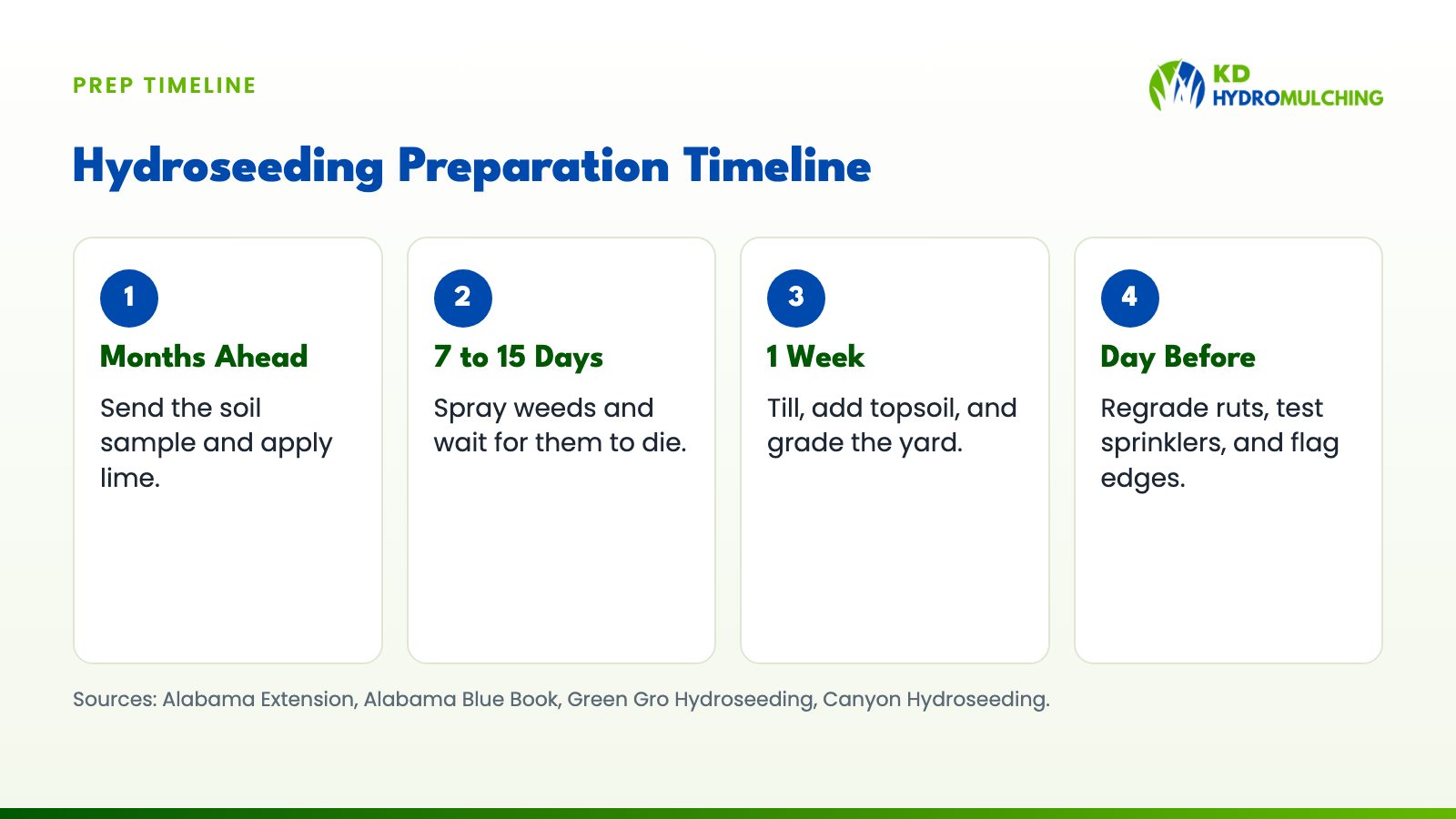
The timeline above puts each task on a calendar. Seeding windows then set the slurry date.
- Months ahead: send the soil sample and apply lime.
- 7 to 15 days ahead: spray weeds.
- 1 week ahead: till, add topsoil, and grade.
- 1 to 2 days ahead: regrade ruts and firm the surface.
The Blue Book sets Sep 1 to Nov 1 for tall fescue and Apr 1 to Jul 1 for bermudagrass. Those dates set the grass seeding windows for Alabama lawns.
What to Do the Day Before Hydroseeding
Walk the site the day before hydroseeding to regrade ruts, test sprinklers, and flag the spray area. Clear access for the hose too. Canyon Hydroseeding asks for a regrade 1 to 2 days before application. A last check catches problems while fixes are still cheap.
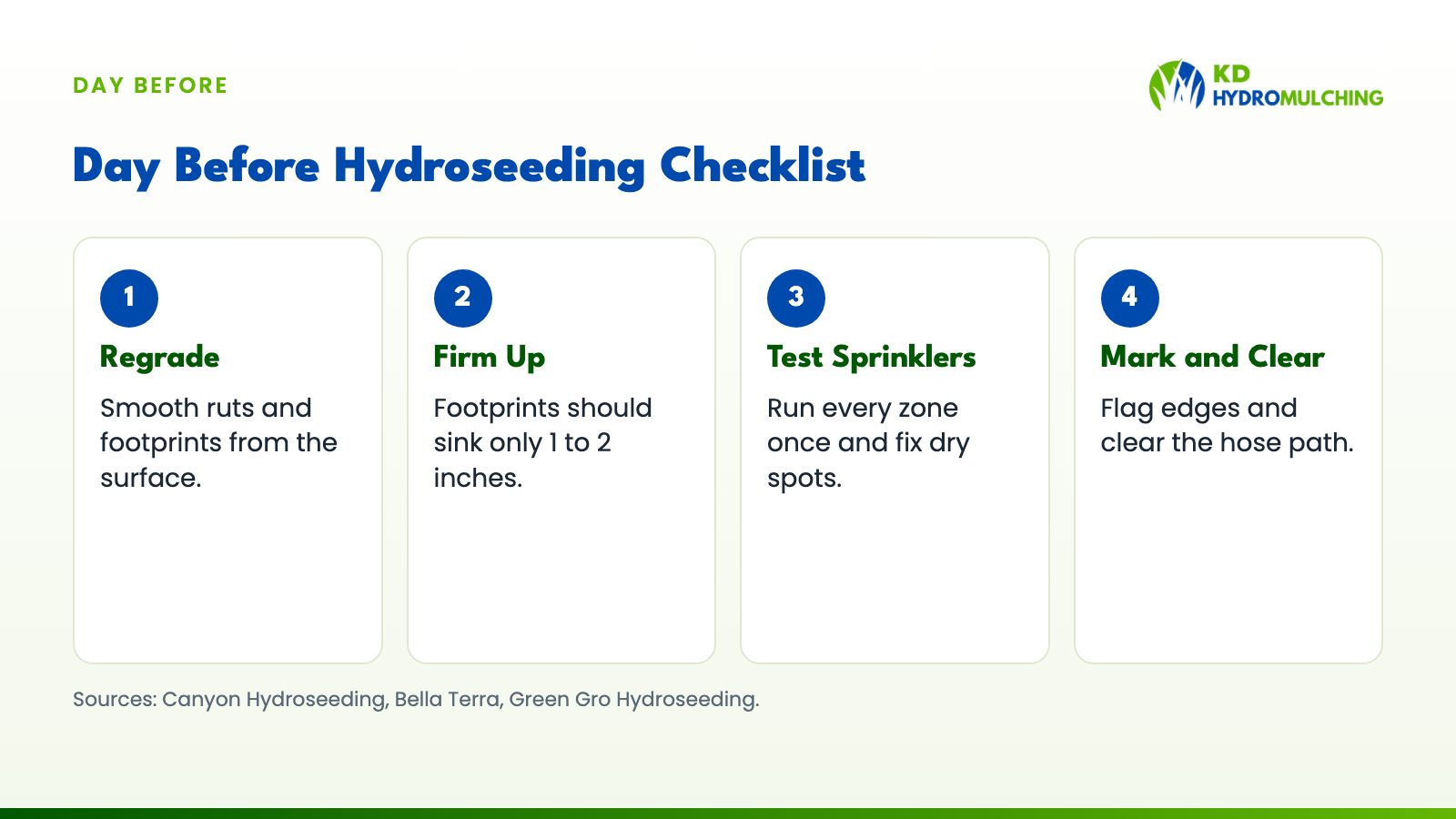
The checklist above has four panels, and the list below adds the finer points.
- Regrade ruts and footprints so the surface is smooth.
- Wet very dry, fluffy soil lightly so it holds firm.
- Run every sprinkler zone once.
- Mark edges with flags, stakes, or spray paint when nobody will be on site.
- Move cars, toys, and furniture out of the hose path.
- Check the forecast, because slurry needs dry hours to set.
Flags give a hydroseed crew crisp edges, and a clear path lets the hose reach every corner. Setup time on the day then stays short.
What Else Should You Know About Hydroseeding Preparation?
Do You Water Hydroseed the First Day?
No, do not water hydroseed on the first day. The mulch needs 2 to 7 hours or until the next day to set. Watering too early can wash seed and mulch downhill. Watering starts on day 2.
Will Heavy Rain Wash Away Hydroseed?
Yes, heavy rain right after application can wash hydroseed off a slope before the mulch sets. Bonded fiber matrix, a stronger mulch, needs 24 to 48 hours without significant rain. Slopes can also use temporary erosion control under the slurry.
Will Hydroseed Grow in Sandy Soil?
Yes, hydroseed grows in sandy soil when compost adds organic matter and the watering plan stays steady. Compost goes on 1 to 2 inches deep in Bella Terra's guidance. Sandy soil also needs less lime, at 1 ton per acre in the Blue Book.
How Many Gallons of Water Does It Take to Hydroseed 1 Acre?
Hydroseeding 1 acre takes 3,000 to 6,000 gallons of water, depending on slurry thickness. The Alabama Soil and Water Conservation Committee lists 4,000 gallons for hydromulch and 500 gallons for seed and fertilizer. The same acreage also sets the per-acre hydroseeding cost.
What Is the Best Month to Hydroseed in Alabama?
Cool-season grass does well when seeded in fall, and warm-season grass does well in late spring. Alabama seeding windows are Sep 1 to Nov 1 for tall fescue and Apr 1 to Jul 1 for bermudagrass. Soil temperature makes the final call.
What Should You Do After Hydroseeding?
After hydroseeding, water 2 to 4 times a day for the first 3 to 4 weeks and stay off the grass. Mowing starts at 4 to 6 weeks. The post-seeding care schedule starts with those daily waterings.
How Does KD Hydromulching Help You Prepare for Hydroseeding?
KD Hydromulching helps homeowners prepare for hydroseeding with debris clearing, rough and finish grading, soil conditioning, compaction fixes, and sprinkler repair. The same crew then applies the slurry, so the seedbed and the seeding match. Tasks that homeowners skip can go on our work list.
Every hydroseeding prep estimate starts with a walkthrough and a written task sheet, since slope, soil type, and lot size decide the work. We outline the prep steps from the lot size and the soil problems.
To get the prep steps written for your lot in Huntsville or North Alabama, call (256) 973-8445.