Lawn Sprinkler System Installation
Lawn sprinkler system installation means planning zones, trenching, laying pipe, and connecting valves and heads. Most yards take 8 to 16 hours and need 30 to 35 psi and 10 to 13 gallons per minute.
Lawn sprinkler system installation is the process of planning zones, trenching, laying pipe, and connecting valves, heads, and a controller. Most yards take 8 to 16 hours of crew work. The design needs 30 to 35 psi of pressure and 10 to 13 gallons per minute of flow. Crews call 811 first, then dig trenches, set a backflow preventer, place heads, and test coverage.
Key Takeaways
- Lawn sprinkler system installation takes 8 to 16 hours and runs through eight steps, from utility marking to a coverage test.
- A system needs at least 30 to 35 psi and about 10 to 13 gallons per minute.
- A quarter-acre yard needs 4 to 7 zones, according to Lawn Love.
- Alabama 811 marks buried lines for free and asks for 2 to 10 full working days of notice.
- Install the system after grading and before seed, sod, or hydroseed goes down.
- A weather-based controller saves nearly 7,600 gallons of water a year, says EPA WaterSense.
How Does Lawn Sprinkler System Installation Work?
Lawn sprinkler system installation works as a fixed sequence from design to testing. A crew maps the lawn, measures water pressure, and splits the yard into zones. Trenches, pipe, valves, and heads follow in that order. A final test confirms that every zone covers its area.
Our crews handle this work through our lawn sprinkler installation service, which also covers repairs. Each job starts with a layout drawing and ends with a coverage test. The graphic below shows the four phases in order.
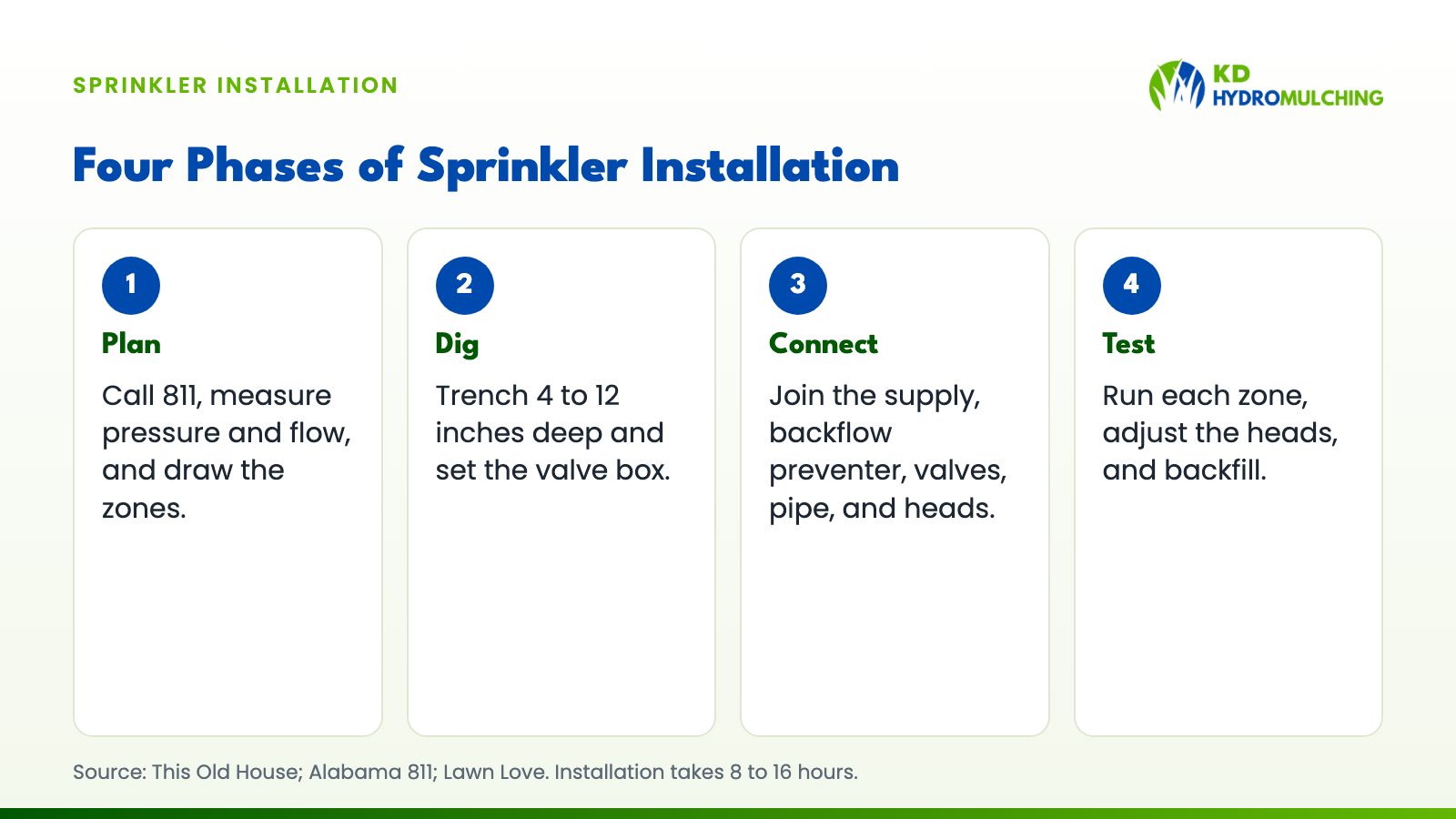
The graphic groups the work into plan, dig, connect, and test. The next section splits those phases into eight numbered steps.
What Are the Steps in In Ground Sprinkler System Installation?
In ground sprinkler system installation follows eight steps from utility marking to the final test. Sequence matters here because trenching, piping, and testing each rely on the prior stage. Crews and homeowners can use this list as a checklist.
- Call 811 and wait for the utility markings.
- Measure water pressure and flow at the supply.
- Draw the zones and mark each head location.
- Dig the trenches and set the valve box.
- Connect the water supply, backflow preventer, and zone valves.
- Lay the pipe, flush it, and attach the heads.
- Wire the valves to the controller.
- Test each zone, adjust the heads, and backfill the trenches.
Step 1 comes first because digging without markings risks a utility strike. Steps 4 through 6 involve the trenching and pipe work, which leads to the question of time.
How Long Does a New Sprinkler System Installation Take?
A new sprinkler system installation takes 8 to 16 hours for an automatic system. Lawn Love gives that range. Larger yards, rocky soil, and extra zones add hours. Utility marking adds a waiting period of at least 2 full working days before digging starts. Trench depth is the next detail to settle.
How Deep Should You Bury a Sprinkler System?
Bury a sprinkler system in trenches 4 to 12 inches deep, with the valve box set deeper. This Old House gives that range, and the right depth depends on the local climate. The valve box needs a hole about 18 inches deep with 2 inches of gravel at the bottom. Depth only helps when the layout is sound, so design comes next.
Can You Install a Sprinkler System Yourself?
Yes, a homeowner can install a basic sprinkler system in a weekend with rented tools. Lawncare Center says a basic system suits that timeline. Trenching, tying into the main line, and backflow rules raise the difficulty. This Old House suggests a licensed plumber for the main line connection. Lawn Love notes that a professional crew also obtains the permits. Design choices come first, and the next section covers them.
How Do You Design a Lawn Sprinkler System Layout?
Design a lawn sprinkler system layout by drawing the yard to scale. Divide the lawn into zones of about 1,200 square feet. wikiHow gives that zone size. Each zone gets one valve and one head type. Spray heads and rotor heads put out water at different rates, so Lawncare Center says never to mix them. Water supply then limits how large each zone can be.
How Much Water Pressure and Flow Does a Sprinkler System Need?
A sprinkler system needs 30 to 35 pounds of pressure (psi) and about 10 to 13 gallons a minute. This Old House gives both figures. Low flow forces fewer heads on each zone. Lawncare Center reports household supply of 40 to 80 psi, while heads work at 30 to 50 psi. A pressure regulator closes that gap.
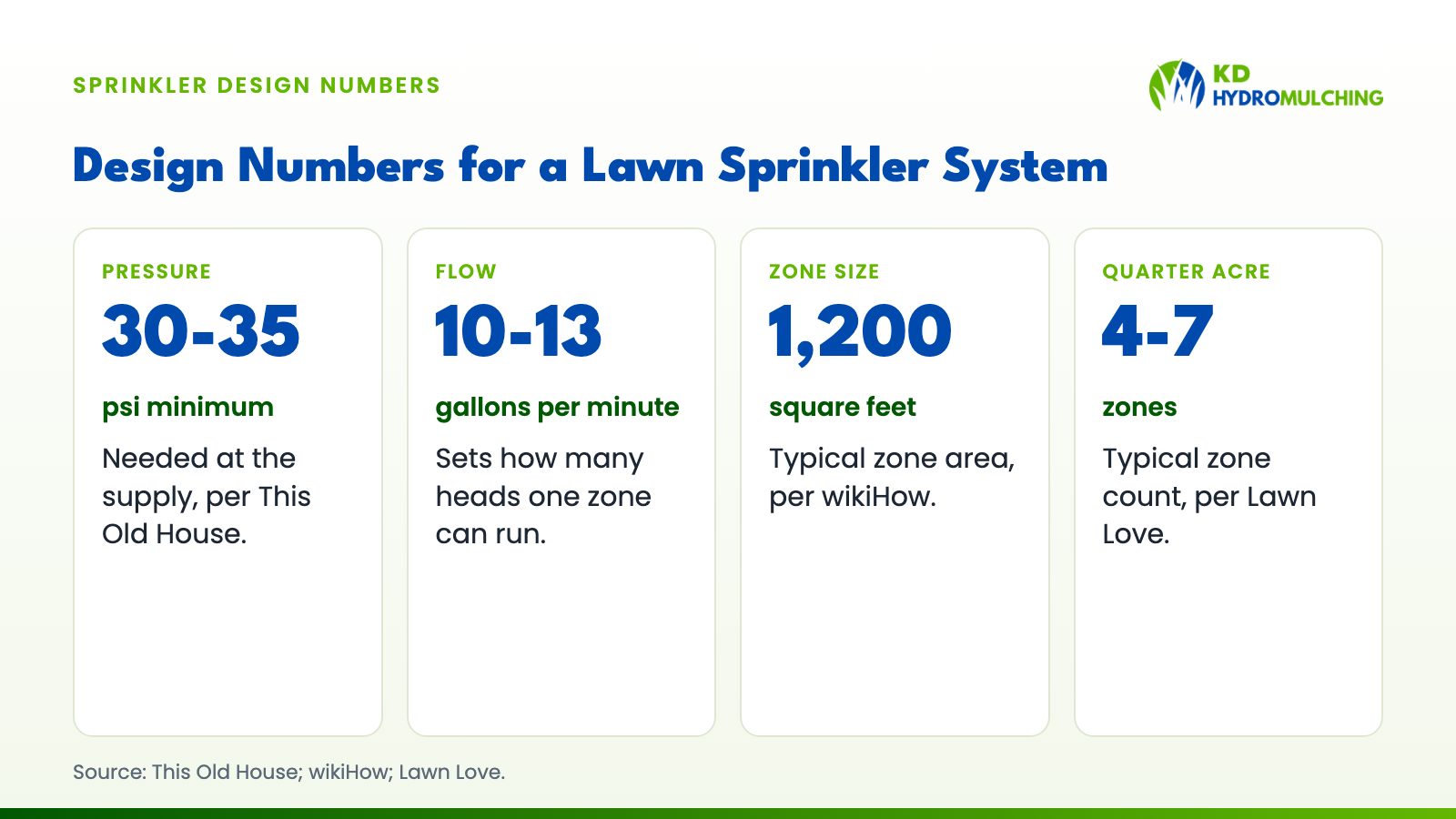
Flow is easy to measure. Fill a 5-gallon bucket from the hose bib and time it. The graphic below lists the design numbers used in this section.
How Many Zones Does a Yard Need?
A quarter-acre yard needs 4 to 7 zones. Lawn Love gives that range, while Lawncare Center puts a residential lawn at 3 to 6 zones. Group areas by sun, soil, slope, and plant type, because each group dries at its own pace. Zone count also drives the head choice below.
Which Sprinkler Heads Suit a Lawn?
Rotor heads suit open lawns, while spray heads suit small and narrow areas. Lawncare Center lists the coverage of each type. The table below compares head types by radius, spacing, and use.
| Head type | Coverage radius | Spacing apart | Use |
|---|---|---|---|
| Fixed spray | 8 to 15 feet | 8 to 12 feet | Small lawns, beds, and irregular shapes |
| Rotor (gear-driven) | 15 to 30 feet | 15 to 20 feet | Open lawn areas |
| Drip tubing | At the root zone | Rows 12 inches apart | Flower beds, shrubs, and trees |
Head-to-head coverage means each head sprays to the next head, with an overlap of 10 to 15 percent, says Lawncare Center. Gaps wider than the spray radius leave dry strips. Tight spacing closes those strips between heads. The parts list below shows what connects to those heads.
What Parts Go Into a Home Sprinkler System Installation?
A home sprinkler system installation uses six main parts, from the backflow preventer to the controller. Each part has one job and one setting that affects the rest of the system. The table below lists them in the order water reaches them.
| Part | Job | Detail |
|---|---|---|
| Backflow preventer | Stops contaminated water from entering the drinking supply | A pressure vacuum breaker sits 12 inches above the highest head |
| Zone valves | Open one zone at a time | Set in a valve box with the lid flush with the grass |
| PVC pipe | Carries water from the main line to the heads | 1-inch schedule 40 PVC runs from the main line to the manifold |
| Sprinkler heads | Spread water across the lawn | Matched by type within each zone |
| Control wire | Links each valve to the controller | 24-volt underground wire runs in a shallow trench |
| Controller | Runs each zone on a schedule | A weather-based model saves nearly 7,600 gallons a year |
The controller matters because a weather-based model cuts waste. The backflow preventer also brings local rules, which the next section covers.
Do You Need a Permit or Backflow Preventer for a Sprinkler System?
Yes, a sprinkler system needs a backflow preventer, and local rules decide whether a permit applies. Permits cost $42 to $200, according to Lawn Love. ADEM, the Alabama Department of Environmental Management, requires a backflow device on every new water service connection. Find Backflow Testers cites Chapter 335-7-9 for this rule. Contact the local water utility before work begins.
What Does a Backflow Preventer Do?
A backflow preventer stops contaminated water from flowing back into the drinking water supply. Colorado State Extension names fertilizers and pesticides as contaminants that can enter through sprinkler heads after a pressure drop. Homes use pressure vacuum breakers or reduced pressure devices, per the same source. Find Backflow Testers reports that Alabama utilities generally require an annual test, at $50 to $250 per assembly.
Do You Need to Call 811 Before Digging?
Yes, call 811 before digging, because Alabama 811 marks buried lines for free. The request needs 2 to 10 full working days of notice. Digging waits until at least 2 full working days have passed. The tolerance zone reaches 18 inches on each side of a marked line, and hand digging applies inside it. Marked lines also affect when a new lawn goes in.
When Should You Install a Sprinkler System for a New Lawn?
Install a sprinkler system for a new lawn after grading and before seed, sod, or hydroseed goes down. Heads must match the final soil level, and our finish grading work sets that level. Trenching then happens while the soil is bare, which keeps turf intact. Main Street Sod says that adding irrigation afterward can mean cutting through new sod.
Drainage fixes also come before trenching, since low spots hold water. Our guide covers yard drainage costs.
New lawn sprinkler system installation also lets the crew test coverage before the turf relies on the water. A tested system shows dry spots while the soil is open. We coordinate sprinkler work with a hydroseeded lawn when both fall on the same job. The graphic below shows the order.
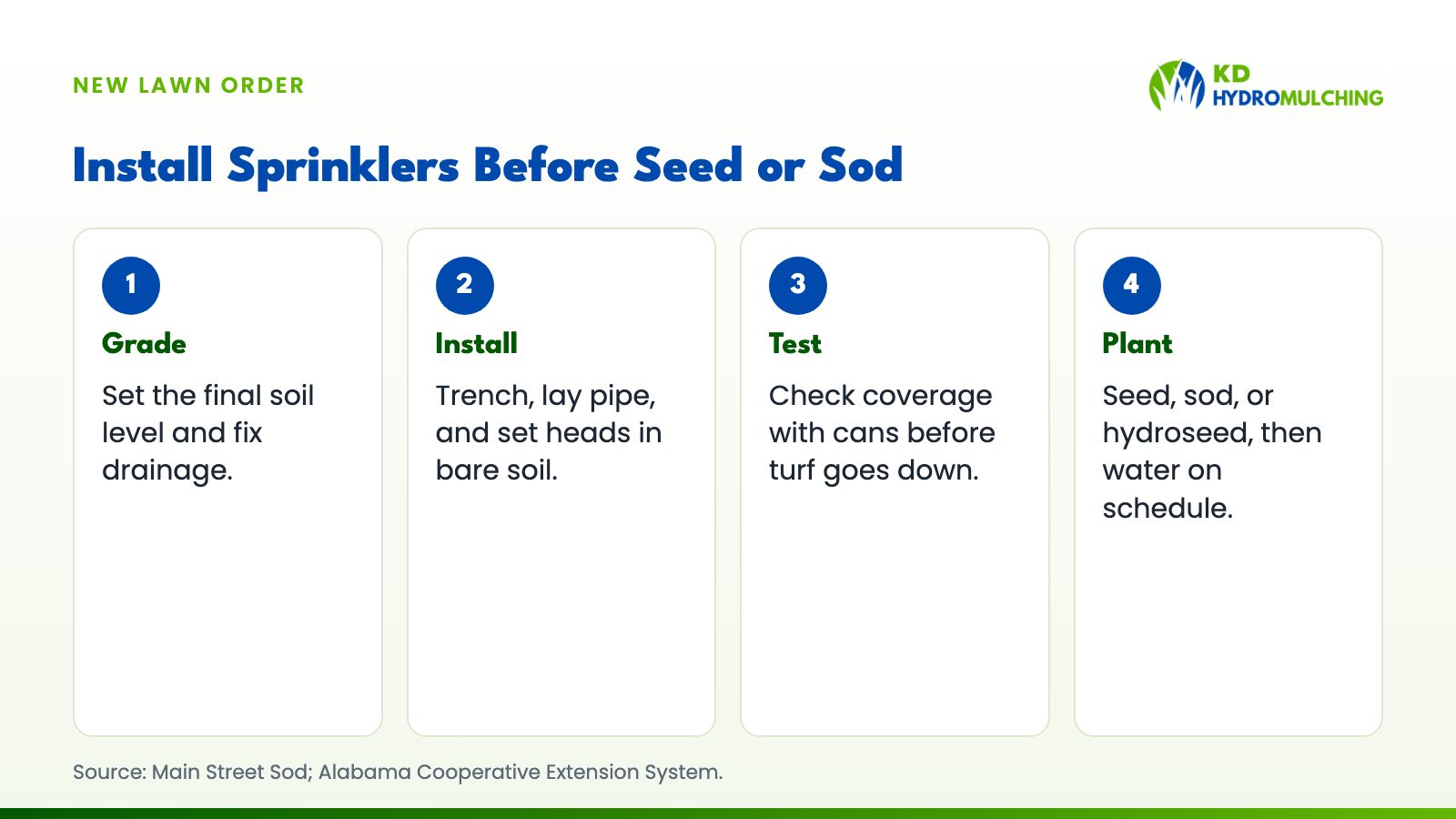
Installing first brings three benefits, based on Main Street Sod:
- Trenches go into bare soil, so no turf is cut or lifted.
- Heads are set to the final grade.
- Coverage is tested before new grass depends on it.
Once the grass is down, our watering instructions cover the first weeks. Extra questions about water use and upkeep come next.
What Else Should You Know About Sprinkler System Installation?
How Much Does Sprinkler System Installation Cost?
Yard sprinkler system installation costs $0.88 to $1.65 a square foot. Lawn Love gives that range. A quarter-acre lawn runs $2,400 to $4,200, says Inch Calculator. New lawn projects add seeding costs, which our guide on hydroseeding prices explains.
How Much Water Should a Sprinkler System Apply?
Turfgrass needs 1 to 1.5 inches of water a week. The Alabama Cooperative Extension System gives that rate. The water can go on in one pass or in two passes of about 3/4 inch. Clemson HGIC adds that watering should soak the root zone 8 to 10 inches deep, ideally between 2 am and 10 am.
How Do You Test Sprinkler Coverage?
Test sprinkler coverage by setting shallow cans around the lawn and running each zone. Alabama Extension names empty tuna or chicken cans for this job. Rain gauges in different areas show uneven zones, such as one zone at 1 inch and another at 1/2 inch.
Do Smart Controllers Save Water?
Yes, a weather-based smart controller saves an average home nearly 7,600 gallons a year. EPA WaterSense reports that figure for labeled models. Outdoor use takes nearly 9 of the 29 billion gallons households use daily. A smarter schedule trims that share.
Can Sprinklers Cause Runoff on a Slope?
Yes, sprinklers cause runoff when water arrives faster than soil absorbs it. Alabama Extension advises against watering to the point of runoff. Shorter cycles let water soak in before the next one starts. Steep ground raises the risk of slope erosion as well.
How Long Does a Sprinkler System Last?
A sprinkler system lasts up to 20 years with maintenance. Lawn Love gives that range. Repairs to leaking heads, broken pipe, and valves extend that life. Our sprinkler system repair work covers those fixes.
How Can We Help With Sprinkler System Installation and Repair?
We offer sprinkler system installation and repair for lawns across North Alabama. Our crews also handle grading, seeding, and hydroseeding, so the yard is ready for water. Each job follows the steps listed above. Our yard problems page shows the other issues we solve.
This sprinkler system installation guide ends with five sprinkler system installation tips:
- Call 811 before any digging.
- Measure pressure and flow before choosing heads.
- Keep one head type in each zone.
- Install the system before seed or sod.
- Test coverage with cans before backfilling.
Our team can walk the yard with you through a sprinkler consultation. We plan the zones, mark the heads, and schedule the work. Each visit covers pressure, flow, zones, and head choice.
Sprinkler work can also run alongside a new lawn, and the KD Hydromulching specialists coordinate both.