In this article7 sections
- What Is Drainage and Erosion Control?
- What Is Drainage Ditch Erosion Control?
- How Do Check Dams Slow Ditch Erosion?
- How Do You Stop a Drainage Ditch From Eroding?
- How Do You Maintain a Drainage Ditch?
- What Else Should You Know About Drainage and Erosion Control?
- How Can KD Hydromulching Help With Drainage and Erosion Control?
Drainage and erosion control moves runoff to a stable outlet and protects the soil along the way. Ditches under 3% slope hold up with thick grass and blankets. Slopes of 3% to 6% need turf reinforcement mats, and slopes over 10% need rock or concrete. Check dams, a protected outlet, and routine upkeep decide whether the channel stays stable for years.
Key Takeaways
- Drainage carries water away, and erosion control keeps the soil in place while the water moves.
- A ditch under 3% slope can use grass with blankets, and 3% to 6% slopes need turf reinforcement mats.
- Rock lining fits flow of 5 to 10 ft/sec or ditch slopes over 10%.
- A 2 ft check dam on a 3% ditch needs spacing of 67 ft.
- Inspect a ditch after every rain over 1/2 inch and repair damage right away.
What Is Drainage and Erosion Control?
Drainage and erosion control is a paired system that moves water off a site and holds soil in place. Drainage covers the channels, pipes, and grades that carry runoff away. Erosion control covers the seed, mulch, blankets, and linings that shield bare soil from that flow.
Our crews handle the soil side of that pair through our ditch erosion protection work, which includes blankets, matting, and silt fence. The drainage side comes first on most jobs, so the next heading explains why the two go together.
Why Do Drainage and Erosion Control Work Together?
Drainage and erosion control work together because concentrated runoff cuts soil faster than bare ground can resist. The Alabama Blue Book calls swales hydraulic structures, which means the shape and lining must match the flow. Vegetated swales need to be well established before large flows enter them.
Kentucky's Erosion Prevention and Sediment Guide adds a second rule. The outlet must be installed, seeded, stabilized, and protected before the ditch receives incoming flow. Drainage methods set the path, and the next heading names the common ones.
What Are the Main Drainage Methods?
The main drainage methods are French drains, swales, and catch basins with downspout extensions. A French drain is a perforated pipe in a gravel trench that collects underground water. A swale is a shallow, sloped channel of turf or stone that guides surface water across a property. A catch basin is an inlet that captures roof or driveway runoff and pipes it to a safe discharge point.
Each method has a niche, such as buried drain pipe for water below the surface. Open ditches serve as the surface method, and the next section covers how to protect them.
What Is Drainage Ditch Erosion Control?
Drainage ditch erosion control is the set of linings, structures, and upkeep that keep a ditch from cutting deeper or wider. Every method does one of three jobs. It slows water velocity, reinforces the soil boundary, or traps sediment before gullies form.
Linings include grass, blankets, turf reinforcement mats, and rock. Check dams slow the water between linings. The causes of ditch erosion come next, because each cause points to a different fix.
What Causes Drainage Ditch Erosion?
Drainage ditch erosion is caused by water velocity that exceeds what the ditch lining can resist. NativeSeed Group lists four triggers: more flow, blocked channels, extra sediment load, and removed vegetation. Silty soil erodes fastest, and clay erodes slowest, according to the Kentucky guide. Five warning signs show up before a ditch fails.
- A headcut, which is an abrupt vertical drop in the ditch bottom.
- An incision, where the channel cuts deeper and the side slopes steepen.
- Water flowing under or around a culvert.
- A blocked culvert full of rock, branches, or trash.
- Bare soil where grass failed to take root.
Any of these signs means the lining has failed or never existed. The lining choice is the next decision.
What Should You Line a Drainage Ditch With?
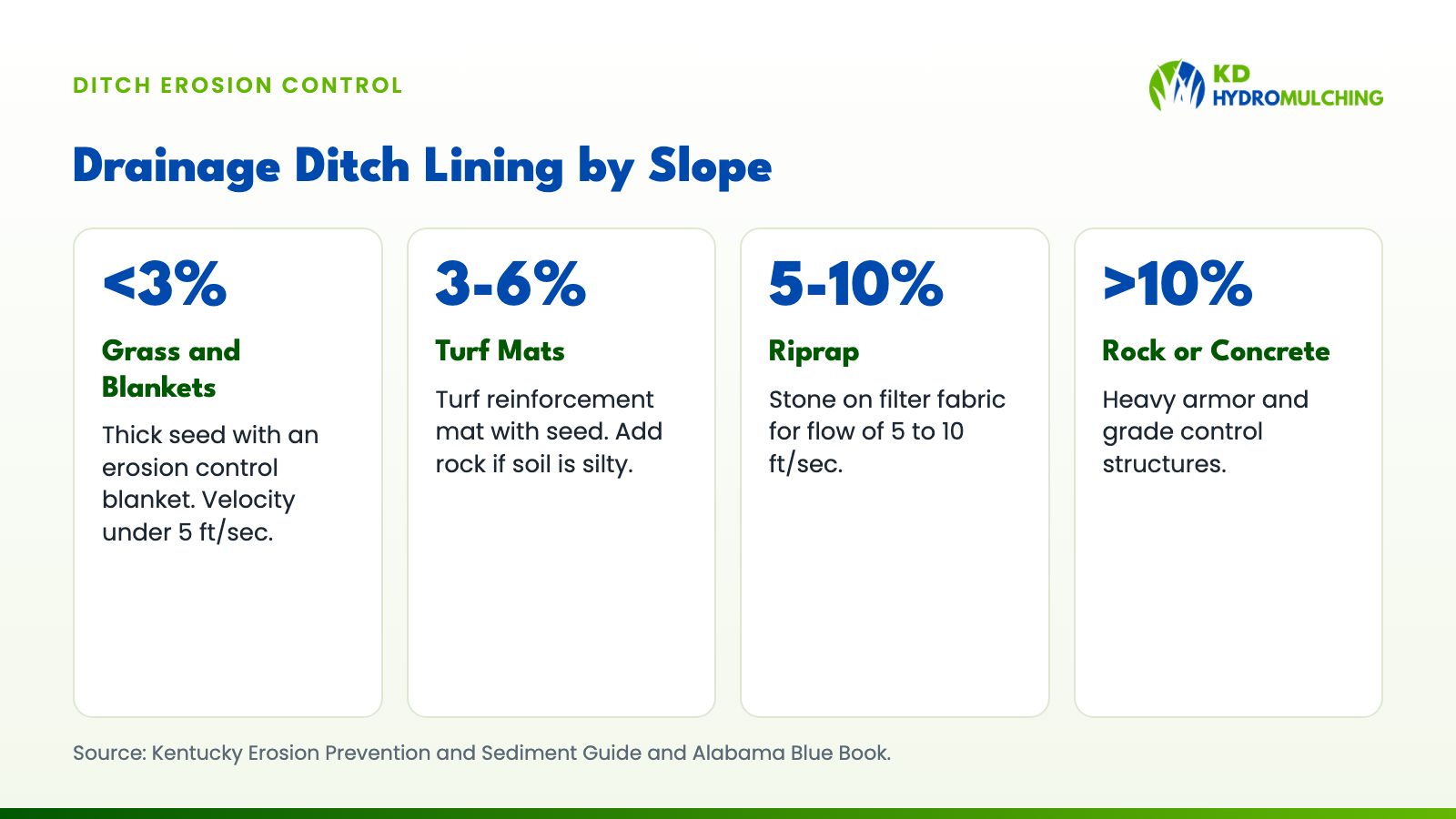
You should line a drainage ditch with grass, a turf reinforcement mat, or riprap, chosen by ditch slope and flow velocity. Slope is the drop in the ditch bottom, shown as a percent. Velocity is how fast the water moves, shown in feet per second (ft/sec). The table below matches each lining to the limits set by the Kentucky guide and the Alabama Blue Book.
Drainage ditch lining options by slope and velocity
Lining | Ditch slope | Flow velocity | Notes |
|---|---|---|---|
Grass with seed and blankets | Under 3% | Under 5 ft/sec | Needs seed and cover in place before flow |
Turf reinforcement mat with seed | 3% to 6% | 2.5 to 9 ft/sec | Permanent mat that reinforces grass roots |
Riprap on filter fabric | 5% to 10% and up | 5 to 10 ft/sec | Stone size grows with velocity |
Concrete or armored lining | Over 10% | Over 10 ft/sec | Needs a protected outlet |
Slope ranges overlap because soil type matters too. Silty soil needs the heavier lining at the same slope, and the figure below shows the ladder at a glance.
Grass is the lowest rung on that ladder, so the next heading looks at when it is enough.
Is Grass Enough to Line a Drainage Ditch?
Grass is enough to line a drainage ditch when flow velocity stays under 5 ft/sec. The ditch also cannot run all the time. The Alabama Blue Book states that grassed swales suit velocities below 5 ft/sec. Continuous flow drowns grass, so those ditches need a lined swale instead.
Seeding performs well when matched to the calendar. The Blue Book advises against building seeded swales in late fall, winter, or early spring. Ditch grass seed mixes and planting dates differ for each season. A blanket then protects the seed until roots form, as the next heading explains for steeper channels.
When Does a Ditch Need Turf Reinforcement Mats?
A ditch needs turf reinforcement mats when the slope reaches 3% to 6% or flow outruns what grass roots can hold. A turf reinforcement mat (TRM) is a permanent three-dimensional mesh that grows into the roots and strengthens them. Kentucky says ditches of 10% or less can use TRMs or blankets if seeded quickly.
The Blue Book rates its Type 5 TRMs for vegetated shear stress of 6.0 to 14.0 lbs/ft2. Shear stress is the dragging force water puts on the ditch surface. Our turf mat installation follows these ratings, and crews lay each roll like roof shingles. Rolls start at the lowest point, uphill pieces overlap downhill pieces, and nothing is stretched. Rock is the next step up for faster flow.
Should You Put Rocks in a Drainage Ditch?
Yes, rocks belong in a drainage ditch when velocity reaches 5 to 10 ft/sec or the ditch slope passes 10%. The Alabama Blue Book assigns riprap-lined swales to that velocity range. Riprap is a layer of large angular stone that absorbs the energy of the flow. Non-woven filter fabric goes underneath to stop undercutting.
Stone size rises with speed, according to the Kentucky guide. Four average rock sizes and one layer rule cover the common range.
- 6 ft/sec needs rock averaging 5 inches.
- 8 ft/sec needs rock averaging 10 inches.
- 10 ft/sec needs rock averaging 14 inches.
- 12 ft/sec needs rock averaging 20 inches.
- The rock layer is 1 1/2 times the average diameter of the largest fourth of the stones.
We do not install riprap or concrete linings. Those jobs go to stone and excavation contractors, and we grade, seed, and lay mats around them. Rock also pairs with check dams, which the next section explains.
How Do Check Dams Slow Ditch Erosion?
Check dams slow ditch erosion by flattening the flow gradient so water loses velocity and shear stress. A check dam is a small barrier built across the channel. The Alabama Blue Book lists rock, wattles, sandbags, and silt fence as materials and does not recommend hay bales.
Water ponds behind each dam, and coarse soil settles out. Check dams do not reduce turbidity, which is the cloudiness from fine particles. Fence dams are the fabric option. Spacing is the next detail to settle.
How Far Apart Should Check Dams Be?
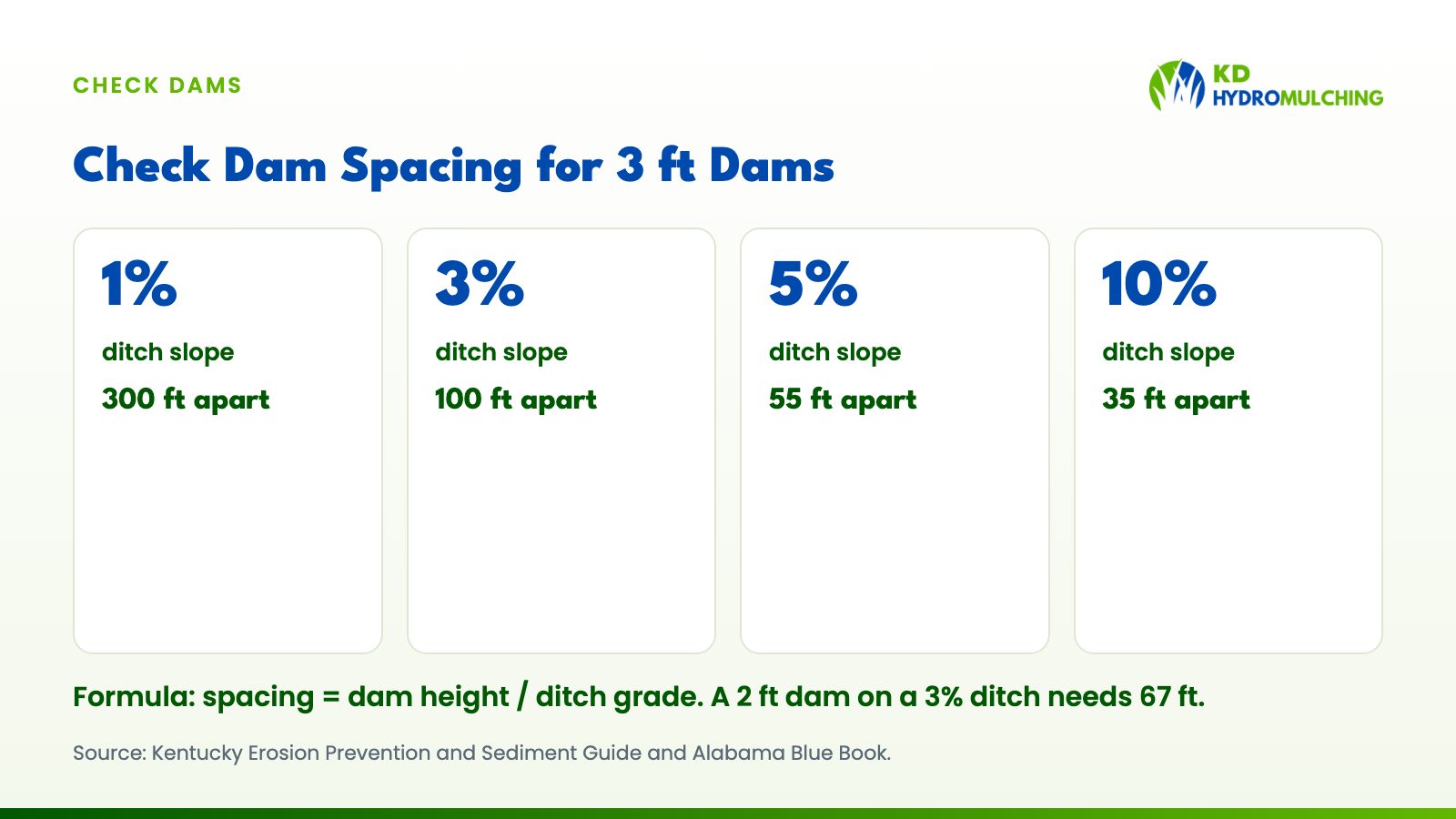
Check dams should sit where each upstream toe is level with the next dam's crest. The Blue Book gives the formula as spacing in feet equals dam height divided by channel grade. A 2 ft dam on a 3% ditch works out to 2 / 0.03, or 67 ft.
Kentucky publishes a ready table for 3 ft dams. Steeper ditches need dams packed closer together, as the numbers show.
Check dam spacing for 3 ft dams by ditch slope
Ditch slope | Spacing between dams |
|---|---|
1% | 300 ft |
2% | 150 ft |
3% | 100 ft |
5% | 55 ft |
10% | 35 ft |
Half the slope doubles the spacing. The figure below puts the same numbers beside a dam profile.
How Tall Should a Check Dam Be?
A check dam should be 3 ft tall or less, with the center lower than the ends. The Blue Book sets that height for drainage areas of about one acre or less. Flow over the top is generally under 1 ft deep, and rock dams use 2:1 side slopes or flatter.
The low center keeps water in the middle of the channel. On a 3 ft dam, Kentucky puts the center 6 inches below the sides. Both ends tie into the top of the bank to prevent bypass. An 8-oz non-woven underlay extends about 3 ft upstream and downstream, which stops scour under the dam. The sequence for fixing a failing ditch comes next.
How Do You Stop a Drainage Ditch From Eroding?
To stop a drainage ditch from eroding, fix the gullies above it first, regrade the channel, and then armor it. NativeSeed Group notes that small rills and gullies feed a ditch and widen it over time. The six steps below follow the Kentucky and Alabama guides.
- Stop the rills and gullies that feed the ditch.
- Clear spoil, sediment, and culvert blockages, and stockpile spoil behind sediment controls.
- Regrade banks to 2:1 or flatter, or 3:1 where mowers cross.
- Build, seed, and protect the outlet before water enters.
- Seed the channel and lay a blanket or turf mat, starting at the lowest point.
- Add check dams, starting before any uphill grading.
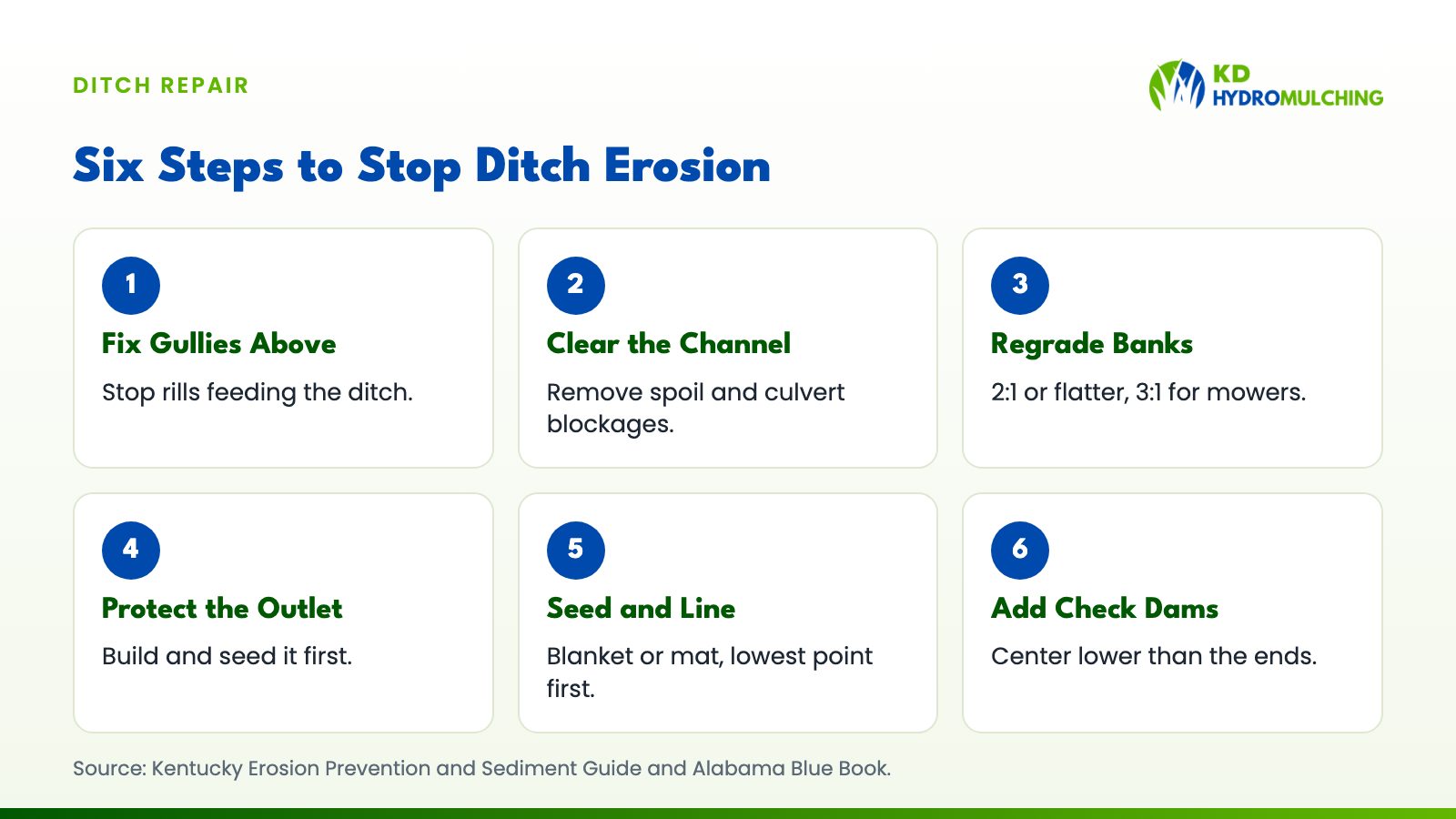
The figure above shows the same six steps in order. Our ditch regrading service reshapes the banks and bottom before any lining goes in. Fresh grading leaves bare soil, so seeding must follow quickly.
Seed and mulch go on in one pass when our ditch hydroseeding crews spray the slurry. The mulch holds moisture against the seed while roots form. Upkeep then keeps the repair working.
How Do You Maintain a Drainage Ditch?
You maintain a drainage ditch by inspecting it after every rain over 1/2 inch and repairing damage right away. Kentucky sets that threshold for check dams. Crews clear sediment from the upstream side, replace dislodged rock, and fix bare spots.
- Clear sediment before it slows flow and raises erosion risk.
- Check culverts for blockages, and add a headwall, apron, or riprap when a culvert is reopened.
- Pick up rock washed downstream before each mowing.
- Remove temporary check dams once vegetation is established.
The Blue Book and NativeSeed Group both list those tasks. Newly seeded ditches need water and patience, and seeded ditch care follows a set watering schedule. Several side questions come up on every ditch job, so the next section answers them.
What Else Should You Know About Drainage and Erosion Control?
What Is the 1% Slope Rule for Drainage?
The 1% slope rule for drainage means a drop of 1 ft per 100 ft, or about 1/8 inch per foot. Builders use it for drain pipe and surface grades. The Blue Book asks for 0.25 ft of freeboard, which is spare depth above the design flow.
Who Is Responsible for Drainage Ditches?
The landowner is responsible for a ditch on private property. The local government handles ditches in public right-of-way. The City of Huntsville lists erosion on existing ditches and overgrown ditches as reportable problems. A property plat shows which side owns a given ditch.
Can You Fill in a Drainage Ditch?
No, filling a drainage ditch without approval risks flooding and permit violations. The city requires a grading permit before filling or other land disturbance. Natural channels need permits from the U.S. Army Corps of Engineers and the state, according to Kentucky's guide. Stabilizing the ditch is the safer fix.
How Much Does Drainage and Erosion Control Cost?
Basic residential drainage and erosion control costs about $1,000 to $4,000. Larger slope or commercial work runs $10,000 to $20,000 or more. Google's AI Overview, citing Path Light Pro, gives those ranges.
How Do You Stop Erosion on a Sloped Yard?
Stop erosion on a sloped yard by covering bare soil with seed and mulch or a blanket for a sloped yard. Divert runoff above the slope too. The Blue Book places diversions at the top of a slope to keep upslope water off it.
How Can KD Hydromulching Help With Drainage and Erosion Control?
KD Hydromulching grades, seeds, and protects the soil around ditches across Huntsville and North Alabama. Our services include rough and finish grading, hydroseeding, erosion control blankets, matting, and silt fence. We also provide ditch bank stabilization for steep sides.
Riprap, concrete, and drain pipe work stay with other contractors, and we coordinate our grading and seeding around them. Every ditch lining estimate starts with your ditch slope, soil, and flow, and we recommend a lining that fits.
Every ditch we line follows these slope and velocity limits. Grass suits gentle channels, and mats suit steeper ones with faster flow. Call (256) 973-8445 to have your ditch walked by a crew based in Huntsville.