In this article8 sections
- Is Hydroseeding in the Fall a Good Idea?
- What Is the Best Month to Hydroseed in the Fall?
- Which Grasses Work for Hydroseeding in the Fall?
- How Late Can You Hydroseed in the Fall?
- How Do You Water Hydroseed in the Fall?
- How Do You Protect Hydroseed From Winter?
- What Else Should You Know About Hydroseeding in the Fall?
- How Does KD Hydromulching Help With Fall Hydroseeding?
Hydroseeding in the fall works because soil stays warm while air cools, which helps new grass sprout and root before winter. Crews should finish at least 45 days before the first hard frost, with soil temperature above 50 degrees Fahrenheit. Cool-season grasses such as tall fescue suit that window. Warm-season grasses such as bermudagrass wait for spring.
Key Takeaways
- Fall is a strong season to hydroseed cool-season grass because warm soil, cool air, fewer weeds, and steadier moisture favor new seedlings.
- Hydroseed at least 45 days before the first hard frost so seedlings reach about 2 inches tall.
- Soil temperature matters more than air temperature, and seed needs soil above 50 degrees Fahrenheit.
- Tall fescue and other cool-season grasses belong in fall, while bermudagrass belongs in late spring.
- Water lightly 3 to 4 times a day for the first 3 to 4 weeks, then taper off.
Is Hydroseeding in the Fall a Good Idea?
Yes, hydroseeding in the fall is a good idea when slurry goes down 45 days before the first hard frost. Soil keeps its summer warmth while cooler air lowers heat stress on young seedlings. Finn Corporation, a hydroseeder manufacturer, rates fall as a prime season for the method.
Our crews at KD Hydromulching offer fall hydroseeding for lawns, bare lots, and slopes. The next heading covers why the season works so well.
Why Is Fall a Good Time to Hydroseed?
Fall is a good time to hydroseed because warm soil, cool air, fewer weeds, and steadier moisture all help new grass. Four conditions drive that result.
- Soil holds summer warmth, so seed still germinates.
- Cooler air reduces heat stress and evaporation.
- Many weeds die back, which cuts competition for water and light.
- Rain returns, which lowers the watering load.
Superior Groundcover notes that weeds lose strength as temperatures drop. American Hydroseeding adds that cooler days and longer nights keep mulch damp for more hours. Grass then spends its energy on roots instead of surviving summer heat. Spring offers a different set of conditions, as the next heading shows.
Is Fall Better Than Spring for Hydroseeding?
Fall is better than spring for hydroseeding cool-season grass because spring brings cold snaps, heavy rain, and summer heat. Easy Lawn warns that late frosts can kill spring seed and that heavy rain can wash it away. NC State Extension adds that spring-established tall fescue is more prone to drought, heat, fungal disease, and weeds.
Fall seed gets two growing periods, fall and spring, before its first summer. Warm-season grass reverses that rule and needs spring. The next section narrows the fall calendar to a month.
What Is the Best Month to Hydroseed in the Fall?
September is the month to hydroseed in the fall, with early October as the closing window for cool-season grass. NC State Extension sets the target between mid-September and early October. The Alabama Cooperative Extension System names September and October for tall fescue.
The best time to hydroseed in the fall begins when nights cool to the mid-60s, according to NC State Extension. Seed that goes down before leaves fall also avoids a smothering leaf layer. Temperature decides the exact date, as the next question explains.
Does Soil Temperature or Air Temperature Matter More for Fall Hydroseeding?
Soil temperature matters more than air temperature for fall hydroseeding because seed sprouts in the soil, not in the air. American Hydroseeding states that hydroseed cares more about soil temperature than air temperature. Seed needs soil that stays consistently above 50 degrees Fahrenheit, according to Rutgers.
Finn Corporation puts the germination floor at 48 degrees, with much slower sprouting below 55 degrees. Easy Lawn gives a working range of 50 to 65 degrees measured 2 inches deep. Superior Groundcover recommends 65 to 75 degree conditions for the first 6 weeks. A soil thermometer takes the guesswork out of the date.
How Far Before the First Frost Should You Hydroseed?
You should hydroseed at least 45 days before the first hard frost. That window lets seedlings grow to about 2 inches, which Finn Corporation says is tall enough to survive frost. American Hydroseeding gives the same 45 days and adds that Kentucky bluegrass needs longer.
Use this short sequence to place a job on the calendar.
- Find the average first hard frost date for the property.
- Count back 45 days from that date.
- Check that soil stays above 50 degrees Fahrenheit, and 55 degrees is better.
- Prepare the seedbed and book the crew inside that window.
- Set up watering before the slurry goes on.
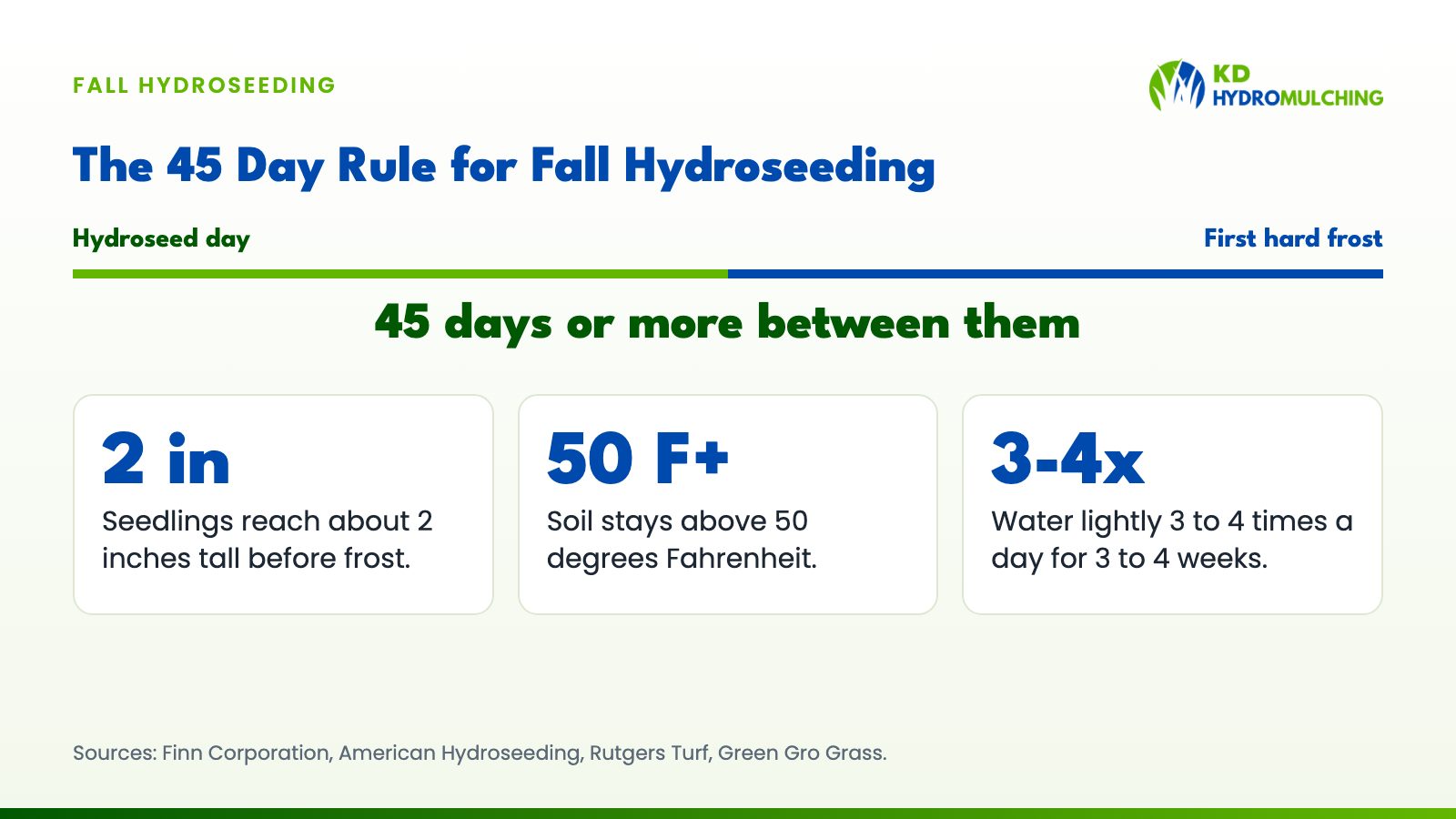
The graphic above shows the 45 day countdown and the soil temperature check. A hard frost can stunt young grass or kill it outright, so the date matters. Grass type matters just as much, as the next section explains.
Which Grasses Work for Hydroseeding in the Fall?
Cool-season grasses such as tall fescue, fine fescue, Kentucky bluegrass, and perennial ryegrass work for hydroseeding in the fall. Finn Corporation names tall fescue and fine fescue as hardy picks. Rutgers notes that perennial ryegrass establishes fastest. Our cool-season seed picks pair with the slurry for slopes and lawns.
Can You Hydroseed Cool-Season Grass in the Fall?
Yes, you can hydroseed cool-season grass in the fall, and fall is the preferred season for it. Cool-season grass thrives at daytime temperatures of 60 to 75 degrees Fahrenheit, according to the Alabama Cooperative Extension System. Tall fescue germinates in 5 to 10 days when moisture and soil temperature are right, per NC State Extension.
The Alabama Blue Book sets a tall fescue rate of 40 to 50 pounds per acre from September 1 to November 1. Mulch in the slurry holds moisture around the seed. Warm-season grass follows different rules, covered next.
Can You Hydroseed Warm-Season Grass in the Fall?
No, you should not hydroseed warm-season grass in the fall, because bermudagrass needs 80 degree days and 60 degree nights to sprout. Bermudagrass, centipedegrass, and zoysia grow in summer and go dormant at the first heavy frost, according to NC Cooperative Extension. The Alabama Blue Book plants bermudagrass from April 1 to July 1.
University of Georgia Extension found that zoysia and centipede suffered more winter injury than bermudagrass when installed late. Seed that sprouts in cool soil has no time to root before frost. The table compares the groups.
Grass Groups and Fall Hydroseeding
Grass Group | Examples | Planting Window | Fall Hydroseeding |
|---|---|---|---|
Cool-season | Tall fescue, fine fescue, Kentucky bluegrass | September to early October | Yes |
Warm-season | Bermudagrass, centipedegrass, zoysia | Late spring to early summer | No, wait for spring |
Winter cover crop | Cereal rye | September 1 to November 15 | Yes, as temporary cover |
The rye row comes from the Alabama Blue Book, which dates rye seeding from September 1 to November 15. Rye covers soil for one winter and does not replace a permanent lawn. The next graphic shows both calendars side by side.
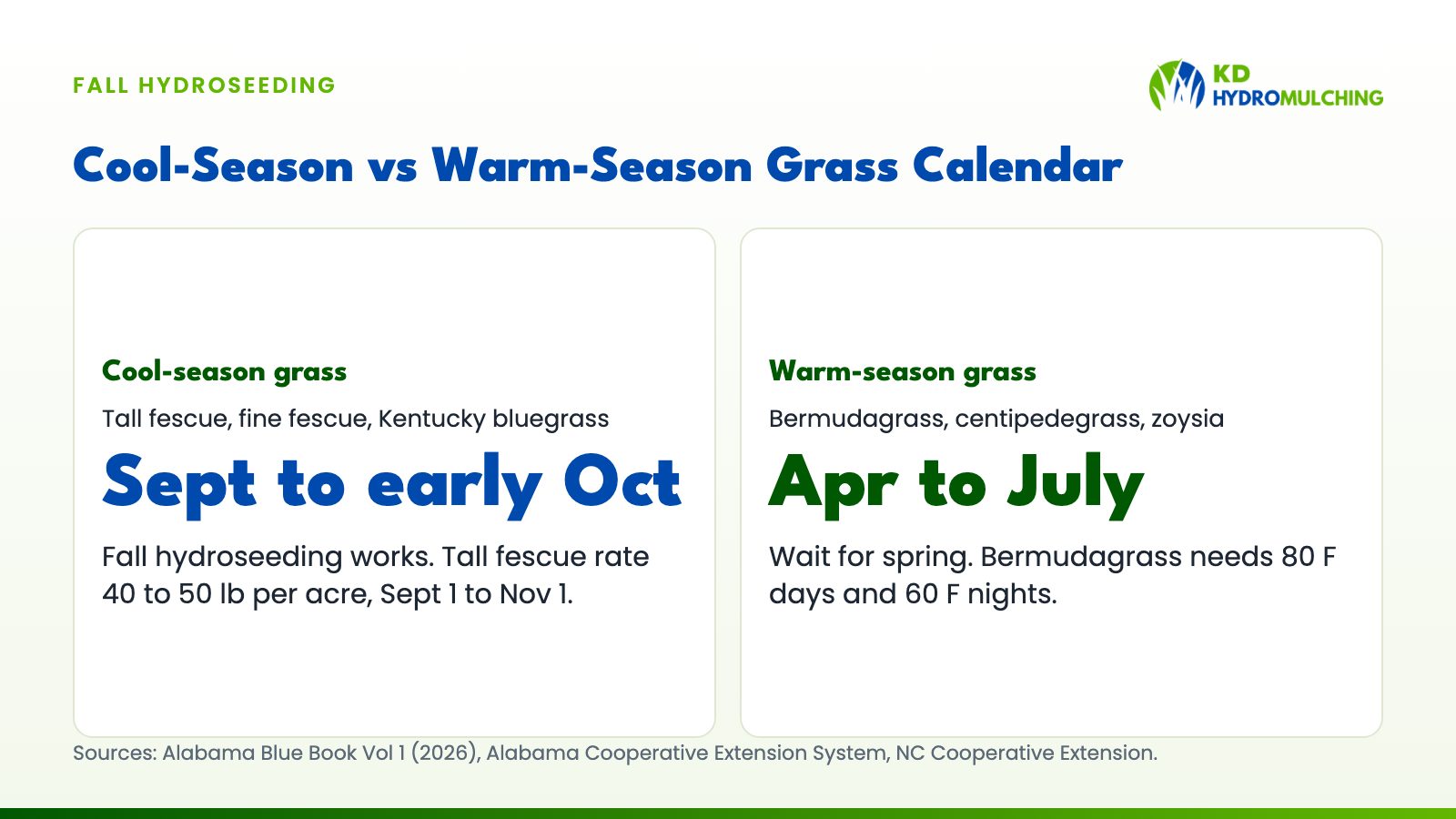
Cool-season grass owns the fall calendar, and warm-season grass owns spring. Even the right grass fails when the date slips, so the next section covers cutoffs.
How Late Can You Hydroseed in the Fall?
You can hydroseed in the fall until 45 days before the first hard frost, while soil stays above 50 degrees Fahrenheit. Finn Corporation notes that crews can work into early November in mild climates, depending on overnight lows. American Hydroseeding stops applications in November, depending on weather.
The Alabama Cooperative Extension System warns that seedlings may not fully establish before winter when planting after October. Frost history for the property sets the true cutoff. The next questions define too late.
How Late Is Too Late to Hydroseed?
Hydroseeding is too late when fewer than 45 days remain before the first hard frost or soil stays below 50 degrees. Seedlings need that time to reach roughly 2 inches. Soil below 55 degrees slows germination sharply, according to Finn Corporation.
Frost forecasts also matter. Finn Corporation advises waiting for spring when a frost is predicted soon after application. Waiting protects the seed investment, as the October question shows.
Is It a Good Idea to Hydroseed in October?
Yes, hydroseeding in October works only when the first hard frost is 45 or more days away. Early October works in cooler climates when soil stays above 50 degrees. Later in the month, the odds drop quickly.
NC State Extension expects temperatures in its region to turn too cool for ideal cool-season germination at some point in October. Warmer regions gain more room, and colder regions gain less. Our crews schedule seasonal hydroseeding around those frost dates. Late seeding carries real risks, as the next heading explains.
What Happens If You Hydroseed Too Late in the Fall?
Hydroseeding too late leaves seedlings too small to survive a hard frost, so stands come in thin or fail. Rutgers warns that seed can germinate and then die when a hard frost follows. Finn Corporation adds that frost can stunt growth or kill seedlings entirely.
Seed that stays dormant faces other losses. Rutgers lists washout and bird feeding as bigger risks in dormant seeding. The Alabama Cooperative Extension System links thin lawns to seeding too late in the fall. A missed window still leaves options.
What Can You Do If You Miss the Fall Window?
A closed window still leaves dormant seeding, a rye cover crop, or a spring application. Dormant seeding places seed after soil drops below 50 degrees and before the ground freezes, so it waits for spring. Rutgers suggests raising seed rates by 30 to 50 percent, and Easy Lawn advises leaving fertilizer out.
Mulch and tackifier hold seed in place during winter storms. Our mulch and tackifier work protects bare soil while the seed waits. Winter weather then becomes the next concern.
How Do You Water Hydroseed in the Fall?
Water hydroseed lightly 3 to 4 times a day for 3 to 4 weeks, then taper off. Green Gro Grass gives that schedule. Superior Groundcover recommends 3 to 15 minutes per cycle for the first 4 to 6 weeks.
Cooler air means less evaporation, so fall watering is lighter than a July schedule. Our weekly care steps cover the routine for new seed. A sprinkler timer also keeps cycles consistent, as the next questions show.
Should You Water Hydroseed Every Day in the Fall?
Yes, you should water hydroseed every day in the fall until seedlings emerge, unless steady rain keeps the surface moist. Per the Alabama Cooperative Extension System, a surface that dries out is a leading reason seedlings fail. It advises light irrigation one to three times each day until seedlings emerge.
Too much water also harms seedlings. The same extension service names excess irrigation as the biggest mistake and links it to damping-off disease. Our sprinkler contractors keep cycles short and even. Duration comes next.
How Long Should You Keep Watering Fall Hydroseed?
Keep watering fall hydroseed for 6 to 12 weeks, the time most hydroseed takes to become an established lawn. Cycles drop in number and rise in depth as roots grow. The Alabama Cooperative Extension System advises deeper, less frequent watering to build roots.
A mature lawn needs 1 to 1.5 inches per week in summer and less in spring and fall. Rain counts toward that total. A rain gauge helps track it, and the next section turns to winter.
How Do You Protect Hydroseed From Winter?
Protect fall hydroseed from winter with a mulch layer, a tackifier on slopes, and no herbicide until the grass tillers. NC State Extension advises holding herbicides until fall-seeded grass has tillered extensively. Tillering means the grass has sent up side shoots and thickened.
The Alabama Blue Book calls mulch essential on slopes steeper than 3:1. Straw matting adds cover on steep ground, as our straw blanket cover article explains. Frost raises one more question.
Does Mulch Protect Hydroseed From Frost?
Mulch protects hydroseed from drying and washout but does not shield seedlings from hard frost. Easy Lawn compares mulch to a light blanket that should not be relied on for frost. Finn Corporation says a fiber mulch mix helps seed through dropping temperatures when it stays in place.
Mulch that washes off protects nothing. Slopes need tackifier or blankets to hold it. Our slope protection crew handles those steeper sites. Frost timing is the next concern.
What Happens to Hydroseed After the First Frost?
Hydroseed seedlings that reached 2 inches before the first frost survive it and simply grow more slowly. Finn Corporation says an early frost on hydroseeded ground may only slow growth. Warm-season lawns go dormant at the first heavy frost instead.
Seedlings that had less time face more risk. Seeding before leaves fall also keeps a leaf layer off new seedlings. Spring brings the payoff, as the next heading shows.
Will Fall Hydroseed Come Back in Spring?
Fall hydroseed comes back in spring when roots had time to establish before freezing. American Hydroseeding says a lawn that establishes in fall returns stronger in spring. Survival still depends on watering and on sudden freezes.
First mowing starts at 2 to 3 inches once the stand reaches about 2.5 inches, per the Alabama Cooperative Extension System. The same extension service advises applying most tall fescue fertilizer in fall.
What Else Should You Know About Hydroseeding in the Fall?
Four side questions come up on fall jobs, and each has a short answer. Cost, speed, preparation, and downsides cover the main points. The answers below stay brief.
How Much Does Hydroseeding Cost in the Fall?
Expect to pay $0.07 to $0.25 per square foot for fall hydroseeding, which comes to about $1,500 for an average lawn. Minimum fees run $300 to $500 on small jobs. Our price breakdown covers every price tier.
How Long Does Hydroseed Take to Grow in the Fall?
Hydroseed sprouts in 5 to 14 days and becomes an established lawn in 6 to 12 weeks. Cooler fall soil sits near the slow end. Tall fescue germinates in 5 to 10 days with good moisture.
How Should You Prepare the Soil for Fall Hydroseeding?
Prepare the soil by killing weeds, loosening the top 3 to 6 inches, and grading away from the house. Grade at least 0.5 inch per foot for 10 feet from a foundation, before the frost countdown starts. Our seedbed grading handles clearing, grading, and soil conditioning.
Is There a Downside to Hydroseeding in the Fall?
The main downside of hydroseeding in the fall is a shrinking calendar, because frost and cold soil close the window. Heavy fall rain can wash seed from slopes, and leaves can smother seedlings. A good plan covers each risk before the work begins.
How Does KD Hydromulching Help With Fall Hydroseeding?
KD Hydromulching helps with fall hydroseeding by matching the application date to the frost calendar and the soil temperature. We are based in Huntsville and serve North Alabama with hydroseeding, drill seeding, site preparation, and erosion control.
Large open ground can also take autumn drill seeding when a drill suits the site. Early planning keeps either job inside the frost window. Sites with slopes or bare spots may need mulch, blankets, or extra grading before seed goes down. Each of those steps takes days on the calendar.
Describe the site on our estimate form, and we will review timing, grass type, and slope needs. A short description of the lot size, soil, and slope helps. A photo of the area also shows what the crew will work with on site.
Find the full service list at KD Hydromulching offerings any time.